Takaichi bows farewell to ROK president after temple visit; gesture of close ties cannot hide differing calculations: expert
By and Li Yu Published: Jan 14, 2026 10:59 PM

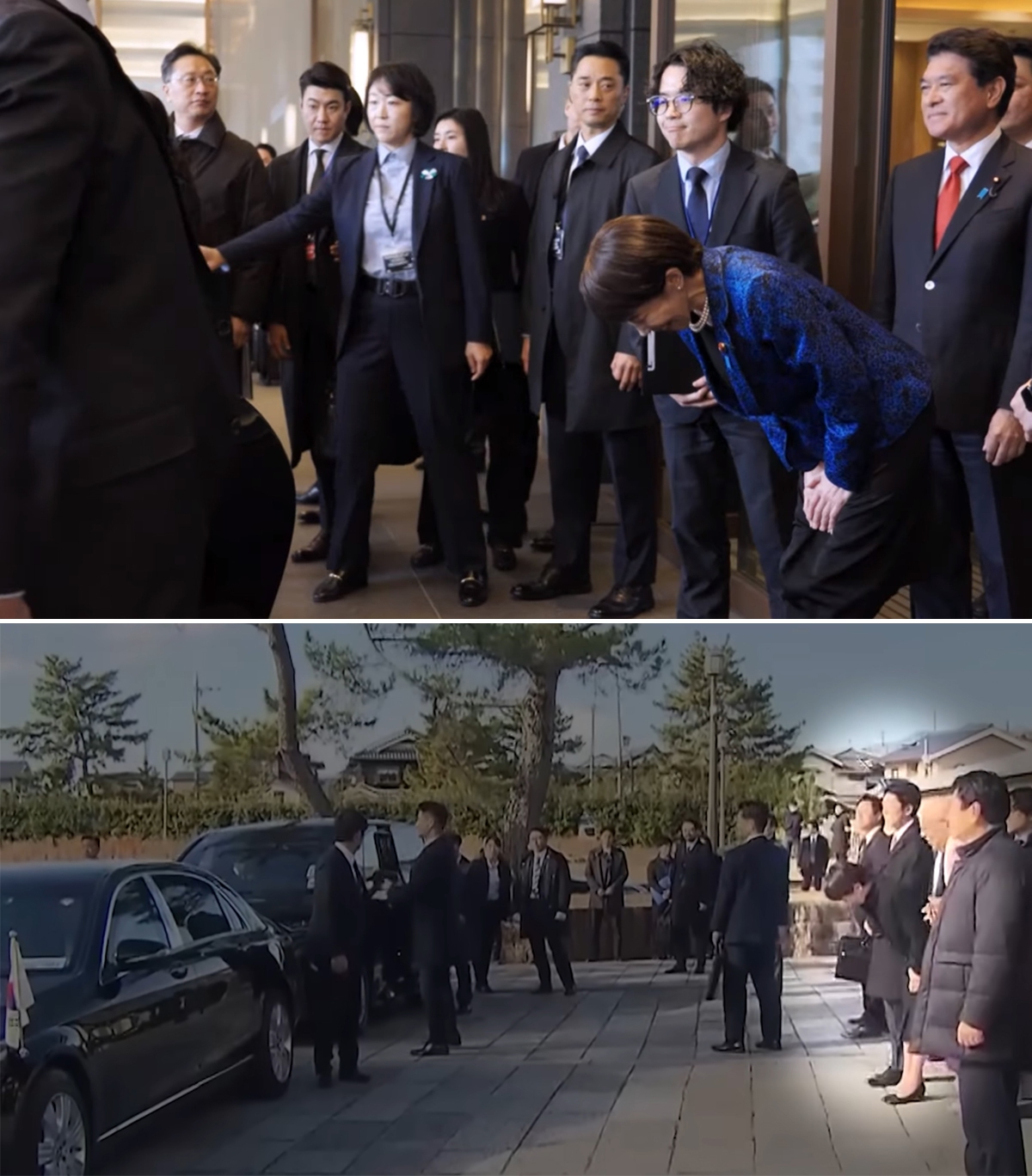
Japanese Prime Minister Sanae Takaichi bows to South Korean President Lee Jae-myung on his arrival and departure. Photo: online screenshots
Japanese Prime Minister Sanae Takaichi on Wednesday bowed farewell to South Korean President Lee Jae-myung, who was seated in his vehicle, after they toured a World Heritage temple in Japan's Nara Prefecture. However, analysts and some media believe that despite Takaichi's meticulous etiquette as host and the fact that the two leaders tried to show gestures of close ties, Tokyo and Seoul have differing calculations, moreover, issues such as historical issue and territorial dispute may bring uncertainty to future cooperation.
Describing the temple visit, South Korean media KBS reported that after exchanging brief remarks outside Horyuji Temple, the two leaders toured the interior while listening to explanations from the head monk. After the visit, Takaichi personally saw Lee off to his vehicle, and the two leaders exchanged multiple farewell handshakes, per KBS.
Korean Times noticed a detail that "Takaichi at one time gently held Lee's arm to caution him about a step he had not noticed on the temple grounds. She also remarked that he appeared to be wearing the same sneakers he had worn the previous day."
Online video released by South Korea's MBC News shows the Japanese prime minister bowing in farewell to Lee, who was seated inside his vehicle. She then leaned toward the car window to reach in and hold his hands before he departed.
However, some users did not appreciate the etiquettes, with one commenting on YouTube in Korean that "They treat you with the utmost respect, but you can't know their true intentions."
"(They) may have ulterior motives... but this precisely shows they have an urgent need for our country," another comment read.
"It's too much, too much.... People like that are the ones you need to be careful with. Japan is currently isolated, so it's a situation where it has to make an effort to get along with everyone," wrote another.
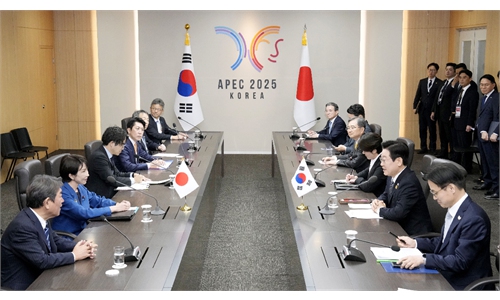
The temple tour came after the two held summit talks on Tuesday in Nara, Takaichi's home prefecture.
On Tuesday after their talks, Lee gave Takaichi a drum set and a pair of drums. The two leaders had staged an impromptu drum performance to K-pop songs during their informal meeting, after which they exchanged signed drumsticks, South Korean media Yonhap said.
In a wrap-up piece on the leaders' meeting, The Japan Times boasted it "a meeting rich in symbolism highlighting the two leaders' commitment to cementing strong personal and bilateral ties."
The South Korean media Yonhap report on Wednesday that "President Lee on Wednesday wrapped up his two-day visit to Japan that raised prospects for closer economic cooperation with Tokyo as well as efforts to test remains of Korean forced laborers."
Though the two leaders show intense gestures of close ties during the two-day meeting, media's opinion piece mentioned the fragile foundation of South Korea-Japan relations.
Nippon published an article titled "The leaders of Japan and South Korea have demonstrated close ties, which means that in response to the changing situation between the US and China, both sides have their own calculations."
Another editorial piece published on Kyodo News casted doubts about their cooperation, saying that the South Korean side is wary of Takaichi, who has a strong hawkish tone on issues related to the history of conscripted laborers and "comfort women," as well as the sovereignty of disputed islets known as Dokdo in South Korea. It is still hard to predict whether the cooperation can proceed smoothly.
From a perspective of overall results, Lee's visit to Japan was brief and, beyond symbolic engagements, produced no significant progress as the two do not fully share the same priorities, Lü Chao, a professor at the Liaoning Academy of Social Sciences, told the Global Times.
According to Lü, Lee has focused on maintaining and stabilizing South Korea-Japan relations, particularly in the economic sphere, viewing continued cooperation as important for South Korea's economic development, while Japan has placed greater emphasis on military and security cooperation, highlighting the consolidation of the so-called US-Japan-South Korea pact. Their targets have yet seen any substantive results.
Lü said Takaichi's multiple times of bowing in meetings with Lee reflect her eagerness to seize South Korean President's visit as an opportunity to push for deeper military and security cooperation with South Korea and to frame relations with Seoul as one of the key achievements of her administration.
Lü noted gestures such as deep bows and prolonged hand-holding farewells appeared insufficiently measured and fell short of the diplomatic manner expected of a head of government. By contrast, Lee's responses were notably more restrained and composed.
"Such high-profile displays of flattering in public settings reflect Takaichi's proactive desire to draw closer to South Korea—a gesture that Seoul, for its part, has not reciprocated with equivalent warmth."
RELATED ARTICLES