China completes 8.47 mln hectares of land greening in 2025, nature reserve system takes shape: National Forestry and Grassland Administration
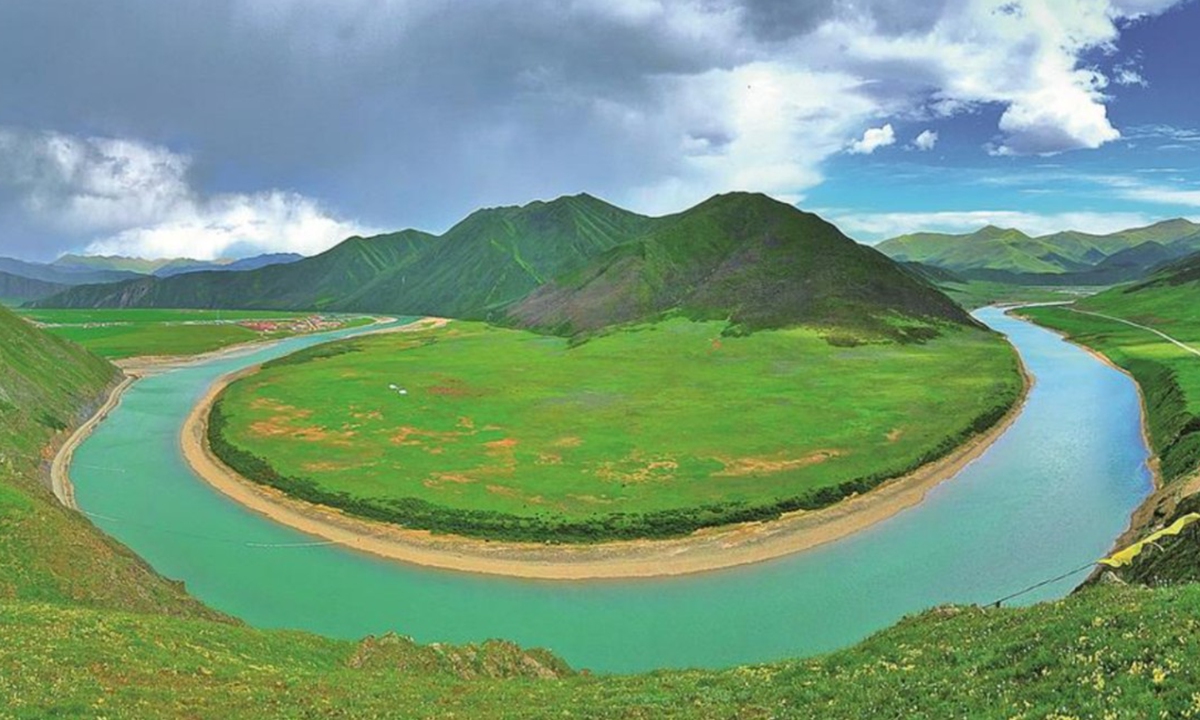
The Sanjiangyuan National Park Photo: Screenshot from local government website
China completed 127 million mu (8.47 million hectares) of land greening in 2025, including 53.45 million mu of afforestation and 73.9 million mu of degraded grassland restoration. The country's forest coverage rate has reached 25.09 percent, with total forest stock volume standing at 20.988 billion cubic meters, further underscoring the country's greener development trajectory, per report from media outlet people.com.cn.
During the 14th Five-Year Plan period (2021-25), China completed 549 million mu of land greening, including 185 million mu of afforestation. Each year, more than 46 million mu of degraded grassland were restored, keeping overall vegetation coverage above 50 percent. Healthy and sub-healthy grasslands reached 2.7 billion mu, accounting for over 70 percent of the total. China also treated 152 million mu of desertified land and placed 27.94 million mu under enclosure protection, helping achieve reduce desertification and land degradation and achieve "zero growth" in land degradation, according to the report.
China has also basically established a new nature reserve system centered on national parks, effectively protecting 90 percent of terrestrial ecosystem types and 74 percent of nationally protected wildlife populations, according to a release sent to the Global Times by the National Forestry and Grassland Administration on Thursday.
During the past five years, China accelerated the development of a national park-led conservation system, promoting large-scale, integrated approaches to ecological protection, green development and livelihood improvement.
Through the release of a national park spatial layout plan, China began to build the world's largest national park system. More than 120 existing nature reserves were integrated, leading to the establishment of five national parks, including Sanjiangyuan National Park and Giant Panda National Park. These national parks have provided unified protection for key ecosystems, including the headwaters of the Yangtze River, Yellow River and Lancang River, as well as habitats of flagship species such as the giant panda, Siberian tiger and Amur leopard.
Authorities have also worked to balance ecological protection with community development. Through ecological conservation jobs, relocation programs and concession-based operations, the five national parks have employed nearly 50,000 local residents, with average annual wage incomes ranging from 10,000 to 20,000 yuan per person.
Furthermore, China has continued to strengthen the legal and institutional framework for protected areas, gradually building a regulatory system centered on one law and two regulations, with progress made in optimizing and consolidating nature reserves by clarifying boundaries, reducing overlaps and addressing conflicts between conservation and development. A national-level nature reserve at Huangyan Dao in South China Sea has been newly established.
With all these efforts, China now has 19 world natural heritage and mixed natural and cultural heritage sites, as well as 49 UNESCO Global Geoparks, ranking No.1 globally in both categories, according to the press release.
Looking ahead to the 15th Five-Year Plan period (2026-30), China aims to further improve a unified, efficient and standardized nature reserve system.
Plans include the high-quality development of national parks, the orderly establishment of new ones, the formulation of national park spatial plans, and the implementation of projects to improve habitats, ecological corridors and biodiversity conservation. Further plans are made to enhance ecological compensation mechanisms, improve wildlife damage compensation policies and promote green industries to further improve livelihoods.
Steady progress has also been made in collective forest tenure reform and the high-quality development of the forestry and grassland industries. In 2025, the total output of the sector reached nearly 11 trillion yuan ($1.58 trillion), while imports and exports of forest products exceeded $180 billion. Annual forest food production surpassed 240 million tons, and the industry directly created jobs for more than 60 million people, playing an increasingly important role in income growth and employment stability, per CCTV News.
Global Times
RELATED ARTICLES