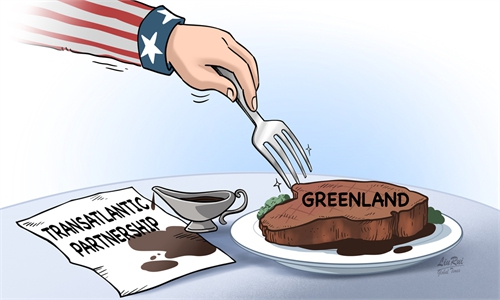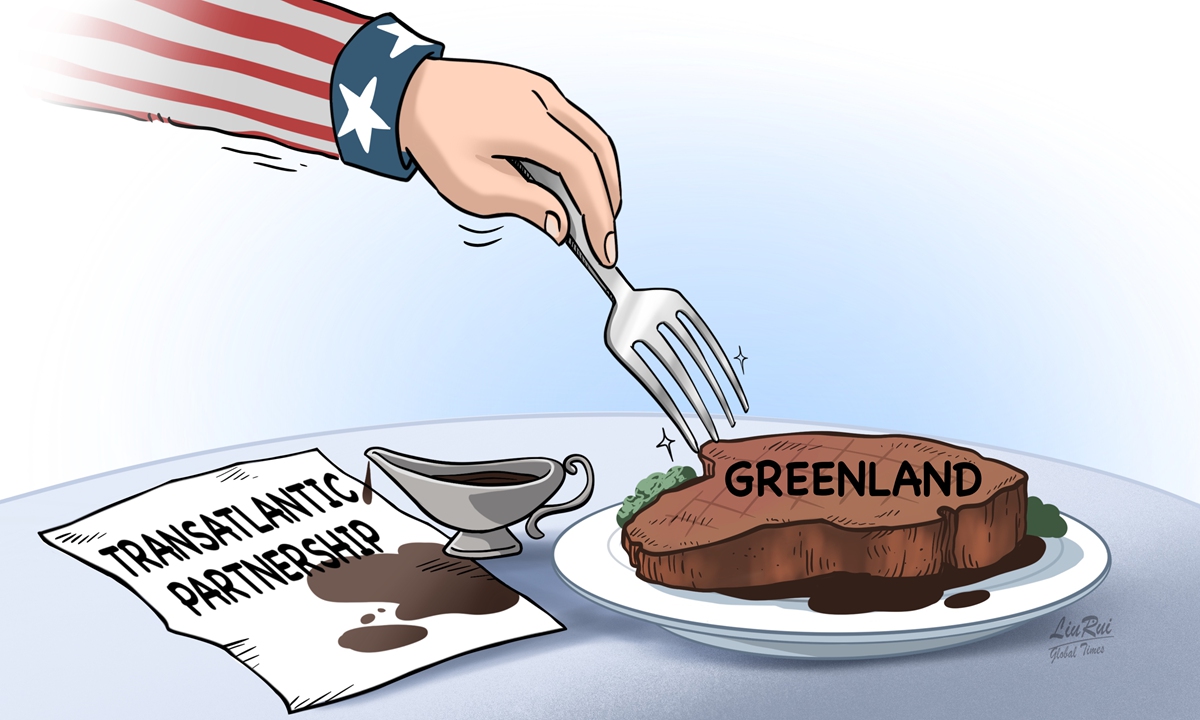
Illustration: Liu Rui/GT
US President Donald Trump's renewed insistence on acquiring Greenland has reached a level of repetition and intensity that suggests he cannot easily withdraw from the idea. His rapid, highly personalized decision-making style - guided more by instinct and moral self-justification than by established international norms - has raised concerns about the trajectory of US global policy. Many observers argue that this combination of unilateralism, militarization and strategic improvisation makes the current US government one of the most destabilizing forces in contemporary world politics.
Domestically, the Trump administration continues to frame its agenda through the familiar lens of "Make America Great Again." Internationally, however, its approach appears increasingly oriented toward a form of strategic autarchy. I call it "The US of Autarchy."
Analysts note that US policymakers are acutely aware of the country's relative decline compared with other global actors. This awareness seems to fuel a sense of urgency that shapes foreign policy choices. Rather than engaging constructively with the emerging multipolar world, the US appears to be moving toward isolation, militarization and a quest for resource self-sufficiency, based on grabbing and controlling what is needed. The underlying message seems to be that the US must be able to stand alone, even if the rest of the world turns away.
Throughout history, great powers have faced the same fundamental challenge: securing access to vital resources. In this context, Greenland's strategic location and mineral wealth make it part of a broader pattern. Observers point to similar US interest in resource-rich regions such as Venezuela, Mexico, Canada, Ukraine and areas around Gaza. The administration's rhetoric about "narcotics" or "external threats" is seen by many analysts as a pretext rather than a substantive justification.
The US may no longer be able to dominate the world through the expansive, missionary style global role it once pursued. But it can still remain a powerful state if it secures the resources necessary for long-term survival. This logic appears to underpin the renewed focus on Greenland.
When President Trump first raised the idea of acquiring Greenland in 2019, he likened the potential purchase to a "large real estate deal." Today, the argument has shifted: Greenland is now presented as essential to US national security in a more direct, almost personal sense. Claims that Russian and Chinese vessels are crowding the waters around Greenland have been met with skepticism even among close US allies. Yet these assertions serve a political purpose: They create a narrative of urgency and inevitability.
Europe will be unable to react to a takeover of Greenland. The EU remains divided, visionless and submissively avoiding challenging US actions. In recent years, European governments have not meaningfully confronted Washington even when faced with actions that many analysts describe as harmful to European interests, such as the Nord Stream incident or broader economic pressures placed on European industries.
If the US were to take control of Greenland, European leaders would likely express concern, emphasize international law and call for restraint. But they will do nothing. NATO's Article 5 theoretically obliges allies to respond to aggression against a member state, yet no European government would contemplate military confrontation with the US. The likely outcome would be strong statements but no decisive response.
So, NATO may well survive until the US leaves it. This scenario could, however, expose the underlying purpose of NATO more clearly. While many citizens believe NATO was created to protect Europe from a Soviet or Russian invasion, the reality is that its deeper function has been to ensure that any major conflict involving Russia would take place on European, not American, soil. The US missile defense systems and the Thule base, now known as Pituffik Space Base, in Greenland, are often cited as examples of this strategic logic.
The idea that "Russia could or would invade multiple NATO countries and occupy European capitals within days" is simply a rearmament and an unrealistic view based on assertions rather than analysis. Yet these narratives persist because they serve political and psychological functions, especially in societies where public understanding of security policy remains very limited and narratives have replaced reality assessments.
Greenland is also part of the Nordic community, historically characterized by cooperation, low tension and a commitment to peaceful regional development. This landscape has changed dramatically. Sweden and Finland have joined NATO in recent years and, together with Denmark and Norway, have accepted a significant US military presence - around 40 bases in total - established without broad public debate and with the bases under exclusive US jurisdiction. The Nordic region, once a model of stability, is now heavily militarized.
In this context, a US-controlled Greenland would further shift the regional balance. One must wonder how Nordic leaders now view their decisions to be friendly hosts to the US military, made under the delusional assumption that the US would act as a "benevolent protector."
Despite these tensions, the Arctic holds enormous potential as a region of peaceful cooperation. With Greenland at its center, the Arctic could become a demilitarized zone focused on sustainable development, scientific collaboration and shared economic benefit. Such a vision would serve both the peoples of the Arctic and the global community.
However, this requires political imagination and a willingness to move beyond zero-sum geopolitics. The Trump administration will not embrace such an approach. If the international community continues to accommodate unilateral actions, the long-term consequences could be severe.
Many voices around the world, therefore, call for coordinated, nonviolent measures to uphold international norms and prevent further destabilization. The window for such action is rapidly narrowing.
The author is the director of the Sweden-based think tank Transnational Foundation for Peace & Future Research. opinion@globaltimes.com.cn
RELATED ARTICLES