Premier says China willing to foster new growth drivers with Canada; Carney’s trip ‘turning point' in ties, meets business’ expectations: expert
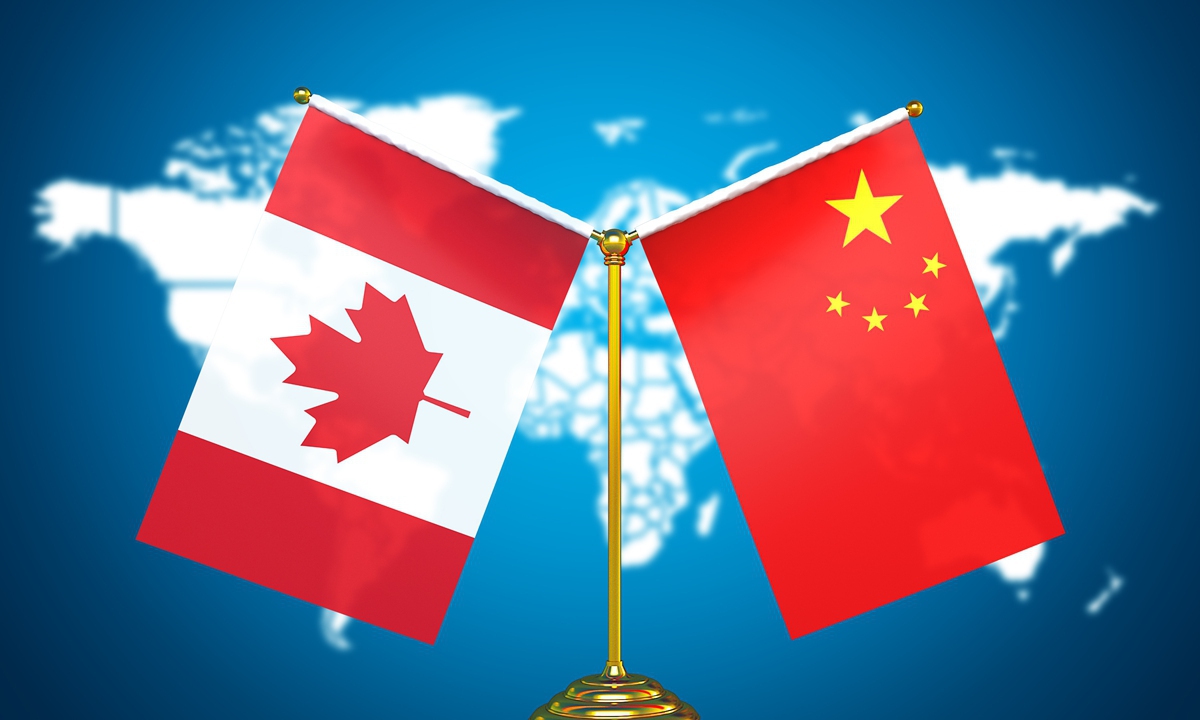
China and Canada Photo: VCG
China is willing to strengthen cooperation with Canada in areas such as clean energy, digital technology, modern agriculture, aerospace, advanced manufacturing and finance, to foster more new drivers of economic growth, Chinese Premier Li Qiang said when holding talks with Canadian Prime Minister Mark Carney in Beijing on Thursday.
Also on Thursday, Chinese Foreign Minister Wang Yi met with Canadian Foreign Minister Anita Anand in Beijing, noting that China is willing to strengthen communication, enhance trust, eliminate interference, and deepen cooperation with Canada to bring bilateral relations forward on a steady and sound track in solid strides under the new circumstances.
Carney's visit to China came amid its predicament of political and economic instability, as well as a strong need to diversify its trade and economic relations. Chinese experts said that this visit is expected to help further improve bilateral relations, and pragmatic trade cooperation conducted on the basis of equality and consultation can also assist both sides in resolving trade differences, jointly addressing unilateralism, upholding free trade, and achieving mutual benefit and win-win outcomes.
Pragmatic cooperation
According to Xinhua News Agency, Li said that China welcomes more Canadian companies to invest in China and hopes that Canada will provide a fair and non-discriminatory business environment for Chinese enterprises investing in the country.
Following the talks, Li and Carney witnessed the signing of multiple cooperation documents covering trade, customs, energy, construction, culture, and public security, Xinhua reported.
For his part, Carney said that since the establishment of diplomatic relations, the Canadian government has firmly adhered to the one-China policy.
Canada is willing to strengthen dialogue with China in various fields on the basis of mutual respect, leverage complementary advantages, and promote cooperation in areas such as economy, trade, energy, green economy, agriculture, and people-to-people exchanges, he noted.
"Against the backdrop of increasing turbulence and uncertainty in the current global trade environment, the signing of multiple cooperation documents fully demonstrates the commitment of both sides to advancing pragmatic cooperation from the high level down to specific sectors, providing enterprises in both countries with a clearer policy framework and greater certainty," said Zhou Mi, a senior researcher at the Chinese Academy of International Trade and Economic Cooperation.
Liu Dan, a research fellow at the Center for Regional Country Studies at Guangdong University of Foreign Studies, told the Global Times on Thursday that strengthening economic and trade exchanges between China and Canada is a win-win for both countries, and aligns with public opinion and the expectations of the business community.
A recent poll released by Ipsos shows that more than half of Canadians express support for closer trade ties and economic agreements with China. The current numbers reflect a growing recognition that Canada should diversify its trading relationships amid uncertainty in its relationship with the US, according to Ipsos.
"The Chinese market is important to Canadian trade, and the visit is an acknowledgement of Canada's need to diversify its markets and a recognition that, to work successfully with China, a recalibration of relations has to take place which will allow our two countries to get beyond the challenges of old issues and bring us to a level where our natural synergies find fuller realization," Mark Ceolin, founder and chair of the Board of Directors of the Canadian Chamber of Commerce in Shanghai, told the Global Times in an exclusive interview.
During a regular press conference of China's Ministry of Commerce (MOFCOM) on Thursday, He Yongqian, spokesperson from the ministry, said that China and Canada support economic globalization and trade liberalization, and share broad common interests and enormous potential for cooperation in economic and trade fields.
China stands ready to negotiate and conclude bilateral and regional trade and investment agreements with all countries and regions that are willing to do so, further promoting the liberalization and facilitation of global trade and investment, and taking concrete actions to uphold the hard-won system of free trade and the multilateral trading regime, the MOFCOM spokesperson said.
China is the second largest single-country trading partner to Canada, totaling $118.7 billion in two-way merchandise trade in 2024, according to the latest data released on the official website of the Prime Minister of Canada's office.
"Through equal consultation, the two countries can promote pragmatic cooperation and reduce trade differences. As important participants in the global economic and trade order, long-term cooperation between the two sides is also conducive to the stability of the global trade landscape, helping counter unilateralism and promote free trade," Liu said.
'A turning point'
During the meeting with Anand, Chinese Foreign Minister Wang Yi said that the trip [of Carney] marks a milestone in bilateral ties and signals a turning point in the relationship, adding that the leaders of the two countries will hold meetings and talks, which are expected to open up new prospects for bilateral relations, Xinhua reported.
Anand said the new Canadian government attaches great importance to relations with China. She also added that Prime Minister Mark Carney looks forward to engaging in in-depth exchanges with Chinese leaders during the visit to set the course for the development of bilateral relations, resume dialogue in various fields, pursue more mutually beneficial outcomes, enhance coordination and cooperation in multilateral affairs, and further advance the strategic partnership between the two countries, according to Xinhua.
When asked about Wang Yi's remarks during his meeting with Anand — where Wang said China is willing to work with Canada to eliminate interference — how much of that interference is created by the US administration, past and present, Chinese Foreign Ministry spokesperson Mao Ning said on Thursday that "I believe that, rather than focusing on and where the interference comes from, it is more important to focus on the fact that both China and Canada are committed to promoting the steady, solid and sound development of bilateral relations under the new circumstances, and providing positive expectations and greater confidence for the development of bilateral relations."
"Carney's visit to China fully demonstrates the urgent need of the new Canadian government to recalibrate and improve China-Canada relations," Liu said, adding that in addition to strengthening economic and trade cooperation, this visit will also inject mutual trust and stability into bilateral relations.
According to the National Post, a Canadian media outlet, Anand was repeatedly pressed by reporters Wednesday evening in Beijing to state if the Liberal government stood behind its stern assessment of China in its 2022 Indo-Pacific strategy. Every time, she refused to say if she agreed that China is a disruptive global force, though she eventually countered that Carney's election brought in a new government with a "new foreign policy."
The National Post said that "Her comments appear to suggest the Carney government is backing away from the stern assessment of China in the Indo-Pacific strategy published under Prime Minister Justin Trudeau."
The shift in the official's tone comes amid intensifying US geopolitical and economic pressure, rule-breaking behavior, and deepening value divergences. Canada has come to a profound realization that excessive dependence on a single market or a single ally is not a sustainable long-term strategy, and therefore hopes to seize this opportunity to strengthen cooperation with China to jointly address unilateralism, Zhou noted.
"Through this visit, the Canadian side should translate its correct understanding of China into concrete actions and provide a fair environment for cooperation with China. This is also what the business communities of both countries and global stability hope to see," Zhou said.
RELATED ARTICLES