Illustration: Liu Rui/GT
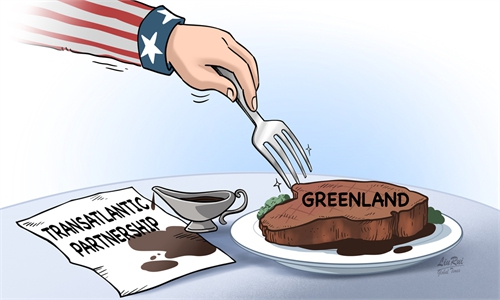
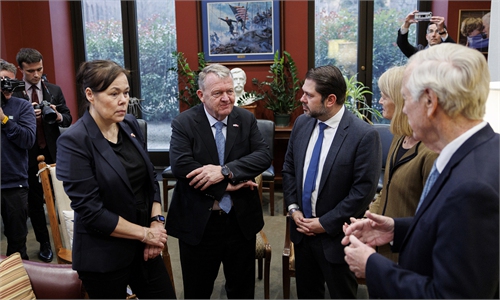
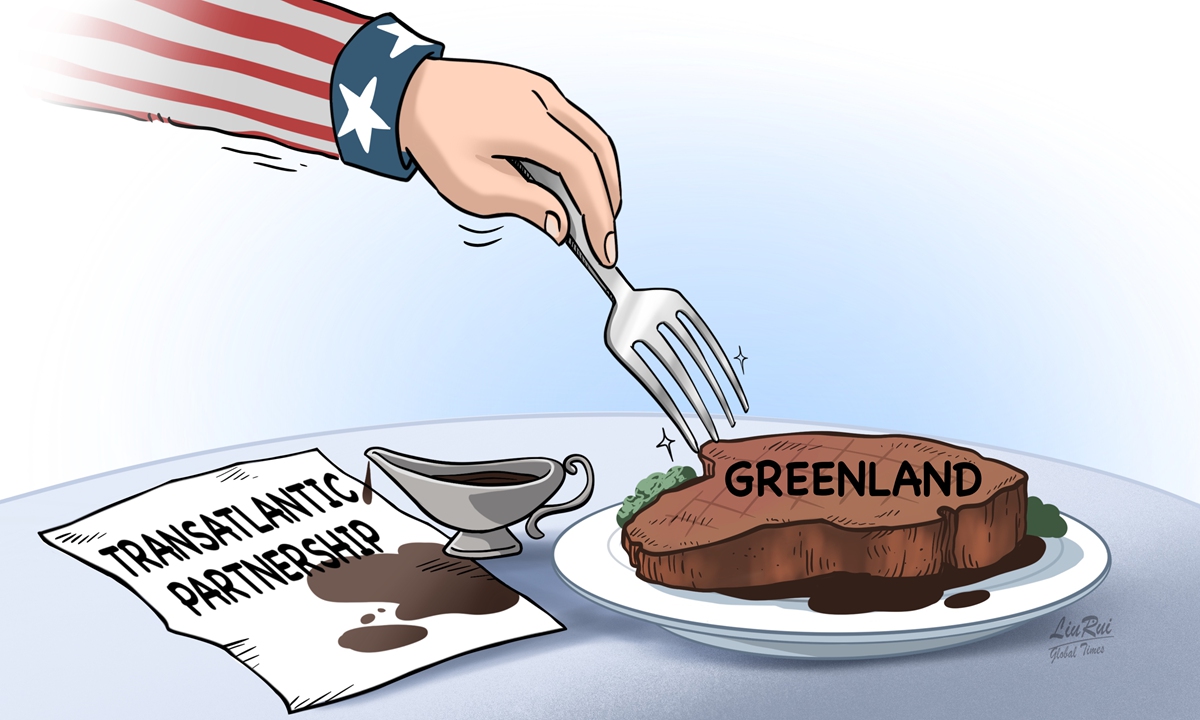
Greenland's fate remains uncertain. Hours after Danish Foreign Minister Lars Lokke Rasmussen traveled to Washington for talks with US officials, several European countries began sending military personnel to Greenland for joint exercises with Denmark. The troop movements "were intended to portray unity among Europeans" amid heightened tensions. Greenland is witnessing a geopolitical pressure test within the West, but it is not merely a matter between the US and Europe.
Europe's efforts to defend Greenland so far have remained largely symbolic. Take the "multinational troop deployment" as an example. Germany sent a "reconnaissance team" of only 13 people on Thursday, carrying out an "exploration" mission, while Britain and Sweden sent one and two people respectively. Compared with the US' blatant threats of force and its existing military bases in Greenland, Europe's small-scale military operations seem more like a "gestural response," an attempt to save face and appease Denmark while avoiding truly angering the US. Many analysts believe that some in Europe may have already accepted the idea of "ceding Greenland," hoping Washington will grant them dignity.
Will Europe compromise? The whole world is watching. This is not only a matter of face and interests for Denmark and Europe, but it's a matter of whether Europe has the courage to stand up and defend hard-won regional peace and justice when international rules and order it has relied on are facing threats. Both World Wars either originated in Europe or had Europe as one of the main battlefields, and Europeans should understand even more clearly that the "law of the jungle" results in no winners, only a major regression of civilization. The initial intention of postwar European integration was essentially a reflection on and rejection of this bloody set of rules. For decades, Europe has touted itself as a "defender and promoter of the rules-based international order," and now, the time has come to test it.
Some Europeans believe that Europe cannot afford the cost of an armed conflict with the US and subsequent NATO's collapse. However, history has proven that the exclusive, confrontational, and power-based security concept represented by collective security mechanisms like NATO cannot bring true security to Europe. NATO's collective security is essentially a zero-sum game, resulting in increased strategic suspicion and an arms race among the blocs, while also fostering a distorted dependency within NATO itself. Europe might consider boldly envisioning how to build a Europe without NATO and a world without hegemony.
Denmark today is in a situation of "possessing a treasure and thus inviting trouble." Europe should be clear that if it cannot create the expectation that a US forcible takeover of Greenland would be met with strong retaliation, then Washington putting Greenland into its pocket will most likely be only a matter of time. By then, what Europe loses will be far more than land and sovereignty. Such compromise would create a pernicious demonstration effect worldwide. America's next targets might be Iceland, Norway, Sweden, or even Canada, ultimately plunging Europe and the world into a state where, as long as the firewood is not exhausted, the fire will not die out. Beyond safeguarding its own sovereignty, if Europe wants to become a significant pole in a multipolar world, it should have the responsibility to defend international law and international order.
The complexity of the current international situation requires the international community to return to and strictly uphold the basic principles of international law with greater resolve than ever before, to resist all forms of hegemonic behavior and power politics, and to jointly uphold a fair international order that is rules based and grounded in equality. Only within such an order can Europe have the opportunity and conditions to maintain peace and achieve sustainable development, and the benefits Europe will gain from it will also include strengthening the foundations of strategic autonomy, securing economic and resource sovereignty, enhancing internal cohesion, and consolidating its image as a champion of multilateralism. In this regard, Europe needs to take a big picture view.
Europe is not without leverage. What it lacks is the courage to bid farewell to the past and a unified will to shake off dependency. Economically, the EU is the US' largest trading partner. Targeted trade countermeasures could precisely strike sensitive US sectors such as agriculture and manufacturing. Militarily, although the EU's rapid reaction forces are limited in size, deploying them within the Arctic Circle could still create effective deterrence and, together with Denmark's defense capabilities, raise the cost of US action. Diplomatically, Europe could unite all countries worldwide that respect rules and endorse peace and, within the UN framework, initiate condemnation of US unilateral actions, exerting strong moral pressure on Washington. The key to all of this lies in whether Europe can break free from the inertia of appeasement.
Will Europe become an appendage of hegemony, or will it hold the line of rules? The Greenland issue is a mirror that reflects Europe's diplomatic predicament and tests its moral responsibility. In the face of an international landscape marked by turbulence and transformation, real security comes from mutual trust and cooperation among countries, and from the shared respect for and adherence to international law and rules by all states, especially the major powers.
RELATED ARTICLES