China-developed world’s largest pile-driving vessel hydraulic cylinder officially rolls off production line
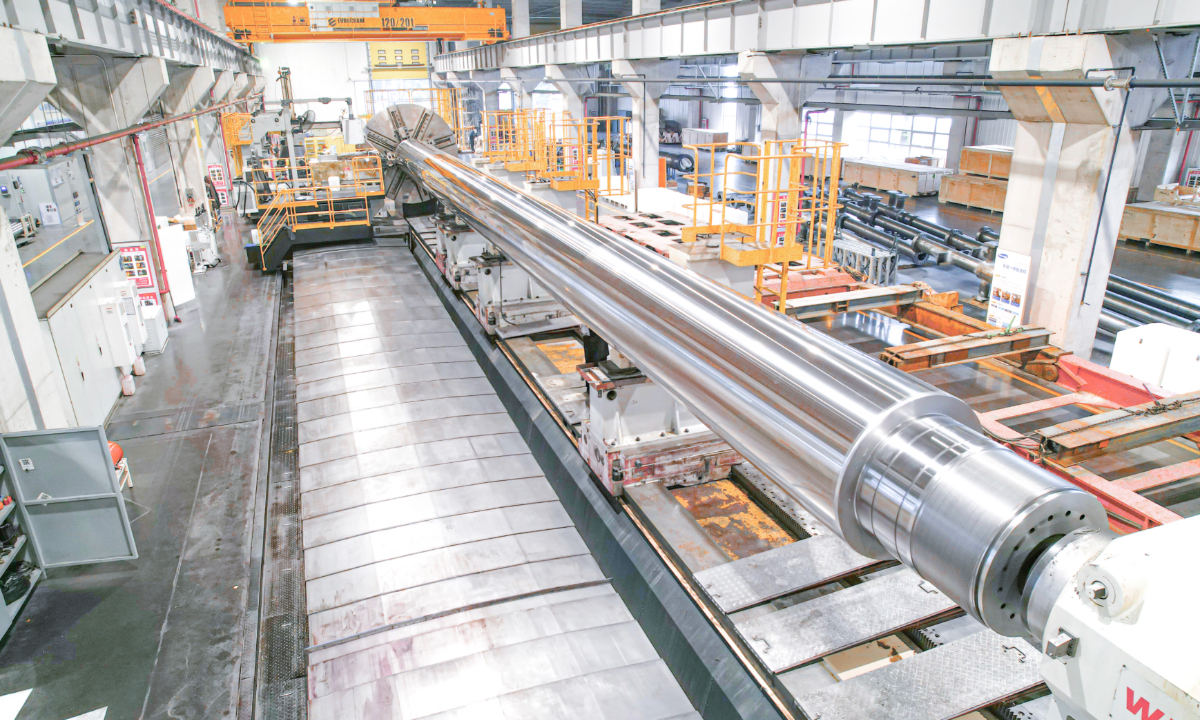
A record-setting domestically developed giant hydraulic cylinder, the core component of the world’s largest pile-driving vessel, rolls off the production line in East China’s Jiangsu Province on Friday. Photo: Screenshot from People’s Daily report
A domestically developed giant hydraulic cylinder—the core component of the world's largest pile-driving vessel—successfully rolled off the production line in East China's Jiangsu Province on Friday, setting multiple global records in weight, diameter, length, thrust and underscoring a major advance in China's high-end marine engineering equipment manufacturing, People's Daily reported.
The cylinder has a diameter of 1.6 meters and a piston stroke of 21 meters, extending to nearly 50 meters in length—about the height of a 17-story building—with a rated thrust of 5,000 tons, equivalent to lifting 3,500 passenger cars at once. It will be installed on the world's largest 156-meter dynamically positioned pile-driving vessel currently under construction, People's Daily reported.
As the core actuator of a hydraulic system, the cylinder converts hydraulic energy into linear reciprocating mechanical motion, with its performance directly affecting equipment reliability, operational precision and efficiency, making it a critical component in a wide range of industrial equipment, People's Daily reported.
The 156-meter dynamically positioned pile-driving vessel is invested in and built by China Railway Construction Bridge Engineering Bureau Group Co. During R&D, the builder partnered with leading domestic suppliers including Hengli Hydraulics and top universities to form an industry-academia-application collaboration. The project team overcame key manufacturing challenges—such as precision control for ultra-large components, deformation prevention for extra-long piston rods, and coating cladding for oversized rods—ensuring exceptional reliability and durability of the "super cylinder" at extreme dimensions.
The cylinder also integrates a closed-loop energy recovery system for the first time globally, converting potential energy generated during pile-frame lowering or forward tilting into electricity and achieving up to 40 percent energy recovery. The system can intelligently switch between consumption and regeneration modes based on real-time operational loads, optimizing energy efficiency across work cycles, significantly reducing overall power consumption, and advancing large pile-driving vessels toward greener and smarter operations, People's Daily reported.
An expert panel concluded that the technical performance of the pile-driving vessel's main hydraulic cylinder and other core components has reached or exceeded that of comparable imported products. The successful development of this major piece of equipment marks another key breakthrough in China's high-end offshore engineering components, providing strong support for future deep-sea projects, cross-sea bridges and offshore wind power construction, while further strengthening China's equipment self-reliance and international standing in the sector.
Wang Peng, an associate research fellow at the Beijing Academy of Social Sciences, told the Global Times that as the "heart" of a pile-driving vessel, the hydraulic cylinder has overcome key challenges in ultra-large component manufacturing and high-precision control, enabling China to independently build super-large pile-driving ships capable of meeting the stringent demands of deep-sea wind power projects and cross-sea infrastructure, and breaking long-standing foreign technological monopolies.
He noted that in terms of marine resource utilization and international cooperation, the technology can directly support offshore clean energy development and deep-sea fisheries facilities, while offering green and intelligent marine engineering solutions to developing countries and contributing to the sustainable use of global ocean resources.
From a manufacturing perspective, Wang said the integration of closed-loop energy recovery and intelligent control reflects China's shift in high-end equipment manufacturing from scale-driven expansion to a focus on quality, efficiency and low-carbon development, providing a China-style model for sustainable global marine engineering.
RELATED ARTICLES