ARTS / CULTURE & LEISURE
Northwest China's Shaanxi unveils its six major archaeological discoveries of 2025
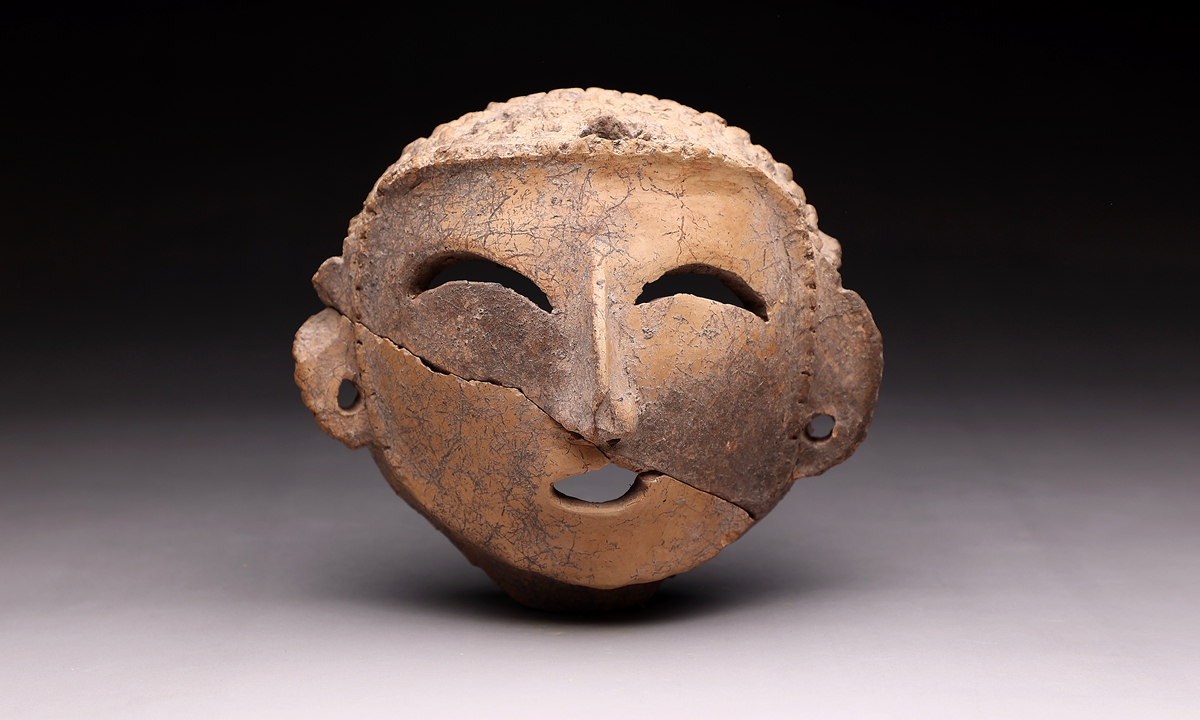
The human-face pottery ware unearthed from the Jiangjia site Photo: Courtesy of Shaanxi Academy of Archaeology
Six archaeological sites were listed as the 2025 major archaeological discoveries in Northwest China's Shaanxi Province at a press conference held by the Shaanxi Academy of Archaeology (SAA) on Friday.
The six sites, listed in chronological order, are the Jiangjia site in Weinan; the Luojiahe site in Xianyang; the Liangluping site in Baoji; the front hall site of the Epang Palace of the Qin Dynasty (221BC-206BC) in Xi'an; the Tongwan city site in Yulin; and the Tomb of Lady Cheng of the Northern Zhou Dynasty (557-581) in Xi'an, SAA told the Global Times on Friday.
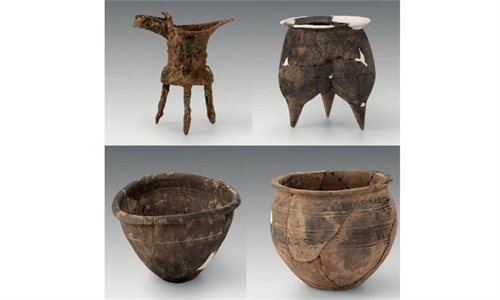
A total of 11 pottery kilns were uncovered at the Jiangjia site, including one featuring symmetrically arranged twin fire chambers. Such kilns are extremely rare in prehistoric archaeological discoveries, making this find an important source for studying the evolution of kiln structures and the development of ceramic production techniques.
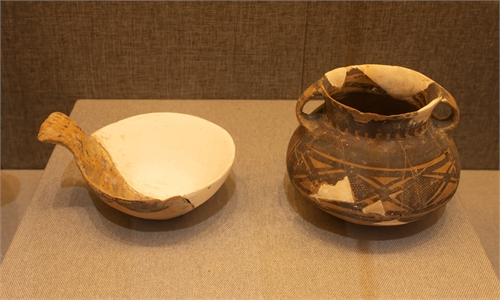
The excavation also yielded a rich assemblage of artifacts, including round-based bowls and painted pottery basins decorated with fish motifs. These finds represent the first large-scale excavation of remains from the early phase of the Miaodigou culture in the eastern Guanzhong Plain (once the heartland of China), providing abundant archaeological evidence for scholarly discussions on the relationship between the Banpo culture and the Miaodigou culture, as well as the origins of the Miaodigou culture itself.
The Miaodigou culture refers to the archaeological culture of the middle Yangshao period, dating back to 5,900-5,400 years ago. It is one of the most widely distributed prehistoric archaeological cultures in China, according to a report by the Chinese Academy of Social Sciences.
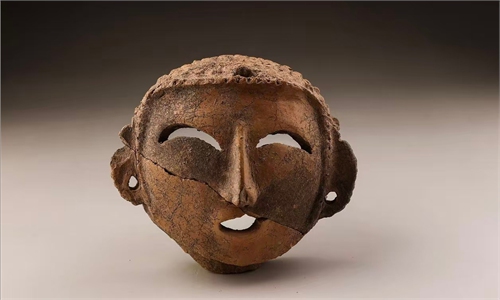
Among the discoveries, a perforated human-face pottery ware stands out for its exquisite form, demonstrating superb craftsmanship and refined artistic expression, and thus holds significant academic value. A large pottery drum was also unearthed; with a surviving height exceeding 1.1 meters, it is unprecedented in scale and serves as tangible evidence of prehistoric ritual systems.
At the Luojiahe site, a total of 17 grain storage pits were identified. The grain-storage facilities are massive in scale, far exceeding the grain production capacity of the settlement itself. No burials have been found at the site. Taken together with its relatively enclosed geographical setting, these features indicate that it was not an ordinary prehistoric agricultural settlement, but rather a specialized storage center.
Archaeological experts said that the Luojiahe site may have been a small settlement established primarily for grain storage during the formative stage of China's early state development. It reflects significant advances in resource control and regional cooperation in prehistoric society, providing important empirical evidence for research into the origins of the early Chinese state and the process of social complexification.
The findings at the Epang Palace site revealed the construction sequence and technical details of the rammed-earth terrace, contributing to research on the building techniques of large-scale elevated platforms from the Warring States (475BC-221BC) to the Qin and Han (206BC-AD220) periods.
In addition, archaeological evidence confirmed that prior to the construction of the Epang Palace, the area was occupied by a large "water basin," or lake. The imposing rammed-earth platform of the Epang Palace was built atop the silted lakebed, providing important clues for understanding the urban planning concepts and site-selection logic of the Qin capital.
RELATED ARTICLES