Chinese research team achieves breakthrough in chip heat dissipation, boosting device performance

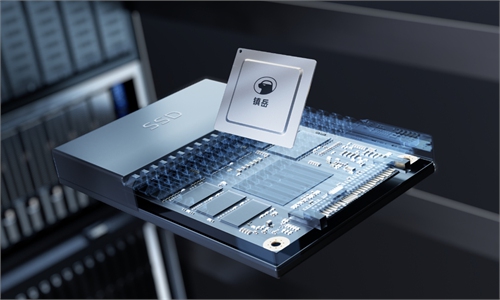
chip Photo:VCG
Chinese researchers have achieved a major breakthrough in semiconductor materials integration by developing an innovative technique that converts rough, island-like interfaces into atomically flat films, significantly improving chip heat dissipation and device performance, Science Daily reported on Friday.
Researchers from Xidian University, led by Academician Hao Yue and Professor Zhang Jincheng, have developed an innovative technique that transforms rough, island-like interfaces into atomically flat films, delivering a breakthrough improvement in chip heat dissipation and device performance. The achievement, which offers a "China paradigm" for high-quality integration of semiconductor materials, has been published in Nature Communications and Science Advances, according to the report.
In chip manufacturing, the long-standing island-like interfacial structures between different material layers have hindered heat transfer, becoming a critical bottleneck to improving device performance, per the report.
"The surface of the nucleation layer in traditional semiconductor chips is uneven, which severely affects heat dissipation," said Zhang, who is also a vice president of Xidian University.
When heat cannot be effectively dissipated, it creates "thermal hotspots," which can significantly degrade chip performance or even damage devices, said the professor. He noted that since the related nucleation technology won the Nobel Prize in 2014, this problem has yet to be fundamentally resolved, remains the biggest bottleneck to improving the performance of radio frequency chips.
The research team pioneered a new technique that transforms a previously random growth process into precise, controllable, and uniform growth. Experiments show that the thermal resistance at the new interfacial structure is just one-third of that in conventional designs.
Gallium nitride microwave power devices fabricated using the technique achieved output power densities of 42 watts per millimeter in the X band and 20 watts per millimeter in the Ka band, surpassing previous international records by 30 to 40 percent. This means that, with the same chip area, detection ranges can be significantly extended, while communication base stations can cover wider areas with higher energy efficiency, Science Daily reported.
The significance of the technology goes far beyond performance gains. It addresses a common heat dissipation challenge faced by both third- and fourth-generation semiconductors and lays a foundation for core devices in future industries such as 5G/6G communications and satellite internet.
"In the future, mobile phones may have better signal coverage in remote areas and longer battery life," Zhou Hong, a professor at Xidian University and member of the research team, said, adding that the team has set its sights on materials with even higher thermal conductivity, such as diamond, which could further boost device power-handling capacity by an order of magnitude if successful.
Global Times
RELATED ARTICLES