Xi calls for advancing building of China-Canada new strategic partnership
Landmark leaders’ meeting pulls relations back on right track: expert
By and Zhang Yiyi Published: Jan 17, 2026 12:23 AM

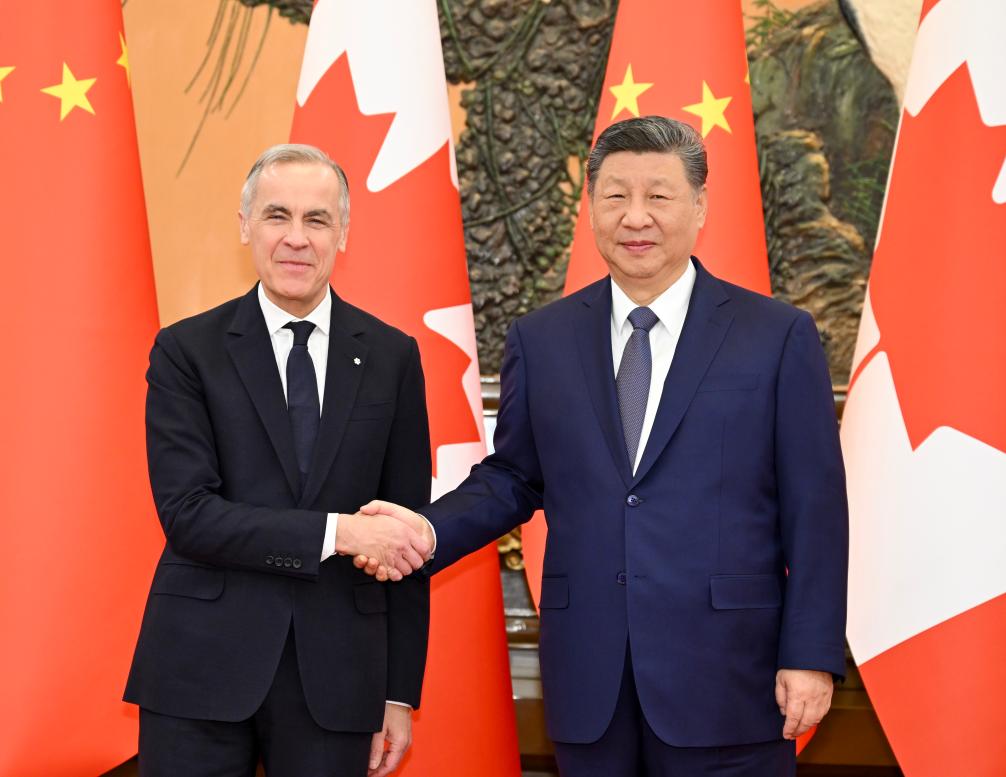
Chinese President Xi Jinping meets with Canadian Prime Minister Mark Carney at the Great Hall of the People in Beijing, capital of China, Jan. 16, 2026. (Xinhua/Xie Huanchi)
Chinese President Xi Jinping and Canadian Prime Minister Mark Carney met on Friday for the second time in less than three months, in a bid to chart the course for bilateral ties that began to thaw last year, the Xinhua News Agency reported on Friday.
The Xi-Carney meeting last October in Gyeongju, Republic of Korea, marked a turnaround of bilateral relationship, and placed it on a new trajectory of positive development.
The healthy and stable development of China-Canada relations is in the common interests of the two countries and also conducive to world peace, stability, development and prosperity, Xi told Carney, who is on an official visit to China from Wednesday through Saturday.
With a sense of responsibility for history, for the people and for the world, the two sides should advance the China-Canada new strategic partnership, steer their ties onto the track of sound, steady and sustainable development, and bring more benefits to both peoples, Xi said.
New strategic partnership
In his meeting with Carney, President Xi put forward four proposals regarding China-Canada relations, emphasizing that the two countries should be partners of mutual respect, common development, mutual trust and collaboration, according to Xinhua.
He said that despite different national conditions, both countries should respect each other's sovereignty and territorial integrity, respect the political systems and development paths they have chosen respectively, and adhere to the correct way of getting along with each other.
Xi urged both sides to encourage exchanges and cooperation in education, culture, tourism, sports and sub-national areas, facilitate personnel exchanges and consolidate the popular will foundation.
China is willing to enhance communication and coordination with Canada within the frameworks of the United Nations, the G20 and the Asia-Pacific Economic Cooperation to jointly address global challenges, Xi said.
Following the meeting with Xi, Carney shared a photo in which he was shaking hands with the Chinese leader and smiling on an X post. The post reads: "A pleasure to meet with President Xi in Beijing. Canada and China are forging a new strategic partnership. We're leveraging our strengths — focusing on trade, energy, agriculture, seafood, and other areas where we can make massive gains for both our peoples."
According to Li Haidong, a professor at the China Foreign Affairs University, in the new strategic partnership stressed by two leaders, the word "new" emphasizes mutual benefit and mutual respect, rather than manufacturing geopolitical confrontation and conflict as some countries do.
The term "strategic" means that China-Canada relations will be oriented toward the long term, with both countries sharing the same strategic objectives in upholding economic globalization, overcoming protectionism, and opposing destructive actions that undermine the UN Charter and the sovereignty of other countries, Li added.
The Financial Times said Carney's visit to Beijing is the first by a Canadian prime minister since Justin Trudeau in late 2017, at a time "when the US is disrupting global economic and political alliances."
Li described the leaders' summit in Beijing as a landmark event that pulls relations back on the right track, marking a major shift rather than just resetting.
"The two leaders' meeting on the sidelines of APEC in 2025 served as an exploratory and preparatory phase, laying the groundwork for deeper cooperation in China-Canada relations. This time, the leaders' meeting represents a substantial elevation of China-Canada relations," said the expert.
He added that the four proposals put forward by the Chinese leader have essentially set the overall future direction for the development of China-Canada relations, replacing the situation of the past few years characterized by "insufficient mutual trust, damaged mutual benefit, and poor communication."
Stepping into right track
China and Canada issued a joint statement of the China-Canada leaders' meeting on Friday. According to the release by the Chinese Foreign Ministry, the leaders reaffirmed the principles and policies that have guided China-Canada relations. Canada reaffirmed its long-standing commitment to its One China policy.
The leaders also committed to strengthening exchanges at all levels and to advancing outcomes in areas including macroeconomic engagement, economic and trade cooperation, energy, finance, public security and safety, people-to-people ties and cultural exchanges, as well as multilateralism.
More specifically, according to the release from the Chinese side, the two sides decided to reinvigorate the high-level China-Canada Economic and Financial Strategic Dialogue (EFSD). The two sides committed to strengthening agricultural cooperation and food security, including through a revitalized China-Canada Joint Agriculture Committee.
The two sides decided to launch a Ministerial Energy Dialogue, a Financial Working Group and to restart the China-Canada Joint Committee on Culture.
The two sides committed to strengthening law enforcement cooperation to combat corruption and transnational crimes, including telecommunication and cyber fraud and illegal synthetic drugs in accordance with their respective laws.
In terms of the electric vehicle (EV) and canola tariffs issues—which have attracted the most attention from the outside world—China did not make any direct reference to them in the joint statement.
A separate Canadian statement specified that Canada will allow up to 49,000 Chinese EVs into the Canadian market, with the most-favored-nation tariff rate of 6.1 percent, which means removal of the additional 100 percent in tariffs it imposed on Chinese EVs following the US move in 2024. It added that by March 1, Ottawa expects the Chinese side to lower tariffs on Canadian canola seed to a combined rate of approximately 15 percent, and that Canadian canola meal, peas, lobster and crab will no longer be subject to the so-called "anti-discrimination tariffs."
Regarding the Canadian side's announcement, an official from China's Ministry of Commerce (MOFCOM) said on Friday that China views this as a positive step taken by Canada in the right direction, and it is also good news for Chinese EVs seeking to explore the Canadian market.
We hope the Canadian side will actively fulfill its commitments and continue to work with China in the same direction. Through friendly consultations, we should create a fairer, more stable, and non-discriminatory environment for further expanding trade and investment cooperation in the EV sector. We look forward to both countries' industries seizing this opportunity, strengthening coordination, and achieving mutual benefit and win-win results, said the MOFCOM official.
When asked about more details on that China and Canada have reached preliminary consensus on adjusting anti-dumping measures for canola, the MOFCOM official said that China and Canada have conducted multiple rounds of consultations in a spirit of cooperation, striving to narrow the list of outstanding issues.
"Canada will make positive adjustments regarding its unilateral measures targeting Chinese electric vehicles EVs, steel and aluminum products, as well as specific cases involving Chinese investment and operations in Canada. Correspondingly, China will adjust its anti-dumping measures on canola and anti-discrimination measures on certain Canadian agricultural and aquatic products, in accordance with relevant laws and regulations," said the official.
Carney described the trade barrier drop deal as a "landmark trade arrangement" when speaking to media in Beijing after the leaders' meeting, the National Post reported. He also said that Canada's relationship with China is "more predictable" than with the US, according to the BBC.
Gao Lingyun, a researcher at the Chinese Academy of Social Sciences, told the Global Times on Friday that the preliminary consensus reached on the EVs and canola tariff issues represents the most substantive progress at present. The mutual tariff reductions on EVs and canola would help ease bilateral trade tensions and create more stable policy expectations for subsequent cooperation.
Zhou Mi, a senior researcher at the Chinese Academy of International Trade and Economic Cooperation, told the Global Times that a considerable portion of the content in Friday's joint statement focuses on rebuilding dialogue mechanisms. In the context of rapidly changing international environments and industrial demands, it forms more institutionalized and predictable arrangements.
This lays a foundation for further cooperation and boosts confidence across various sectors, Zhou added.
Citing analysts, the BBC described Carney as "performing a delicate balancing act", noting that it could "set an example for others across the world who are also feeling the pain of Washington's trade policies."
Although Canada faces pressure from the US, it has shown strong willingness to pursue a more independent and autonomous foreign policy, whether it is to diversify its economic development, resist being "the 51st state" of the US, or to demonstrate Canada's status as a major power in multilateralism and global governance, Li said.
For Canada, in the context of its heavy dependence on the US market, strengthening cooperation with China would help expand its policy and market maneuvering room, enhance its resilience, and increase its bargaining power in negotiations, said Gao.
RELATED ARTICLES