Weiqi masters, fans brave snow to bid final farewell to Weiqi Sage Nie Weiping
Strength, commanding presence of Nie still vivid in my mind: Japanese Go Sage
By Lu Wenao and Published: Jan 18, 2026 11:26 AM

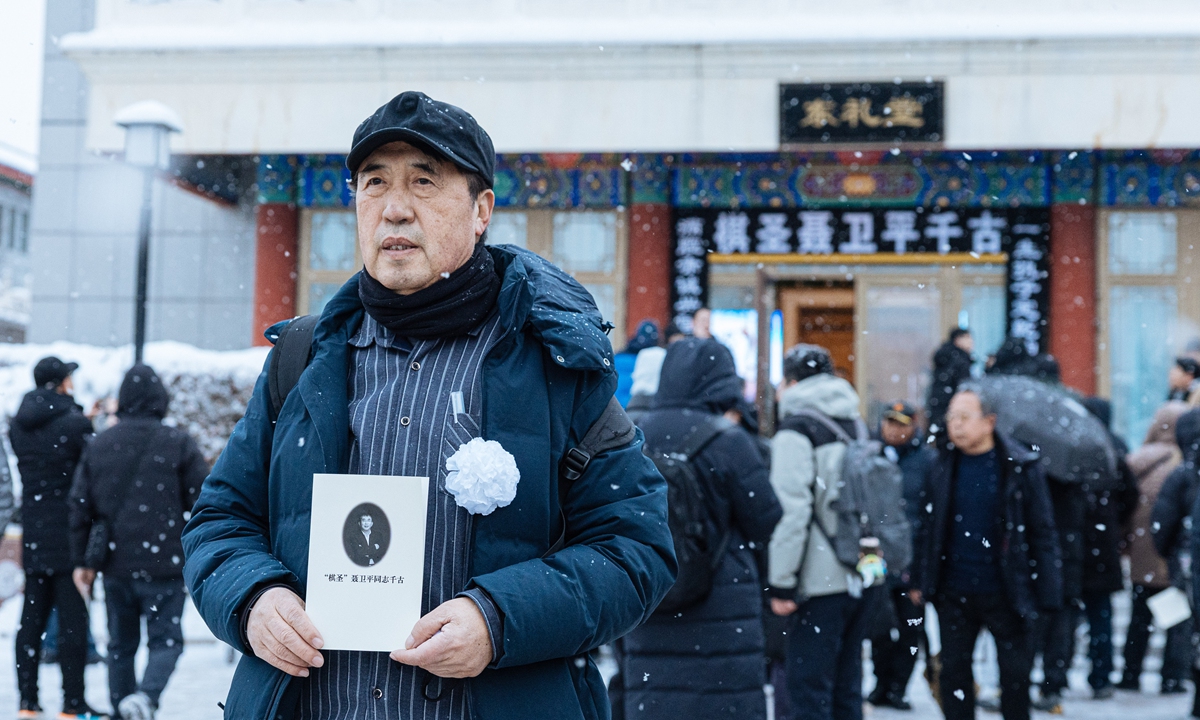
A mourner holds a memorial leaflet of Nie Weiping in snow at the Babaoshan Funeral Home in Beijing on January 18, 2026. Photo: Li Hao/GT
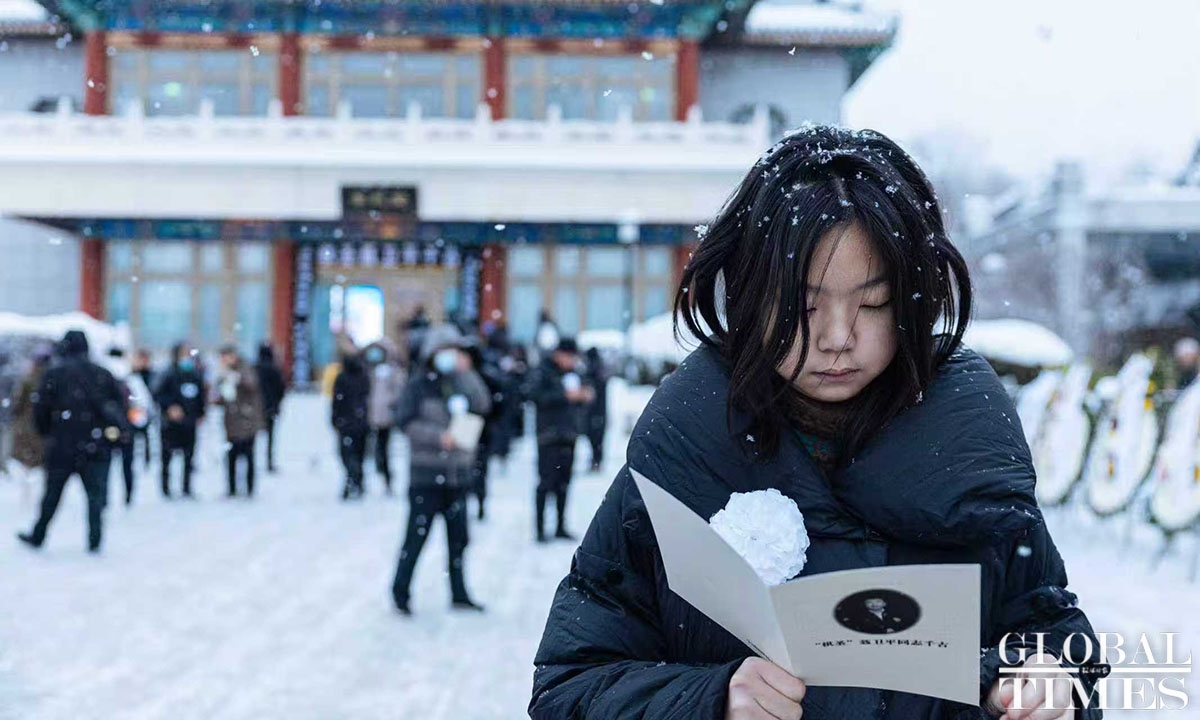
Photo: Li Hao/GT
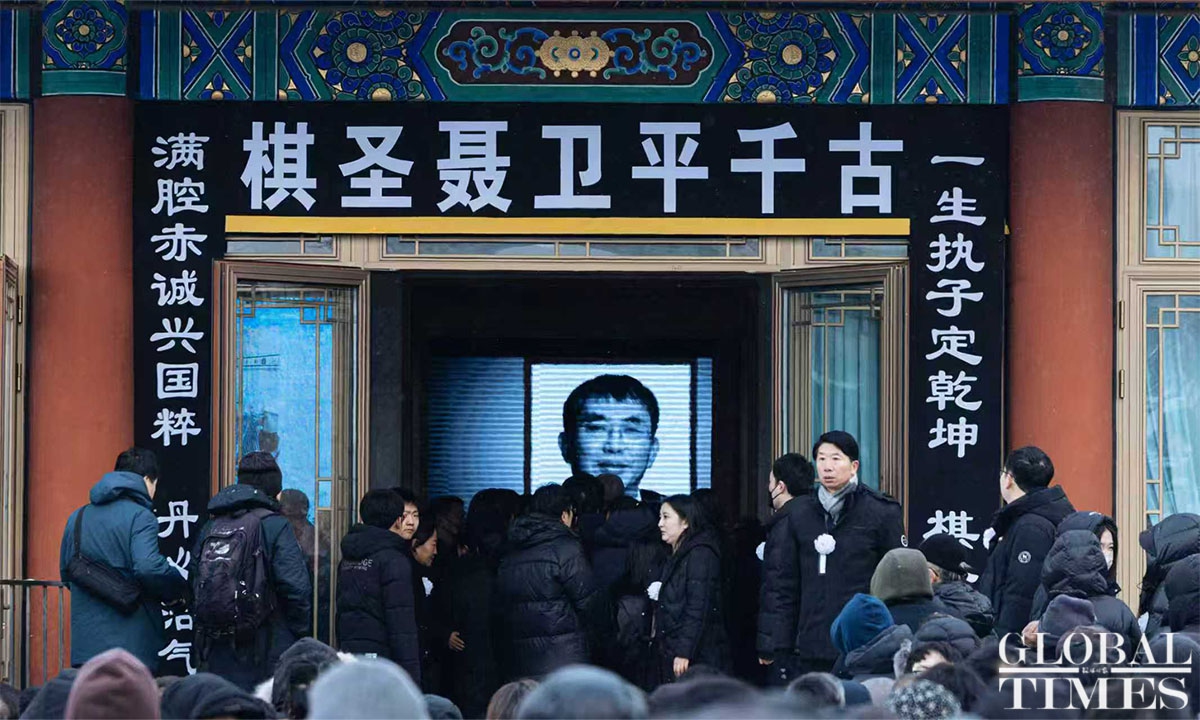
Photo: Li Hao/GT
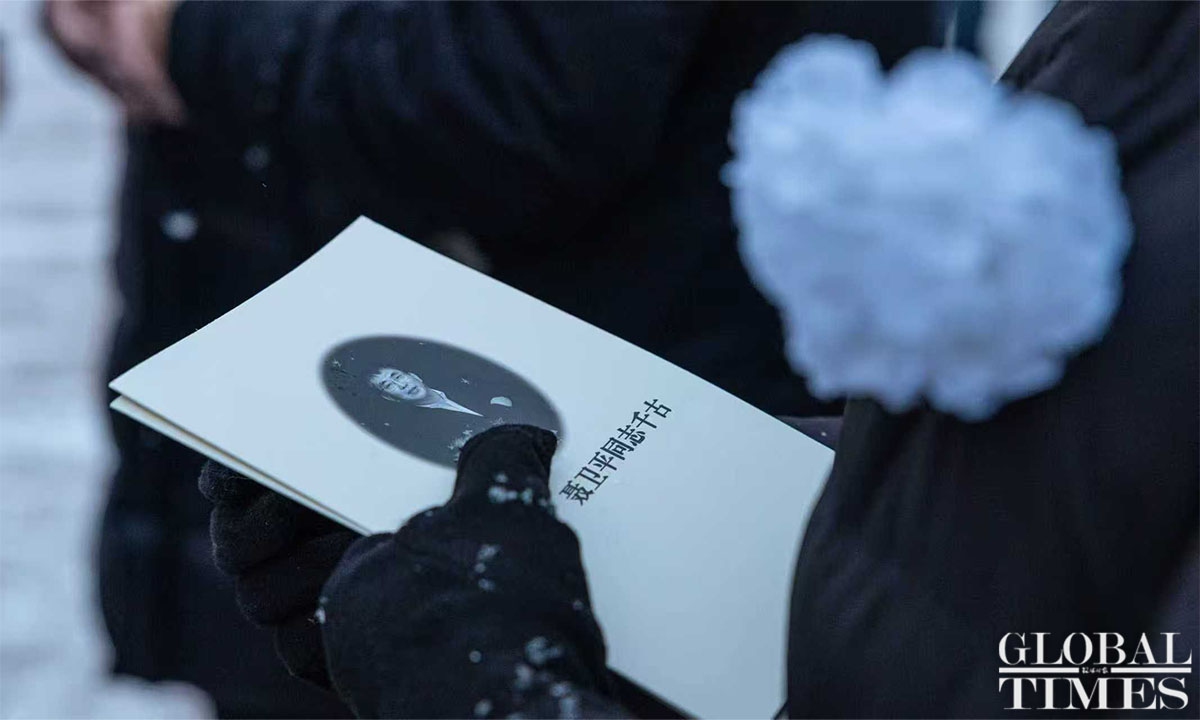
Photo: Li Hao/GT
Following the passing of renowned Chinese Weiqi legend Nie Weiping, relevant leaders of CPC Central Committee expressed condolences in various forms and extended sympathies to his family members, Xinhua News Agency reported Sunday.
On a snowy, windswept Sunday morning in Beijing, Weiqi masters and fans braved the heavy snow at the Babaoshan Funeral Home in Beijing to bid their farewell to China's revered Weiqi legend Nie, paying tribute to the man widely revered as the "Weiqi Sage" who helped revive and reshape modern Chinese Weiqi.
Nie, 74, passed away on January 14 in Beijing after a prolonged illness. A household name in China and known affectionately as the "Weiqi Sage," Nie was honorary president of the Chinese Weiqi Association, former head coach of China's national Weiqi team.
The mourning ceremony was scheduled to begin at 8 am, but many mourners arrived early at daybreak amid rare strong snow in Beijing to queue in line when the Global Times reporters arrived at the Babaoshan venue.
Inside the farewell hall, solemn funeral music played, filling the hall with a somber atmosphere. LED screens on both sides of the hall displayed scenes from the life of Nie. His body lay in repose amid flowers, draped with the flag of the Communist Party of China, an honor seldom accorded to figures from the sports community.
Hua Yigang, honorary chairman of the Chinese Weiqi Association, paid tribute to his late close friend. Hua noted that he was also deeply moved after reading a heartfelt online article written by Nie's longtime rival, Japanese top-tier player Koichi Kobayashi, in mourning Nie. "It is very rare for Kobayashi to express such sincere emotion," Hua was quoted as saying by Beijing Daily on Sunday.
Icon across East Asia
Nie's influence has extended well beyond China. The Japan Go Association released a condolence message on Thursday, expressing "heartfelt condolences" and praising Nie as a first-generation player under China's modern professional Weiqi system who led Chinese Weiqi domestically and internationally from the 1980s through the 1990s.
The association noted that Nie captained China from the inaugural China-Japan Super Go Match and earned the nickname "Qisheng" (Weiqi Sage) in 1988 for his outstanding contributions. His performances, it said, sparked an unprecedented Go, or Weiqi, boom in China.
Japanese honorary Go Sage Koichi Kobayashi wrote a heartfelt tribute recalling his famous defeat by Nie in the first China-Japan Super Go Match in 1985.
"Losing that game and having my head shaved remains an unforgettable and cherished memory," Kobayashi wrote. "The strength and commanding presence he showed across the board are still vivid in my mind."
Another Japanese honorary Go Sage, Hideo Otake, described Nie as a dear friend and a symbol of the revival of Chinese Weiqi, while Japan Go Association chairman Yoko Takemiya said Nie occupied "a lofty position in the global Go community" and played a vital role in fostering China-Japan cultural exchange through the game.
Nie devoted himself for many years to cultural exchanges between Japan and China, deepening mutual understanding and friendship through Go and building an unshakable bridge between the two countries, stated Takemiya.
Though Nie never won a world championship title, his legacy was cemented in the 1980s during the China-Japan Supermatches. In 1985, facing Japan's Koichi Kobayashi, Nie, then 33 and famously wearing a shirt borrowed from China's national table tennis team with a logo that reads China in Chinese characters, secured the first major victory by a Chinese player over a Japanese opponent.
Nie went on to claim an astonishing 11-game winning streak, leading China to three consecutive team victories and igniting nationwide pride. His exploits earned him the enduring nickname "Whirlwind Nie" and transformed Weiqi into a symbol of confidence and revival in modern Chinese sport.
South Korean Weiqi legend Cho Hun-hyun also traveled to Beijing to attend the ceremony on Sunday. He recalled that his last meeting with Nie in person was in March 2025 in Singapore.
"The sudden news of Nie's passing came as a shock. For someone who had been my friend for 40 or 50 years, the impact was enormous, and I am deeply saddened," Cho told reporters through an interpreter on Sunday.
Cho was not only a rival of Nie's throughout their careers but also a lifelong friend. Their competitive relationship was emblematic of the rise of Weiqi in East Asia.
"I had sincerely hoped that he would recover soon and continue playing Go for many more years, but sadly he has left us first. I hope we may meet again in heaven and continue our games there. Today's weather feels as if the heavens are mourning a genius, sharing in our grief," Cho said.
Inspiration for generations of Chinese players
For generations of Chinese players, Nie was not only a national hero but also a mentor.
Ahead of the start of the farewell ceremony, Sun Guangming, vice chairman of the Chinese Weiqi Association, paid tribute to Nie at the farewell ceremony.
"We miss him dearly and feel profound grief. His departure came too soon. Without Master Nie, Chinese Weiqi would not be as thriving as it is today," Sun told reporters. "Our deep love for the game has been greatly influenced by him."
Gu Li, a nine-dan ranked player and one of Nie's most famous students, recalled his learning days with Master Nie.
"The guidance and assistance from Master Nie became the solid foundation for my subsequent efforts and eventual achievements," Gu told reporters, who became Nie's disciple in 1997.
"There would be no Chinese Weiqi as we know it today without Master Nie. As one of his disciples, it falls upon us to carry forward his spirit and ensure that Chinese Weiqi continues to advance toward even greater heights."
Cao Dayuan, a former nine-dan Weiqi player and now a respected Weiqi coach, said emotionally that he hasn't recovered from the frustration of Nie's passing away.
"For our generation of players, we will have to gradually come to terms with a Weiqi world without Nie. This is a great loss for the Chinese Weiqi community." He added that courage and a deep love for the game were the lasting legacies Nie left behind.
At the farewell for Nie in Beijing on Sunday, a fan told the Global Times that they wished Nie will rest in peace.
Another told the Global Times, "My generation grew up inspired by Nie Weiping. I learned not only Weiqi skills from him, but was also deeply motivated by his fighting spirit."
RELATED ARTICLES