Japan Go Association, honorary Go Sages mourn Chinese Weiqi master Nie Weiping, recall his legendary victories



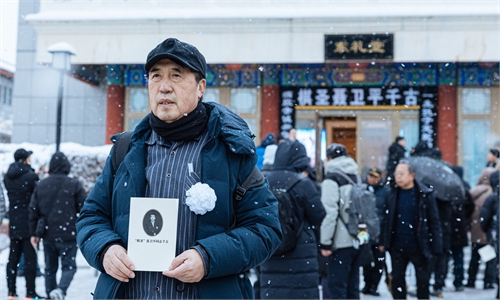
Weiqi masters and fans brave the snow on January 18, 2026 morning in Beijing to bid farewell to revered Weiqi (Go) master Nie Weiping at the Babaoshan Funeral Home. Photo: Li Hao/GT
As Weiqi masters and fans braved the snow on Sunday morning in Beijing to bid farewell to revered Weiqi (Go) master Nie Weiping at the Babaoshan Funeral Home, his passing was also mourned by the Japan Go Association (Nihon Ki-in) and its honorary Go Sages (Japanese meijins) including Koichi Kobayashi and Hideo Otake. Nie was known for his dramatic victories over Japanese rivals.
At the farewell event on Sunday, Hua Yigang, honorary chairman of the Chinese Weiqi Association, paid tribute to his late close friend, stating, "What I know for certain is that Japanese Go player Masaki Takemiya has arrived in Beijing." Hua added that he was also deeply moved after reading a heartfelt online article written by Nie Weiping's longtime rival, Japanese top-tier player Koichi Kobayashi, in mourning Nie. "It is very rare for Kobayashi to express such sincere emotion," Hua noted, the sports channel of the Beijing Daily reported.
Nie, 74, passed away on Wednesday night in Beijing after a prolonged illness.
The Japan Go Association released an article of condolence on its website on Thursday, stating that “We express our heartfelt condolences and pray for his peaceful rest.”
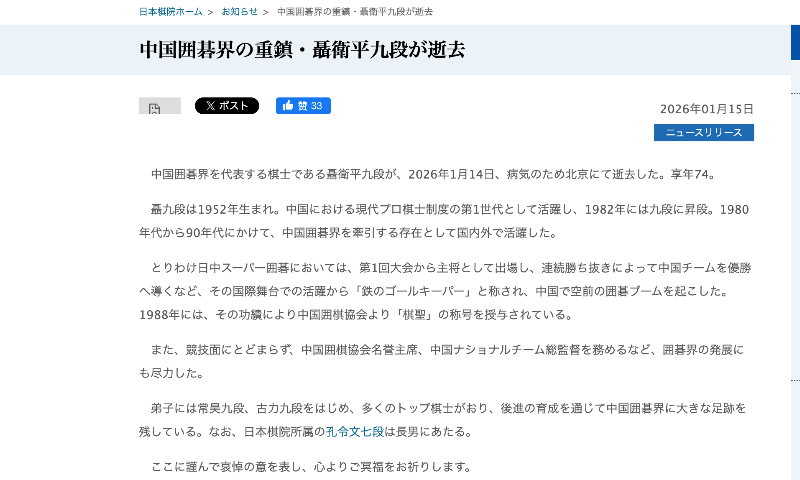
Photo: Screenshot of an article of condolence released on Japan Go Association (Nihon Ki-in) website on January 15, 2026
Noting Nie as the first-generation player under China's modern professional Go system and was promoted to 9-dan in 1982, the article said that Nie “led Chinese Go as a dominant player both domestically and internationally from the 1980s to the 1990s.”
Notably, the article said, in the China-Japan Super Go Matches, he served as the Chinese captain from the very first tournament, leading the Chinese team to victory through consecutive wins. His performances on the international stage earned him the nickname "the iron goalkeeper" and sparked an unprecedented Go boom in China. In 1988, he was honored with the title "Qisheng" (Weiqi Sage) by the Chinese Weiqi Association for his outstanding contributions, according to the article by Japan Go Association.
The Association stated that Nie left a profound legacy in Chinese Go. Additionally, Kong Lingwen, 7-dan, who belongs to the Japan Go Association, is his eldest son, according to the article.
Japanese honorary Go Sage Koichi Kobayashi wrote in tribute released on the website of the Japan Go Association on Thursday about his memorable defeat at the hands of Nie.
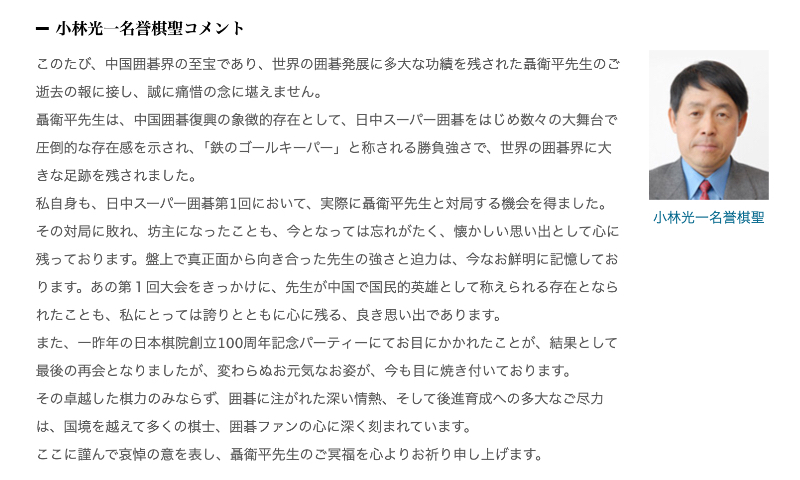
Photo: Screenshot of an article of condolence released by Japanese honorary Go Sage Koichi Kobayashi on Japan Go Association (Nihon Ki-in) website on January 15, 2026
“I myself had the opportunity to play against Nie in the first China-Japan Super Go Match. Losing that game and having my head shaved remains an unforgettable and cherished memory. The strength and intensity he displayed across the board are still vivid in my mind. It fills me with pride to recall how that first tournament established him as a national hero in China – a fond memory I hold close to my heart,” Kobayashi said.
He also recalled his last meeting with Nie two years ago at the Japan Go Association’s 100th-anniversary celebration, noting at that time “the image of his ever-energetic demeanor remains etched in my memory.”
Another honorary Japanese Go Sage Hideo Otake also wrote on the Japan Go Association that he was “overwhelmed with grief” upon hearing of the passing of Nie.
Otake said that “Nie, though younger in age, was a dear friend with whom I shared a close bond over many years.”
“Nie, as a symbol of the revival of Chinese Go, demonstrated unparalleled competitive spirit on major stages like the China-Japan Super Go Matches,” read the condolence message wrote by Otake. “I truly believe he was a hero of Chinese Go,” Otake wrote, noting that the magnitude of Nie’s influence transcends borders and will be recounted for generations to come.
Yoko Takemiya, chairman of the Japan Go Association, wrote in his condolence message on its official website on Thursday that Nie “not only laid the foundation for the development of Chinese Go but also occupied a lofty position in the global Go community through his exceptional skill and profound understanding of the game. The loss of such a leader is a tremendous blow to the Go world.”
Nie devoted himself for many years to cultural exchanges between Japan and China, deepening mutual understanding and friendship through Go and building an unshakable bridge between the two countries, stated Takemiya. “We will remember Nie's great achievements and carry forward his noble spirit,” he wrote.
According to media reports, Nie is best remembered for his dramatic victory in the first China- Japan Super Go in 1985. Few had hope that China would win because its players had long lagged behind Japanese competitors in the strategy board game. By the time it was Nie’s turn to play in Tokyo, Japan’s top player, Kobayashi, had already won six straight games against his Chinese counterparts. Nie was the only Chinese player left to face Japan’s three highest ranked players, the South China Morning Post said.
Nie became a national hero after he defeated all three rivals and seized the championship after winning the final in Beijing. Nie’s victory ended Japan’s dominance in Weiqi and made him a national icon, SCMP said.
At the farewell for Nie in Beijing on Thursday, a fan told the Global Times that they wished Nie will rest in peace.
Another told the Global Times, "My generation grew up inspired by Nie Weiping. I learned not only Go skills from him, but was also deeply motivated by his fighting spirit."
RELATED ARTICLES