Trump’s tariff threat over Greenland sparks European pushback; 8 European countries vow ‘full solidarity’ with Denmark over Greenland in joint statement
Chinese experts note widening transatlantic divide


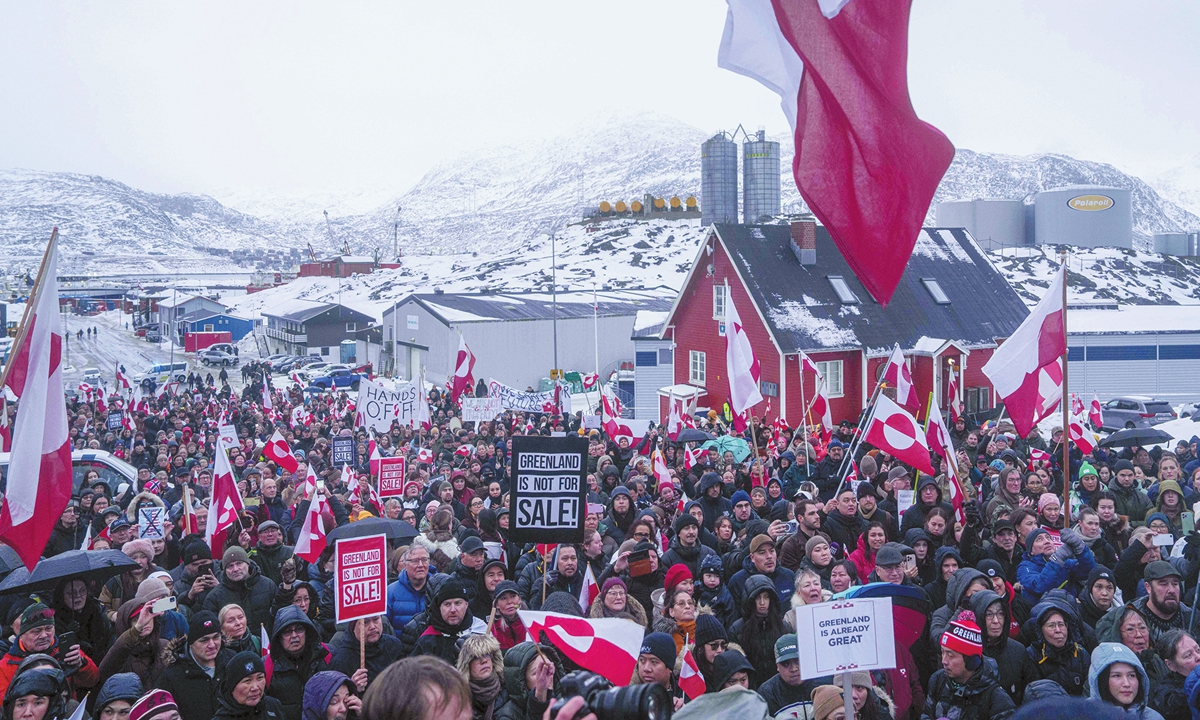
People protest against US President Donald Trump's policy toward Greenland in front of the US consulate in Nuuk, Greenland, on January 17, 2026. Photo: VCG
US President Donald Trump's threat to impose new tariffs on eight European countries unless Denmark accepts a deal over Greenland has drawn swift rebukes from Nordic capitals and major European leaders, fueling calls for an EU-level response, and casting fresh doubt over the implementation of last year's EU-US tariff "truce," according to media reports on Sunday.
Pointing out that the US has instrumentalized Europe's dependence, Chinese experts believe the US tariff threat over the Greenland issue would further widen transatlantic rifts.
In a social media post on Saturday, Trump said the US would levy a 10-percent tariff from February 1 on goods from Denmark, Norway, Sweden, France, Germany, Britain, the Netherlands and Finland. He warned the rate would rise to 25 percent on June 1 and remain in place until a deal is reached for the "complete and total purchase" of Greenland.
In response, the eight countries issued a joint statement Sunday, Associated Press reported. In the statement, they vowed "full solidarity" with Kingdom of Denmark and the people of Greenland.
"Tariff threats undermine transatlantic relations and risk a dangerous downward spiral. We will continue to stand united and coordinated in our response. We are committed to upholding our sovereignty," the eight countries voiced in the joint statement.
Copenhagen has always refused to consider putting a price tag on the world's largest island and has rebuffed US offers before. In 1946, after the US had taken over the defense of Greenland in the Second World War, then US president Harry Truman offered Denmark $100 million in gold, which is equal to about $1.7 billion today, adjusted for inflation. Denmark said no, the Times reported on Sunday.
On Saturday local time, Trump also posted a personal black-and-white photo on his Truth Social platform, proclaiming himself the "Tariff King."
European nations this week sent military personnel to the island at Denmark's request, Reuters reported.
Commenting this in another Truth Social post on local time Saturday, Trump claimed that "Denmark, Norway, Sweden, France, Germany, The United Kingdom, The Netherlands, and Finland have journeyed to Greenland, for purposes unknown." "These Countries, who are playing this very dangerous game, have put a level of risk in play that is not tenable or sustainable. Therefore, it is imperative that, in order to protect Global Peace and Security, strong measures be taken so that this potentially perilous situation end quickly, and without question," he wrote in the post.
In response to Trump's threat, Nordic leaders and senior officials were among the first to push back, stressing that disputes between allies should be handled through dialogue rather than pressure, Xinhua reported.
Danish Foreign Minister Lars Lokke Rasmussen said the tariff threat was a "surprise" given the "constructive meeting" with top US officials earlier this week in Washington, AP reported.
Trump's threat to put tariffs on a number of European countries is "turning friends into enemies", the deputy speaker of the Danish Parliament, Lars-Christian Brask, tells the BBC.
Norwegian Prime Minister Jonas Gahr Store called the threats "unacceptable" in comments to national news agency NTB, saying threats have no place among allies and reiterating Norway's support for the sovereignty of the Kingdom of Denmark.
Finnish President Alexander Stubb said issues among allies are best resolved through discussion, not pressure, warning that tariffs could harm transatlantic relations and trigger a dangerous downward spiral, CNN reported.
Swedish Prime Minister Ulf Kristersson rejected the tariff as "blackmail," saying Sweden "will not allow ourselves to be blackmailed" and arguing the matter should be handled at EU level.
Other European leaders also signaled a tougher posture should Washington move ahead with the measures.
Calling the tariff threat "unacceptable," French President Emmanuel Macron said Europeans would respond in a united and coordinated manner should the measures be confirmed, Reuters reported Saturday.
He said France's participation in a Denmark-organized exercise in Greenland reflects France's commitment to national sovereignty and independence, stressing that "no intimidation or threat will influence us."
British Prime Minister Keir Starmer said it was "completely wrong" to apply tariffs on allies for pursuing collective security within NATO, adding that Britain would raise the issue directly with the US administration and reiterating that Greenland's future should be decided by Greenlanders and Danes, BBC reported Sunday.
Italy's Prime Minister Giorgia Meloni called Trump's threat to slap tariffs on opponents of his plan to seize Greenland a "mistake" on Sunday, adding she had told him her views, Barrons reported.
"I believe that imposing new sanctions today would be a mistake," Meloni told journalists during a trip to Seoul. "I spoke to Donald Trump a few hours ago and told him what I think, and I spoke to the NATO secretary general, who confirmed that NATO is beginning to work on this issue."
The German government also said it was coordinating closely with European partners and that an appropriate response would be decided jointly in due course.
At the EU level, European Commission President Ursula von der Leyen and European Council President Antonio Costa warned in a joint statement that tariffs linked to Greenland would undermine transatlantic ties and risk a "dangerous downward spiral," Euronews.com reported Sunday.
They underlined that territorial integrity and sovereignty are fundamental principles of international law, and said Europe would remain "united, coordinated, and committed to upholding its sovereignty."
"In fact, what the US is doing to Europe is also a kind of hybrid warfare - the US is deploying every pressure tool it can think of against Europe," Cui Hongjian, a professor at the Academy of Regional and Global Governance at Beijing Foreign Studies University, told the Global Times.
The US is instrumentalizing Europe's dependence with the US with the goal to force Europe to accept American conditions so that Washington can achieve its objectives, Cui added. By escalating pressure on the Greenland issue and resorting to tariff threats, the White House's coercion would deepen the transatlantic divide, Cui said.
Coming as tensions escalated between the US and Europe over Greenland and after concluding his China visit and having reached agreements to reduce barriers on Chinese EV imports while China moved to adjust anti-dumping measures on Canadian canola, Canadian Prime Minister Mark Carney wrote on Sunday in an X post that "The Canada-China relationship has been distant and uncertain for nearly a decade. We're changing that, with a new strategic partnership that benefits the people of both our nations," he wrote in the post.
Some European media have also noted Canada's changing orientation under US pressure. Austrian public broadcaster ORF reported that after years of strained relations, China and Canada are seeking to improve ties amid growing tensions with the US, adding that more countries around Washington are attempting to build alternative connections, including the EU's recent trade deal with Mercosur states and hopes for an EU-India agreement.
Potential trade countermeasures from EU
Besides France's participation in a Denmark-organized exercise in Greenland, Macron will also ask the European Union to activate its powerful "anti-coercion instrument (ACI)" if the US imposes additional tariffs in the standoff over Greenland, his team said Sunday, France24 reported.
The bloc's weapon - never-before used and dubbed its trade "bazooka" - allows for curbing imports of goods and services. It has been invoked as a possible way to push back over tech and trade, and now the Danish territory US President Donald Trump wants to acquire.
Meanwhile, thousands of people took to the streets in Greenland and Denmark on Saturday in protest at the proposed US takeover, BBC reported Sunday. They held signs of protest, waved their national flag and chanted "Greenland is not for sale" in support of their own self-governance, Euronews.com reported Sunday.
Zhou Mi, a senior researcher at the Chinese Academy of International Trade and Economic Cooperation, told the Global Times on Sunday that this tariff threat stems from Trump's typical transactional mindset of resorting to tariffs to solve other problems.
Zhou believes that more European citizens will grow increasingly disappointed with US actions and its future role. Many European companies are also likely to reassess their economic and trade ties with the US, and it is not impossible that some may adjust their global operations out of concern, leading to a further decline in trade volume between the US and Europe, Zhou commented.
RELATED ARTICLES