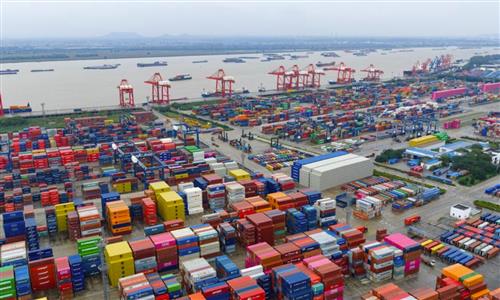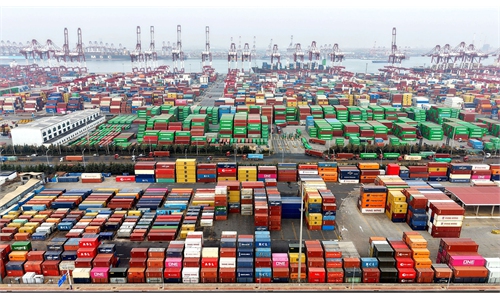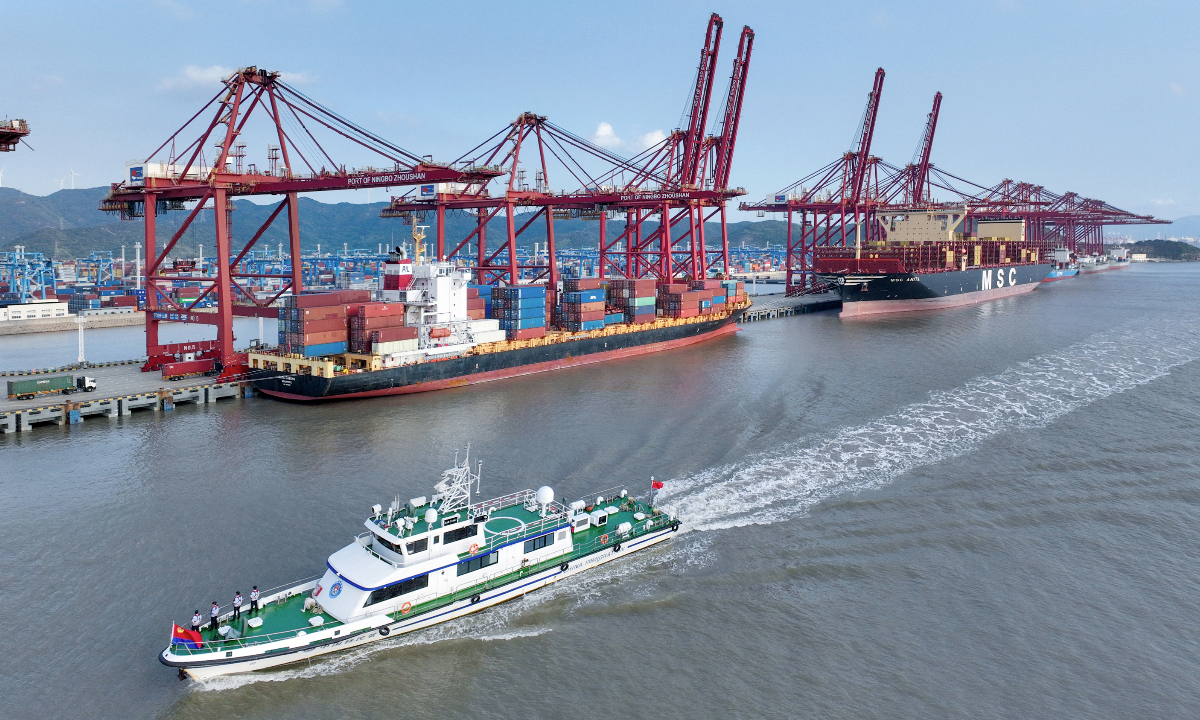
View of a container terminal of Ningbo Zhoushan Port in East China's Zhejiang Province on October 13, 2025. Photo: VCG
Several Chinese provinces and regions saw their 2025 foreign trade growth outpace the national average, driven by surging exports in electronics and new green products, according to official customs data on Monday.
In 2025, the nine mainland cities of the Guangdong-Hong Kong-Macao Greater Bay Area recorded a total import and export value of 9.15 trillion yuan ($1.31 trillion), up 4.7 percent year on year, accounting for more than 20 percent of China's total foreign trade, reported CCTV News, citing customs data on Monday.
The number of enterprises in the nine cities with actual import and export activity exceeded 150,000 in 2025, marking the highest level on record, the report said.
South China's Guangdong Province remained China's top trader in 2026, maintaining its No. 1 position for 40 consecutive years. Its total goods trade hit a record of 9.49 trillion yuan in 2025, marking up a 4.4-percent increase and accounting for 20.9 percent of the national total. The province contributed 24.1 percent to the nation's total trade growth, according to customs data.
East China's Zhejiang, another major province of foreign trade, reported total import-export value of 5.55 trillion yuan in 2025, up 5.4 percent year-on-year. Exports increased 7.2 percent while imports edged up 0.3 percent. Zhejiang has now posted year-on-year growth in total trade, exports and imports for ten consecutive years since 2016, according to data released by local customs offices, the Xinhua News Agency reported on Monday.
In 2025, Zhejiang conducted trade with more than 240 countries and regions, with import and export growth recorded in trade with more than 180 of them, the report said.
Southwest China's Sichuan Province posted total goods trade of 1.03 trillion yuan in 2025, ranking eighth nationally. Electromechanical products accounted for 820.12 billion yuan in trade, up 2 percent. Exports of the province's "new three" products - electric vehicles, lithium batteries and photovoltaic products — jumped 69.4 percent to 33.77 billion yuan, a record high, china.news.com reported on Monday.
Moreover, private enterprises have played an increasingly important role in driving foreign trade growth. For example, the number of private enterprises in the nine mainland cities of the Guangdong-HongKong-Macao Greater Bay Area reached 139,700, while their total trade volume reached 5.87 trillion yuan - both figures representing record highs, with increases of 20.3 percent and 5.3 percent, respectively.
Traditional electronics manufacturing remained strong in the nine mainland cities of the Guangdong-HongKong-Macao Greater Bay Area: exports of electronic components, electrical apparatus, and computers and parts rose 20.1 percent, 17.0 percent, and 9.7 percent, respectively. Emerging "new three" products, along with 3D printers and drones, saw export surges of 31.2 percent, 37.1 percent and 40.8 percent, respectively, CCTV News reported.
The steady growth of major trade provinces, despite mounting external uncertainties, underscores the resilience and international competitiveness of the foreign-trade sector in these developed regions, Bai Ming, a research fellow at the Chinese Academy of International Trade and Economic Cooperation in Beijing, told the Global Times on Monday.
Fresh data underscore the continued resilience of China's foreign trade sector in 2025, supported by enduring strengths in traditional manufacturing and a rapid shift toward smart, green and high‑tech exports, Bai said.
"The optimized structure reflects improved self-reliance in China's foreign trade sector, as export-oriented companies increasingly rely on their own brands, domestically-developed technologies and independent supply chains," Bai said.
He added that this resilience is the result of continued manufacturing transformation and upgrading. Policy support for industrial upgrading, R&D investment, green-energy deployment, digitalization, and diversified trade links further accelerate this transition, helping to stabilize trade flows, attract investment and strengthen China's role as a global supplier of both traditional manufactured goods, and next-generation sustainable technologies.
Global Times
RELATED ARTICLES