China's foreign trade expands by 3.6% in first 11 months, showcasing industries' competitiveness, resilience
Upbeat data reflects positive full-year growth trajectory
By and Yin Yeping Published: Dec 08, 2025 12:12 PM

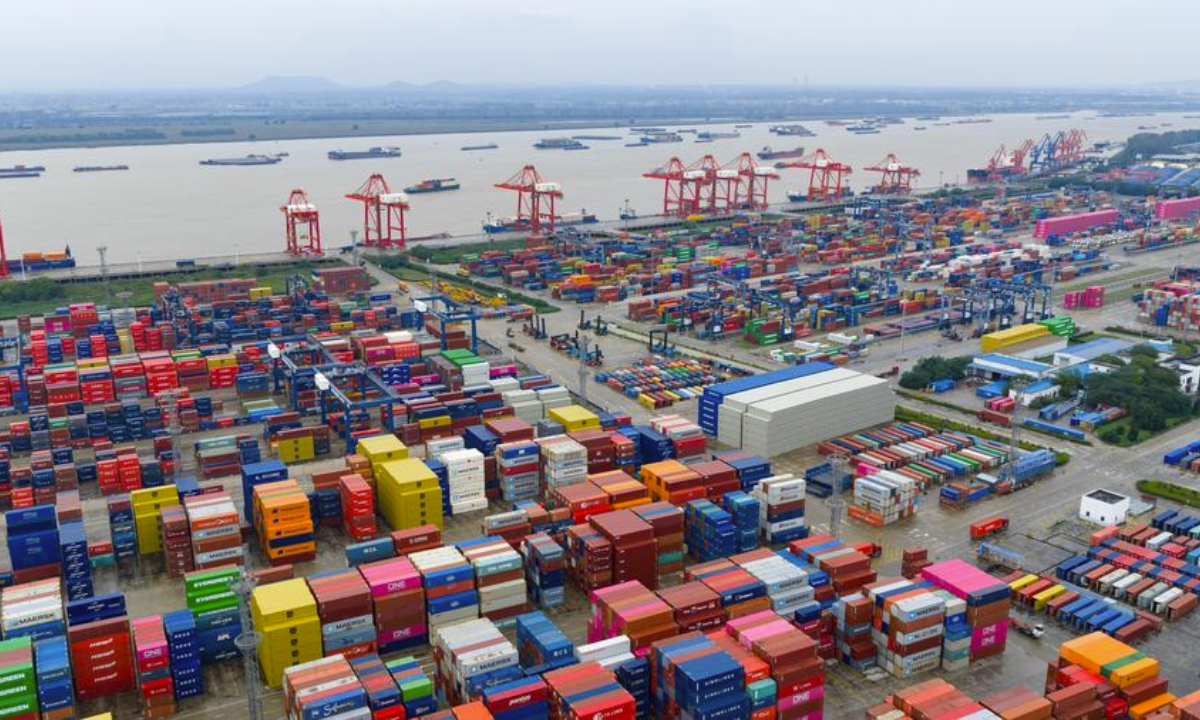
An aerial drone photo shows the view of a container terminal of Nanjing Port in east China's Jiangsu Province, Oct. 19, 2025. (Photo by Yang Suping/Xinhua)
China's foreign trade edged up in the first 11 months of 2025, with total merchandise trade rising 3.6 percent year-on-year to 41.21 trillion yuan ($5.83 trillion), according to data released by the General Administration of Customs on Monday. Exports reached 24.46 trillion yuan, up 6.2 percent, while imports grew 0.2 percent to 16.75 trillion yuan, the data showed.
Observers said that the upbeat data, in particular with regard to a swift rebound in trade growth in November, underscored the competitiveness and resilience of China's foreign trade engine. The reading in the first 11 months also reflected a robust expansion for the full year, with an analyst predicting that the figure could reach around 45 trillion yuan, setting a new record.
In November alone, total trade reached 3.9 trillion yuan, up 4.1 percent year-on-year, the data showed. The growth rate accelerated 4 percentage points from October. In November, exports rose by 5.7 percent year-on-year, while imports jumped 1.7 percent.
"The January-November data demonstrated that China's foreign trade is developing on track and continues to show strong vitality, regardless of a short-term fluctuation in October," Tian Yun, an economist based in Beijing, told the Global Times on Monday. He cited a number of factors that underpin this positive trajectory, including the strong competitiveness of "Made in China" products, the ongoing industrial upgrade and stepped-up efforts to diversify export markets.
In the first 11 months, exports of mechanical and electrical products reached 14.89 trillion yuan, up 8.8 percent year-on-year, accounting for 60.9 percent of the country's total exports. Exports of integrated circuits and automobiles expanded 25.6 percent and 17.6 percent in year-on-year terms, the data showed.
"With more countries successively entering interest-rate-cutting cycles, which is likely to stimulate demand for Chinese goods, I am very confident that China's total foreign trade this year will reach around 45 trillion yuan - marking a new milestone," Tian noted.
China's foreign trade hit a record high in 2024, with total merchandise trade standing at 43.85 trillion yuan, up 5 percent year-on-year, customs data showed.
Tian is also bullish on China's foreign trade prospects for 2026. "In this era of global turbulence, everyone is looking for a stable and reliable partner, and China is naturally a top choice. In line with this trend, China has been making concrete efforts in pursuing high-standard opening-up."
"This year, China and ASEAN signed the upgraded China-ASEAN Free Trade Area 3.0 Upgrade Protocol, and the country is fully prepared to join the Comprehensive and Progressive Agreement for Trans-Pacific Partnership. All these efforts are leading to new growth points in trade, and the country is set to see steady trade growth during the 15th Five-Year Plan period (2026-30)," Tian noted.
Reuters reported on Monday that China's higher-than-expected exports in November were "driven by a surge in shipments to non-US markets as manufacturers deepen trade ties with the rest of the world," given the US' prohibitively high tariffs.
In the first 11 months, ASEAN remained China's largest trading partner, with bilateral trade reaching 6.82 trillion yuan, up 8.5 percent year-on-year, accounting for 16.6 percent of China's total foreign trade. The EU was China's second-largest trading partner, with trade hitting 5.37 trillion yuan, up 5.4 percent year-on-year, accounting for 13 percent of China's total foreign trade.
China's trade with the US, which is China's third-largest trading partner, plunged by 16.9 percent year-on-year to 3.69 trillion yuan in the January-November period, accounting for 8.9 percent of China's total foreign trade.
He Weiwen, a senior fellow at the Center for China and Globalization, told the Global Times on Monday that such a decline indicates the continued impact of US tariff policies on trade.
The Chinese and US delegations reached basic consensuses on arrangements to address their respective trade concerns in Kuala Lumpur in October, which raised expectations for a gradual recovery in bilateral trade. However, a meaningful rebound would still require the US to make greater efforts to meet China halfway, and show more sincerity by stopping its relentless curbs on China involving trade and economic issues, He said.
In the first 11 months, China's trade with Belt and Road Initiative partner countries rose 6 percent year-on-year to 21.33 trillion yuan.
Despite trade tensions, protectionism, and industrial policies by G20 economies, "China's edge in advanced manufacturing and dominant position in high-growth emerging sectors like EVs, batteries, and robotics mean that we project its global export market share to reach 16.5 percent by 2030, up from 15 percent now," according to a research note by Chetan Ahya, chief Asia economist at Morgan Stanley, sent to the Global Times on Monday.
RELATED ARTICLES