Beijing introduces robotic-specific professional title system to boost talent development
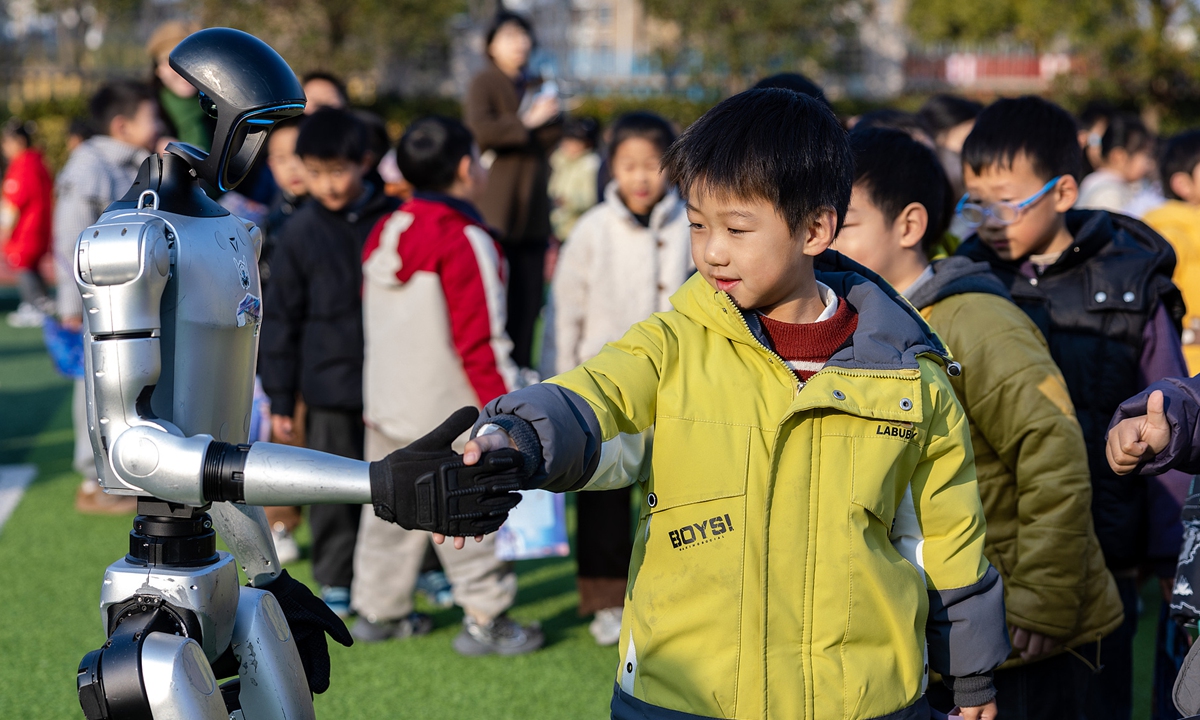
A primary school student in Huzhou, East China's Zhejiang Province, shakes hands with a robot during a final exam on January 15, 2026. The exam assessed students' comprehensive literacy and practical application skills. Photo: VCG
Beijing has released a trial regulation establishing a dedicated professional title evaluation system for robotics engineers, aiming to better align talent assessment with industry needs and support the Chinese capital city's ambition to become a global robotics innovation hub, CCTV News reported on Monday.
The policy will take effect in 2026, with the first round of professional title evaluations scheduled to begin in July this year.
Under the new rules, robotics will be added as a dedicated specialty within the engineering title system, with evaluations divided into four key directions: core components, algorithms and software, robot design and manufacturing, and system integration and applications. The framework covers the entire robotics value chain, from fundamental technologies to real-world deployment, ensuring that talent evaluation is more closely aligned with actual industrial needs.
The system comprises four professional levels: assistant engineer, engineer, senior engineer, and principal senior engineer, establishing a clear career pathway from early-career professionals to top-tier experts. It will apply to technical staff working in state-owned entities, private companies, and social organizations engaged in robotics-related fields in Beijing.
According to the regulation, the evaluation system will apply broadly to professional and technical personnel engaged in robotics-related work across Beijing, including those in state-owned enterprises and public institutions, private companies and social organizations, reflecting the sector's increasingly diverse and market-driven landscape.
The regulation emphasizes innovation capacity and real-world contributions, with performance and results as core evaluation criteria. Assessments will focus on technological breakthroughs, innovation outcomes, commercialization and industrial impact, recognizing achievements such as patents, standards formulation, project implementation and technology transfer. Outstanding results in national robotics competitions may also qualify candidates for fast-track promotion to senior professional titles.
Zhao Mingguo, director of Tsinghua University's Robotics Control Laboratory, told the Global Times that the new mechanism could serve as a "special channel" to attract young, high-potential talent from home and abroad, while promoting closer university-industry collaboration and accelerating the transformation from research to industrial application.
Beijing currently hosts more than 940 robotics-related companies and approximately 30,000 professionals, supported by leading universities such as Tsinghua University and Beijing Institute of Technology, top research institutes like Chinese Academy of Sciences' Institute of Automation, and multiple national-level innovation centers.
Local authorities said that they will continue to monitor the implementation of the policy and dynamically refine evaluation standards and procedures, with the aim of turning the professional title system into a catalyst for talent aggregation and industrial innovation in the robotics sector.
RELATED ARTICLES