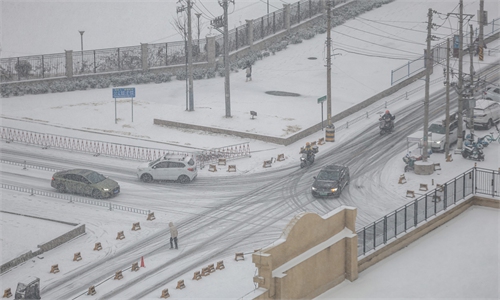
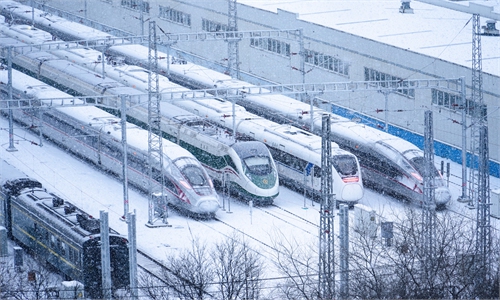
Local residents brave the snow in Hankou Road, Huangpu District of Shanghai on January 20, 2026. Photo: VCG
Amid the first cold wave of this year, several southern cities including Shanghai and Nanjing, East China's Jiangsu Province, witnessed snowfall on Tuesday, while some southern cities saw their daily high temperatures fall below zero for the first time this winter. Affected cities have taken response measures, with some leveraging big data to facilitate smoother traffic flow, while others stocked up on vegetables in advance to ensure adequate supplies for residents.
Shanghai Meteorological Bureau said on Tuesday morning via its official Sina Weibo account that light snow fell intermittently in multiple suburban areas of the city, as well as near the Xujiahui area from Monday night to Tuesday morning, with scattered light snow expected in some regions later in the afternoon.
The bureau also forecast that the highest temperature on Tuesday would be only around 4 C, accompanied by persistent strong northeasterly winds of force 4-5, with gusts up to force 6, and relative humidity ranging from 60 percent to 90 percent.
As of press time, a blue alert for strong winds issued by the Shanghai Central meteorological Observatory at 8 pm on Monday remained in effect. Districts including Minhang, Songjiang, and Baoshan issued yellow alerts for icy roads, while Songjiang also issued a yellow frost alert, The Paper reported.
To ensure road safety and traffic order during the cold wave, Shanghai's public security traffic management department has stepped up traffic congestion relief efforts by leveraging big data, The Paper reported.
Building on a prior comprehensive survey of waterlogged and ice-prone road sections across the city, the department has combined on-site police deployment with video surveillance to ensure rapid incident response, the report said.
Forecasts indicate that the prolonged low temperatures will persist until Thursday in Shanghai, with the coldest point expected Thursday morning. Minimum temperatures in urban areas will fall to around -1 C, with thin ice expected, while suburban areas will see lows ranging from -6 C to -3 C, accompanied by freezing or severe freezing conditions.
Ma Jun, director of the Institute of Public and Environmental Affairs, told the Global Times that the current snowfall coincided with the arrival of a cold air mass rather than premature precipitation, adding that the precipitation process is highly complex, involving multiple transitions among rain, sleet, freezing rain and snow.
The cold wave will continue to affect China on Wednesday, with central and southern Guizhou, northern Guangxi, and Jiangxi experiencing sharp temperature drops, peopleapp.com reported. Many areas are expected to see the lowest temperatures of this cold wave.
The National Meteorological Center issued a blue alert for the cold wave at 6 am on Tuesday. From 8 am on Tuesday to 8 pm on Wednesday, temperatures in western Jianghuai region, eastern and southern Jiangnan region, southeastern parts of Southwest China, and South China are expected to drop by 4-6 C.
In some areas, including southern Jiangxi, western Fujian, southern Guizhou, Guangxi, and northern Guangdong, temperatures may drop by as much as 8 C, with localized decreases exceeding 10 C.
Extensive freezing rain is expected in regions including Hunan and Guizhou, with moderate to heavy snow in some locations.
Ma said this cold wave will bring the strongest rain, snow, and freezing weather event that central and eastern China face this winter. What sets it apart from previous ones is the extreme complexity of precipitation types, especially in areas south of the Qinling Mountains-Huaihe River line, he added.
Ma said the cold wave is pushing southward slowly, leading to a longer period of impact but relatively weaker intensity in individual locations.
Multiple cities affected by the cold wave have also implemented measures. In Hexian county, Anhui Province, farmers reinforced vegetable greenhouse facilities in advance and insulated crops to mitigate cold damage, CCTV News reported on Tuesday.
Local agricultural departments also dispatched technicians to guide farmers in preparing for cold, freezing and rain-snow conditions to ensure stable winter vegetable production, the report said.
Nanjing has launched vegetable supply guarantee measures to maintain adequate reserves of seasonal and storable vegetables in local markets, CCTV News reported.
RELATED ARTICLES