IN-DEPTH / IN-DEPTH
GGI’s focus on actions will strengthen capacity-building, governance effectiveness in Global South: former Egyptian FM
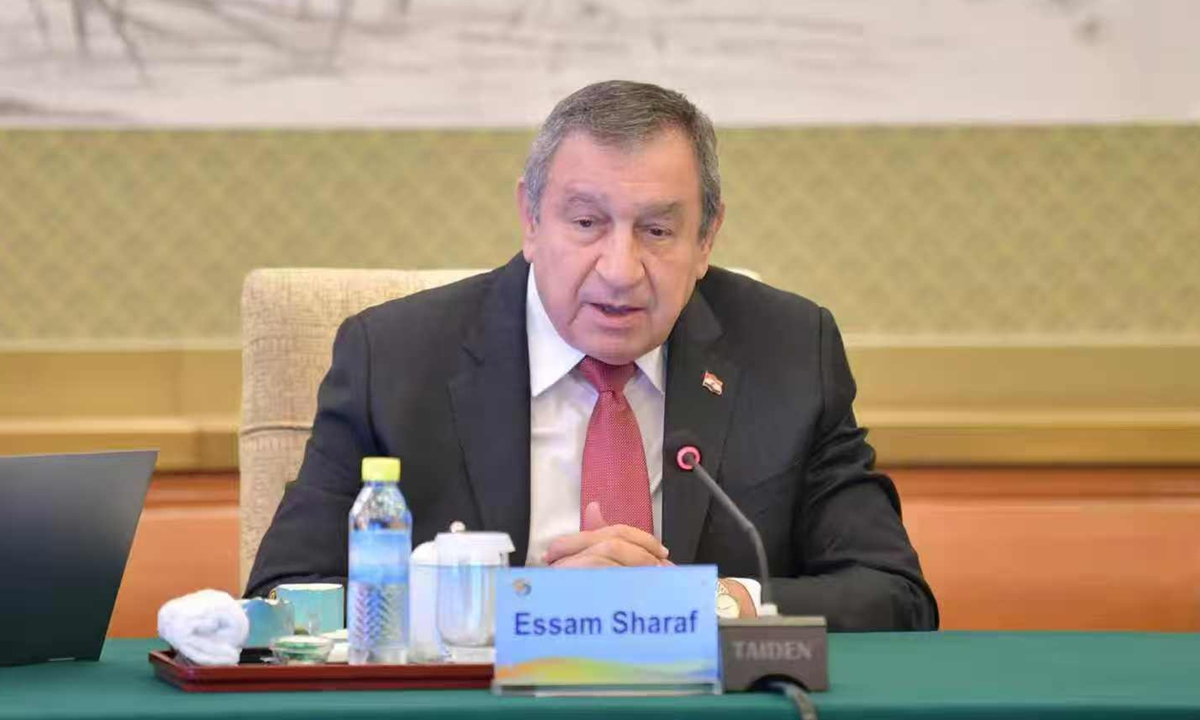
Former Egyptian prime minister Essam Sharaf Photo: Courtesy of Sharaf
At present, global governance is facing a significant action deficit across multiple areas — climate, security, development, and technology — most notably reflected in the difficulty of turning consensus into practical measures and the clear gap between commitments and implementation. In September 2025, China put forward the Global Governance Initiative (GGI), of which one core principle is an emphasis on being action-oriented. In a recent interview with Global Times reporters Xie Wenting and Chen Zishuai (GT), former Egyptian prime minister Essam Sharaf (Sharaf) said the current international situation is fragile and the world urgently needs such an initiative. What is most valuable is that the GGI focuses on actions that can bring change, which will strengthen capacity-building and long-term governance effectiveness in the Global South and thereby help promote the rise of the Global South.GT: You once used the metaphor of "a building" to describe international relations, advocating that countries should strengthen interconnection and build mutual trust to avoid the "risk of collapse." Given the current global environment, do you think such a "risk of collapse" exists? What should we do to prevent such a collapse?
Sharaf: The international situation is very fragile. Geopolitical tensions and mutual mistrust persist, and weak multilateral institutions have further undermined global stability. This is precisely what the Global Governance Initiative (GGI) is designed to address. That is why the initiative is timely in responding to the fragile international environment: The world is confronting growing isolationism and fragmentation.
GT: As the world is confronting isolationism and fragmentation, China has been advocating solidarity and multilateralism. Chinese leader put forward the GGI in September 2025. As a senior statesman who has long focused on international governance and China-Egypt cooperation, what was your initial impression when you first heard about the GGI?
Sharaf: My first impression was a mixture of surprise and satisfaction. Actually, I wasn't really surprised; rather, I felt satisfied because it is a global governance initiative. It is timely amid fragmentation and uncertainty — the world is in urgent need of such an effort. To be honest, I expected such an initiative because I have been following the Chinese leader closely and appreciate his wisdom and carefulness regarding global affairs, especially his idea of "building community with a shared future for humanity." When you look at the principles of the GGI, they align exactly with that concept. So that's why, as I said, I wasn't surprised and I was happy.
I consider the GGI to complete the picture alongside other Chinese public goods initiatives — such as the Global Development Initiative, the Global Security Initiative, the Global Civilization Initiative, and the Belt and Road Initiative (BRI). I expected this because I felt the efforts behind all these initiatives needed a legal and governance framework. For that reason, the GGI is timely and much needed; the concept works.
GT: The GGI encompasses five core concepts: adhering to sovereign equality, abiding by the international rule of law, practicing multilateralism, advocating a people-centered approach, and focusing on taking real action. In your opinion, what is the inherent logical connection among these five concepts? And what significance do they have for addressing the current deficit in global governance?
Sharaf: Let me first say that the GGI was created to address several deficiencies. The first is the underrepresentation of the Global South, which comprises roughly 85 percent of the world's population and has long experienced colonization and resource exploitation. The second deficiency is that international institutions are suffering erosion: Their influence is weakening and they lack the capacity to effect meaningful change. The third deficiency is their current inability to meet the requirements of the 2030 Sustainable Development Goals.
To overcome these deficiencies, I propose regrouping the initiative's five concepts into three programmatic groups. The first group includes concepts one and two; their purpose is to build trust in global institutions. The second group contains concept three, which aims to counter fragmentation and rising geopolitical confrontation — multilateralism is a core element of this concept. The third group comprises concepts four and five, and is intended to address systemic gaps and provide practical solutions to global challenges.
These global challenges are fundamentally about people and their development, especially in Global South countries. A people-centered approach and concrete actions will benefit the entire world, and in particular, developing countries in the Global South.
GT: Currently, the implementation of the UN's 2030 Agenda for Sustainable Development is progressing slowly. Issues such as climate change and regional conflicts are also difficult to mitigate due to insufficient implementation efforts. How do you understand the concept of "focusing on taking real actions" proposed in the GGI? Why can it become the key to advancing the practical implementation of global governance?
Sharaf: This issue comes from a system perspective — specifically a results-based system approach. That means the real measure is whether we achieve tangible actions that lead to change. When there are real actions that lead to positive results, they demonstrate the system's effectiveness, because its response is not just talk or empty gestures. It is work and activity that produce concrete outcomes rather than speeches.
Therefore, the most important step is to reshape existing institutions so they can take real action. Currently, international institutions suffer from endless meetings and an inability to change. If we are to move toward real results, we must reform national and global institutions so they become capable of taking effective, tangible action.
GT: What significance does the GGI hold for Global South countries? What impact will it have in terms of actionable practices?
Sharaf: Generally, when we talk about the Global South, as I said before, we are referring to roughly 85 percent of the world's population. Historically, the Global South has been underrepresented. The GGI calls for greater innovation and representation. Actionable practices will first strengthen Global South countries' capacity-building and long-term governance effectiveness. This is a continuation of the previous discussion.
Improved capacity and governance will create more opportunities for development and resolving conflicts through dialogue. Preparing Global South countries for peaceful coexistence will foster regional development and, ultimately, stronger, more influential regions — and hence a more powerful Global South.
GT: In practicing the action-oriented principle, China has taken many concrete measures, such as promoting high-quality cooperation under the BRI, facilitating reconciliation between Saudi Arabia and Iran, and establishing the International Organization for Mediation. How do you evaluate the practical role of these Chinese efforts in promoting global governance?
Sharaf: The three measures you mentioned are related to the noble goal of peaceful development. First, the dialogue-based conflict resolution is an example of promoting regional peace. The other measure related to the International Organization for Mediation is an example of creating a mechanism for dialogue-based conflict resolution.
At the same time, this peaceful mechanism complements initiatives like the BRI. The BRI is the largest platform for international and regional cooperation through connectivity. By connectivity we mean hard, soft, and institutional links. This initiative can deliver high-quality global and regional development.
These initiatives provide development schemes that cannot be implemented or have a significant effect without peace. That is why the two points about peace are essential: Peace enables bilateral and multilateral development projects; without peace, development cannot succeed.
GT: As a senior statesman who has long been committed to promoting international cooperation, what expectations do you have for countries to work together to implement the GGI and build a community with a shared future for humanity? Could you put forward some specific suggestions for the promotion of this initiative?
Sharaf: I believe that developing countries — the Global South — have learned that a lack of cooperation among themselves has delayed their development and prosperity. This is a fact. Developing countries must recognize that if they continue in the same way, they will not achieve development and prosperity. Therefore, I expect Global South countries to benefit from the GGI by first embracing multilateralism and rejecting bloc politics (geopolitical blocs). They should avoid aligning themselves with political blocs; this is crucial.
Second, countries in the Global South should adopt locally based, regional conflict-resolution mechanisms rather than copying approaches from the Global North. The Global North sometimes has interests that can create or exacerbate hot spots; different countries and regions should rely on locally rooted conflict-resolution processes to achieve a higher level of peaceful coexistence.
Third, countries themselves should pursue a people-centered development approach. It is surprising that some development plans remain capital-centered and produce low development outcomes. A people-centered approach will make countries stronger, more resilient, and better able to sustain development efforts.
GT: How do you predict the development of global order in 2026? Will the Global South play a bigger role on the global stage?
Sharaf: Now I can say that countries in the Global South have learned the value of cooperating with one another and solving their problems together. They have long been dominated by the Global North. I believe that in the very near future, the Global South will and should take action to resolve its own problems and strengthen regional cooperation. You can already see what I call a process of rationalization within some regions: Countries working together more efficiently.
Global South countries should cooperate and pursue the best possible conflict-resolution mechanisms. This cooperation will foster peace, and peace will in turn lead to development.
RELATED ARTICLES