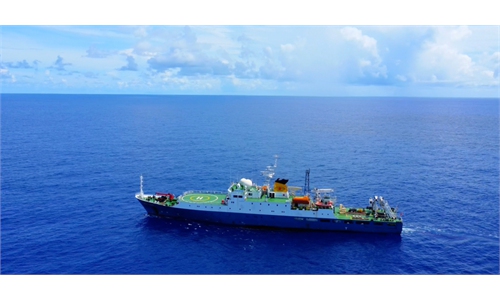
China and Chile undertake first joint marine research on 435-mile stretch of Atacama Trench
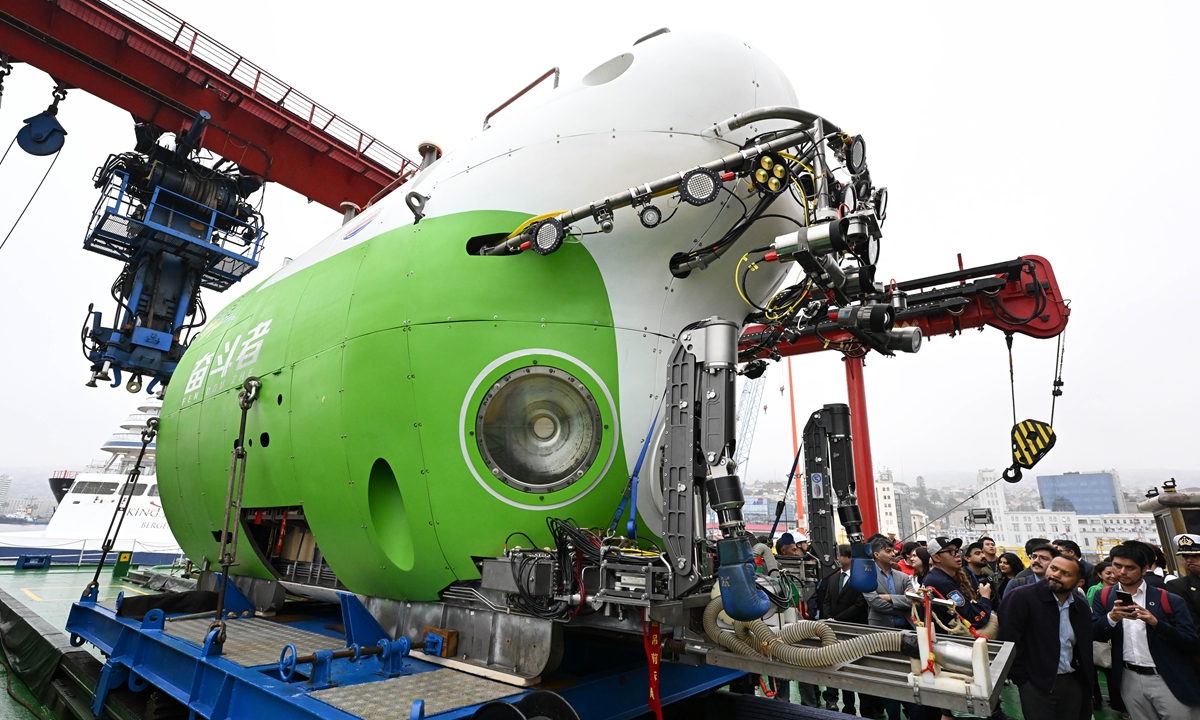
People visit the Chinese research vessel Tan Suo Yi Hao that is docked at Valparaiso Port in central Chile on local time January 19,2026. The China-Chile joint scientifi c expedition to the Atacama Trench was launched at the port on the day. Photo: Xinhua
The expedition is jointly conducted by the Institute of Deep-sea Science and Engineering under the Chinese Academy of Sciences and the Millennium Institute of Oceanography at the University of Concepcion in Chile, with its launch ceremony convened at the Chilean port of Valparaíso on Monday, the Chinese Embassy in Chile reported on its official website.
More than 60 participants, including representatives from Chile's Ministry of Foreign Affairs, Ministry of Science and Technology, Academy of Sciences, Navy and the public, attended the event, the embassy said.
It aims to explore a 435-mile stretch of the Atacama Trench, a massive subduction zone in the eastern Pacific Ocean. At 6,000 kilometers long and roughly 8,000 meters deep, this underwater canyon is a place of extremes, the New York-based tech site Interesting Engineering reported.
Osvaldo Ulloa, Director of the Millennium Institute of Oceanography, said that this will be the second time in human history to descend to the Atacama Trench.
Onboard the vessel, the manned submersible Fendouzhe will dive into the deep-sea regions adjacent to the trench, Xinhua reported.
Du Mengran, leading researcher of this expedition, said during the ceremony that the vessel can reach a maximum diving depth of 10,000 meters. It is the world's only manned submersible capable of sustained operations at full ocean depth, providing us with a powerful tool for exploring the hadal zone below 6,000 meters, she added, per Xinhua.
This mission targets three key frontiers. First, it could help enhance global disaster prevention by studying the seismic belts that threaten Pacific nations with tsunamis. Second, it could solve climate puzzles by investigating the trench's role as a massive carbon "recycler." And lastly, hunting for rare molecules that could spark breakthroughs in biomedicine.
The three-month expedition is a high-stakes hunt for the geological triggers of tsunamis and earthquakes, and for the strange, sunless life forms that might hold the key to the next generation of medicine, the report said.
The embassy also noted that this joint expedition is the first major international collaboration under the UN-endorsed Global Hadal Exploration Programme, which is dedicated to exploring the unknown and illuminating the deepest realms of the world's oceans.
It is said to be the "largest" deep-sea operation ever conducted in the region, and is the culmination of a multi-year alliance that grants Chilean scientists exclusive access to advanced Chinese technology, Interesting Engineering reported.
Chinese Ambassador to Chile Niu Qingbao said during the launch ceremony that the China-Chile joint scientific expedition to the Atacama Trench marks the first joint marine scientific expedition between the two countries, serving as a milestone in scientific and technological cooperation and an example of "science knows no borders" and win-win collaboration.
Niu said that this year marks the 10th anniversary of the establishment of the China-Chile comprehensive strategic partnership. He noted that this joint scientific mission brings together top scientists from both countries tasked with expanding the boundaries of human knowledge and unraveling the mysteries of life.
Rodrigo González, the regional minister of Science, Technology, Knowledge, and Innovation for the Central Macrozone, described this cooperation as a "quantum leap."
He was quoted as saying that leveraging China's cutting-edge scientific capabilities and fostering constructive interaction is fundamental, even vital, for advancing knowledge exploration.
"The challenges facing our planet are increasingly complex, and only through interdisciplinary alliances can we find solutions that match the pace of these transformative demands," he said.
Global Times
RELATED ARTICLES