European leaders’ shift in their Davos addresses exposes Europe’s strategic anxiety
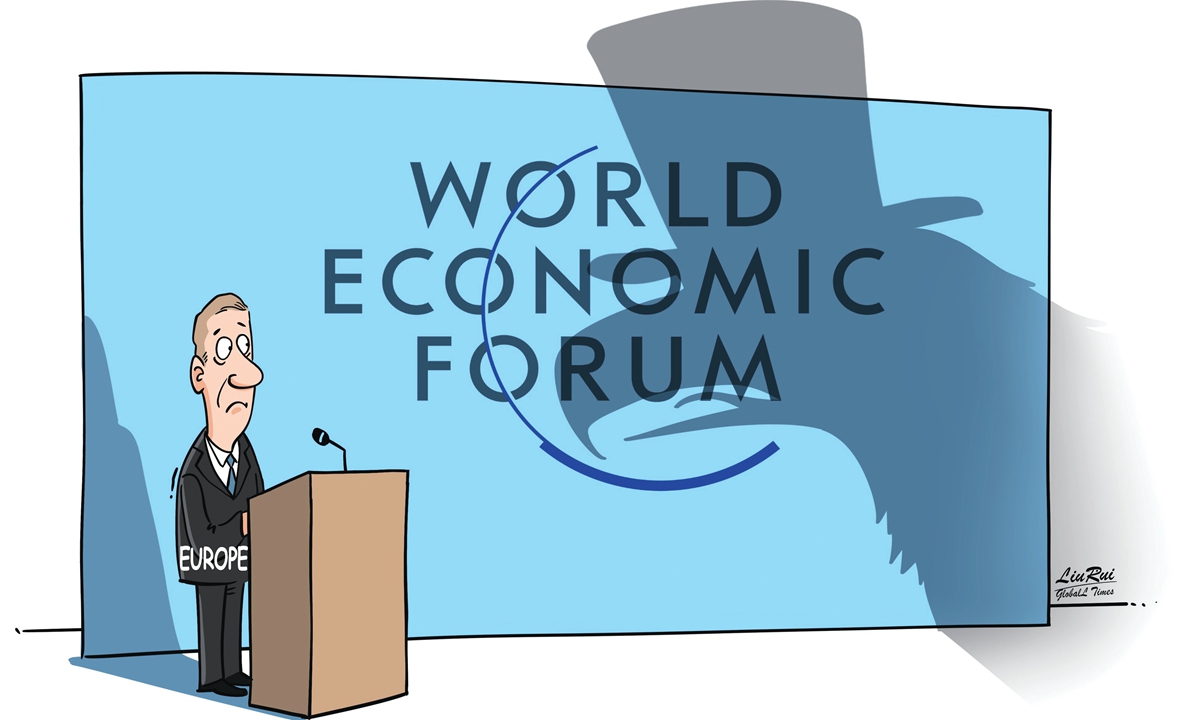
Illustration: Liu Rui/GT
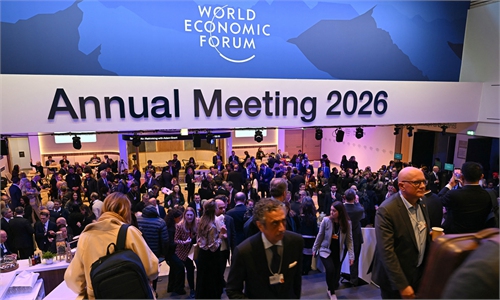
The World Economic Forum (WEF) annual meeting recently kicked off in the Swiss resort city of Davos. This year's forum took place amid rare transatlantic tensions triggered by the US intention to acquire Greenland. The focus of European leaders' speeches pivoted noticeably from global economic issues to geopolitics, reflecting Europe's deepening strategic anxiety amid structural contradictions with the US.
French President Emmanuel Macron said the EU should not bend to "the law of the strongest," while Belgium's Prime Minister Bart De Wever said the bloc was "at a crossroads" where it must decide on how to get out of a "very bad position" after trying to appease Trump. Even European Commission President Ursula von der Leyen highlighted the "geopolitical shocks" and "a dangerous downward spiral" brought by the US.
"The forum sends a clear political signal of Europe's growing strategic awakening," Zhao Junjie, a senior research fellow at the Institute of European Studies at the Chinese Academy of Social Sciences, told the Global Times on Wednesday.
The maximum pressure exerted by the US on the Greenland issue has shaken the long-standing value consensus between Europe and the US. Its unilateral and bullying actions have triggered strong fear and anxiety across Europe, which is a key reason for the heightened emotions and intense reactions toward the US among European representatives at this year's forum.
The statements made by European leaders at the forum appear to have demonstrated Europe's resolve to stand firm to the world. Yet it remains to be seen whether such firm commitments can be translated into practical, unified, and effective actions. As senior bankers and corporate executives at Davos noted, they believe the current responses of European leaders to the US are more emotional than pragmatic. Moreover, due to long-standing structural constraints - its deep entanglement with the US in security, energy, and economic affairs - Europe's response is weak and constrained. Zhao further noted that Europe still lacks systematic measures to effectively counter American unilateralism, with current efforts largely limited to soft multilateral mechanisms.
Europe's response to US unilateral pressures has been sluggish and lacking in internal coordination. The EU countries have not reached a consensus on the activation of Anti-Coercion Instrument. Meanwhile, Europe continues to grapple with "double standards" in its multilateral engagements. Despite the leaders' calls for trade diversification, restrictive market-access policies toward certain foreign products have fueled ongoing trade tensions. This contradiction is illustrated by Macron's appeal for Chinese investment in key sectors, even as the EU moves to phase out components and equipment from tech suppliers such as Huawei in some sectors - a policy that inevitably raises questions about Europe's consistency and sincerity in pursuing cooperative partnerships.
Canada has already taken action. Prime Minister Mark Carney stated that middle powers are not "powerless" facing "a rupture in the world order." He called for "honesty about the world as it is" and for building "something bigger, better, stronger, and more just." Recently, Canada established strategic partnerships with China and Qatar to promote the diversification of its foreign relations. Such strategic sobriety may offer some inspiration for Europe.
Ursula von der Leyen declared in her special address that "Europe will always choose the world, and the world is ready to choose Europe." Yet Europe must now answer a more pressing question: what path will it choose for itself in the changing global order?
The statements at Davos have sent a clear political signal of Europe's awakening. Moving forward, Europe must consolidate its strength through unity, steer its own course with greater autonomy, and expand its strategic space through diversification. Confronted with external pressures, only by reinforcing internal solidarity, advancing pragmatic actions, and broadening multilateral cooperation can Europe truly safeguard its own interests and uphold the international multilateral order. Only in this way can Europe genuinely protect its interests amid profound changes. History does not wait for the hesitant - it is time for Europe to act.
RELATED ARTICLES