QR code livestock tracking in Ethiopia shows rise of digital supply chains in developing countries

Illustration: Liu Rui/GT
In a rural village in Ethiopia, some sheep now carry ear tags embedded with QR codes. A simple scan reveals the animal's date of birth, vaccination record and other basic information. According to the People's Daily, a villager said that livestock enrolled in the system can sell at a 15 percent higher price, helping to boost household incomes. The QR code itself is physically small. The traceability system behind it, however, hints at changes in how international supply chains are increasingly organized, assessed and priced.In many developing countries, agricultural and livestock products are generally sufficient in quantity and quality. Increasingly, what matters is their visibility and credibility in global markets. New technologies, including the wider adoption of digital tools, can strengthen this recognition and help local products integrate more seamlessly into international supply chains.
According to the People's Daily, establishing a livestock traceability system for production and export in Ethiopia is part of a value-chain capacity-building project launched in 2021 by China, Ethiopia and the United Nations Industrial Development Organization. The project aims to promote the modernization of Ethiopia's livestock sector.
Livestock is an important component of Ethiopia's agricultural economy and a source of foreign exchange, mainly to markets in the Middle East and North Africa. According to media reports, unclear origins and the inability to trace production processes previously limited both the potential for higher prices and the scope of meat exports. Since the launch of the value-chain project, a system for livestock identification and traceability - covering breeding, transport and slaughter - has been gradually implemented and continuously refined, fostering a more scientific approach to livestock farming.
This effort provides a lens through which to observe a subtle but meaningful development in global supply chains. As digital technologies spread through production networks, they create what might be called "digital interfaces," enabling goods to be tracked, verified, and linked to global supply chains through their digital information. Cross-border e-commerce, digitized logistics, and enterprise-level supply chain management are all part of this expanding digital layout, gradually shaping how products are monitored, traded, and valued internationally.
This development is not limited to high-end manufacturing or large multinational corporations. As digital technologies become more widespread and their costs gradually decline, traditional industries in developing countries - including rural agriculture and livestock - are increasingly integrated into the digital ecosystem through QR codes, databases, and information platforms. For many of these countries, the rapid pace of digitalization presents both new challenges and significant opportunities.
Beyond individual case studies, a range of digital technologies is increasingly being deployed across global supply chains. Tools such as artificial intelligence (AI), the Internet of Things, blockchain and big data are enabling more precise tracking, lowering transaction costs, streamlining logistics, and improving resilience to disruptions.
Against this backdrop, technology cooperation between China and other developing countries is expanding. China's rapid advances in AI and digital infrastructure, combined with the continuing global demand for agricultural and logistics solutions, make digital trade and technological cooperation a promising avenue for economic growth and mutually beneficial collaboration across the Global South.
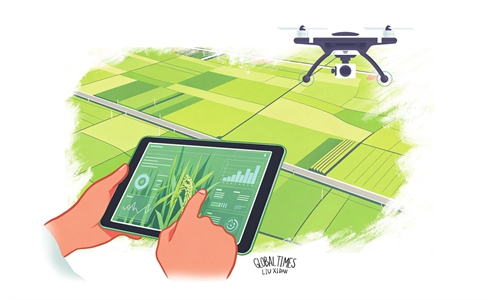
In recent years, China has supported Africa's agricultural digital transformation through pragmatic cooperation, achieving results across multiple sectors. In May 2025, China International Development Cooperation Agency and the United Nations International Fund for Agricultural Development signed an agreement to jointly support the Leveraging Satellite-based Digital Solutions for Climate-Resilient Agriculture in Tanzania Project.
This is the first project under the Global Development and South-South Cooperation Fund jointly undertaken by both parties, aiming to enhance Tanzania's agricultural productivity and climate resilience through accessible, affordable, and actionable satellite information and communication technologies. The project will directly benefit 5,000 smallholder farmers and indirectly reach up to 1 million farmers across Tanzania.
There is still significant scope for this type of cooperation to expand and bolster local economic growth in developing countries. A study by the United Nations Food and Agriculture Organization indicated that if African countries broadly implemented such digital solutions, food production on the continent could increase by more than 40 percent over the next decade, according to the People's Daily.
Returning to the story of livestock traceability in Ethiopia, it's an example of how targeted digital technologies can ripple through local economies and integrate into global supply chains. As these technologies continue to evolve and diffuse, they have the potential to drive further innovation in trade, transparency, and economic opportunity across developing countries.
The author is a reporter with the Global Times. bizopinion@globaltimes.com.cn
RELATED ARTICLES