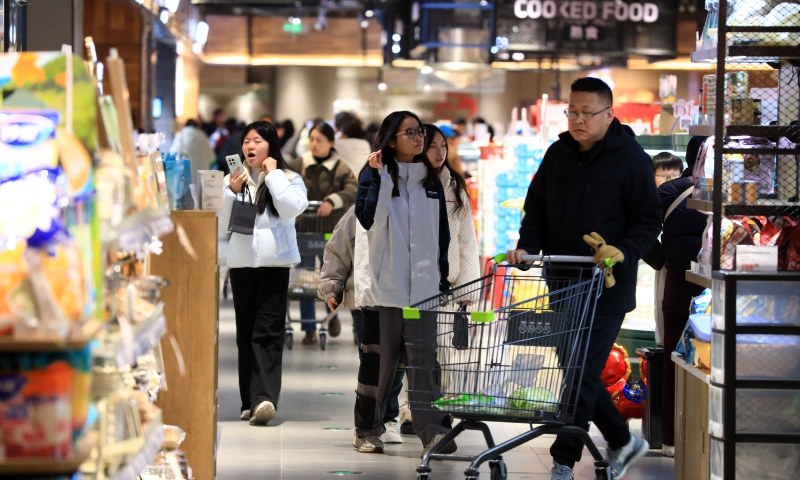
Consumers shop at the food section of a supermarket in Huaian, East China's Jiangsu Province, on December 31, 2025. Photo: VCG
Amid rising global economic uncertainty, China delivered a stable performance in 2025, with the economy expanding by 5 percent year-on-year, according to data released by the National Bureau of Statistics on Monday.As 2026 marks the opening year of the 15th Five-Year Plan, the government is prioritizing domestic-demand-led growth. The Central Economic Work Conference in December last year listed building a robust domestic market as the top task among eight key policy objectives for the year.
At the start of the year, a series of policies aimed at boosting consumption and expanding domestic demand were rolled out.
The consumer goods trade-in program has been identified as a key policy lever.
The National Development and Reform Commission, the Ministry of Finance, and other departments issued a framework that extends subsidies for vehicle scrappage and replacement and expands support to home appliances, digital products and smart products.
Vehicle scrappage subsidies can reach up to 20,000 yuan ($2,871.95), and replacement subsidies up to 15,000 yuan, now linked to the price of new vehicles rather than flat amounts, aimed at steering consumers toward new-energy and higher-tech models.
To support implementation, the Ministry of Finance has advanced approximately 62.5 billion yuan in proceeds from ultra-long special bond funds to local authorities.
Chandrasekhar Saratchand, a professor at the University of Delhi in India, noted that shifting growth drivers more toward the domestic market is a reasonable choice to enhance economic resilience amid rising external uncertainties.
"Consumption subsidies can directly stimulate household spending in the short term, and by guiding green and upgrade-oriented consumption, they help form more stable demand expectations for advanced manufacturing. This is of positive significance for medium- to long-term structural adjustment of the economy," he said.
Early indicators suggest positive consumer responses. In Hebei, home appliance and smart product sales totaled 590 million yuan over a two-day period in early January. In Ningxia, over 7,600 applications were submitted in the first round of the auto trade-in program, with thousands of applicants selected by lottery, generating 31.9 million yuan in consumption.
Beyond subsidies, China is fostering new consumption scenarios. The "Shopping in China" campaign launched the 2026 Online Chinese New Year's Shopping Festival on Monday, running through early March and integrating Spring Festival demand with cross-border e-commerce. Last year, daily online retail sales during the festival rose 6.2 percent year-on-year, making it a key barometer for annual consumption trends.
Analysts say these measures aim not only to stabilize growth but also to accelerate structural upgrades in consumption and industry.
Invesco Asia-Pacific Global Market Strategist Zhao Yaoting said that despite external trade uncertainties, China's economy is likely to sustain roughly 5 percent growth in 2026, supported by pro-investment initiatives and domestic-demand policies.
The author is a reporter with International Financial News. opinion@globaltimes.com.cn
RELATED ARTICLES