Trump reportedly drops Greenland tariff threat with claim of ‘framework’; ultimate outcome remains uncertain: Chinese expert
By Feng Fan and Published: Jan 22, 2026 01:42 PM

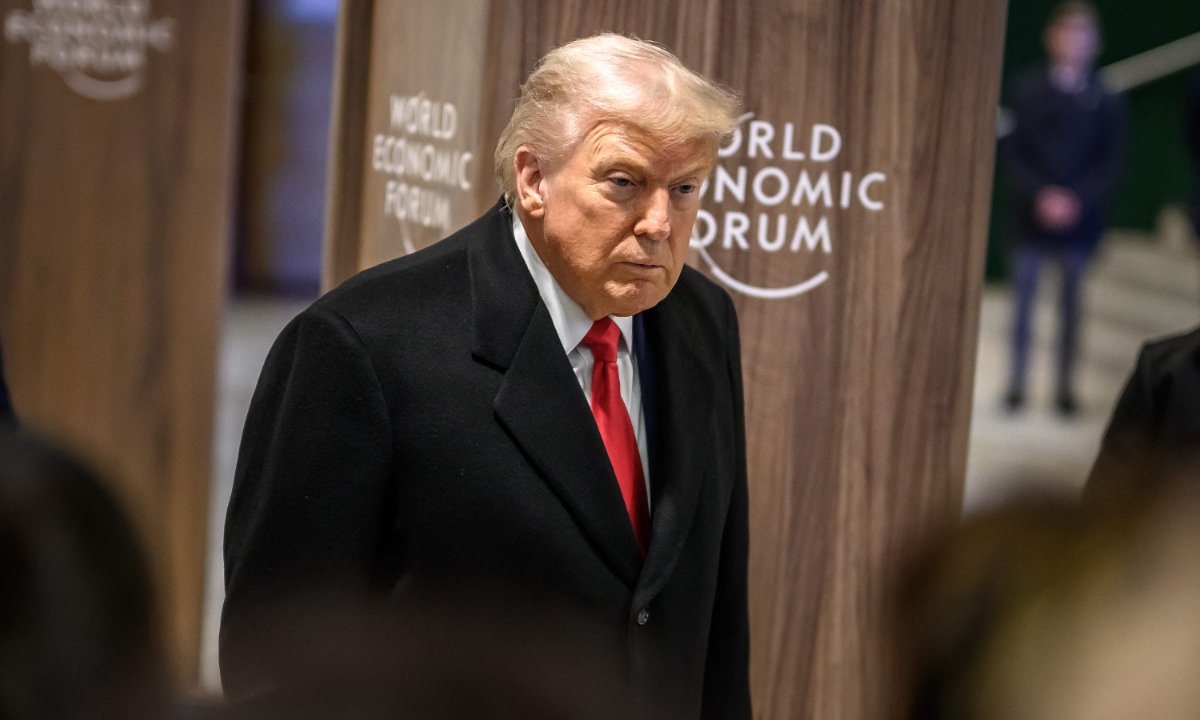
US President Donald Trump addresses the media during the World Economic Forum annual meeting in Davos on January 21, 2026. Photo: VCG
US President Donald Trump has announced that he would not impose tariffs he had threatened to impose on eight European nations that had been set to take effect on February 1 unless those nations allowed the US to take control of Greenland, according to multiple media reports.
Previously, Trump had threatened the eight countries with an additional 10 percent tariff on exports to the US starting February 1, if they did not abandon opposition to the US acquisition of Greenland from Denmark. The tariff rate would have increased to 25 percent on June 1 had they remained firm, according to The New York Times.
In a social media post on Wednesday, Trump claimed that based upon a meeting he had with Mark Rutte, Secretary General of NATO, they have "formed the framework of a future deal with respect to Greenland and, in fact, the entire Arctic Region." He added that "based upon this understanding, I will not be imposing the Tariffs that were scheduled to go into effect on February 1st."
The eight European countries threatened with the tariffs are Denmark, Norway, Sweden, France, Germany, the UK, the Netherlands and Finland. As of press time on Thursday, reports in major Western media outlets showed only Denmark had responded to the US president's latest decision.
The Danish government welcomed the news, according to NBC News. "The day is ending on a better note than it began," Demark's foreign minister Lars Løkke Rasmussen was quoted by NBC News as saying. "We welcome that President Trump has ruled out to take Greenland by force and paused the trade war with Europe."
Notably, hours before Trump's announcement, the European Union's parliament halted final approval of a critical trade deal that Trump reached with the bloc last summer. EU leaders were also scheduled to hold an emergency summit Thursday to coordinate a response to Trump's threats, according to NBC News.
Chinese experts said that while the announcement appeared to remove the immediate risk of a trade war with Europe over Greenland, Trump's recent claims may have already left European leaders deeply disillusioned with the US, and risks and tensions will likely persist as whether a deal acceptable to all parties could realistically be reached remains to be seen.
Trump's threat to put tariffs on European countries over Greenland was likely a negotiating tactic and a form of leverage against Europe, and the decision to withdraw the tariffs may have reflected a calculation that such measures would do more harm than good to the US, Li Haidong, a professor at China Foreign Affairs University, told the Global Times on Thursday.
But even with the tariffs shelved, Europe has already been thoroughly disappointed with the US, Li said.
Hours before climbing down on tariffs, during a rambling speech in Davos, Trump said the US would not use force to seize Greenland, but stressed that he still planned to wield his nation's economic and diplomatic power to obtain it - and extolled the benefits of US tariffs, The Guardian reported.
Some European leaders criticized the speech. Swedish Prime Minister Ulf Kristersson said Wednesday that Trump's speech in Davos was "unjust in every conceivable way," accusing him of using threatening and scornful rhetoric against Denmark and other partners, according to Xinhua News Agency.
Speaking at a press conference in Davos, Kristersson said that while he welcomed Trump's public statement ruling out military force over Greenland, he remained disappointed by the overall tone and substance of the remarks, Xinhua reported on Thursday.
Lü Xiang, a research fellow at the Chinese Academy of Social Sciences, pointed out that there remain differences over the Greenland issue between the US and Europe.
Although the US president claimed to have reached a framework with Rutte, the move does not likely represent NATO's final position, and his statements appeared to have assumed that the Danish government and Europe as a whole would eventually accept his proposal, Lü told the Global Times.
Rutte said he had not discussed the key issue of Danish sovereignty over Greenland during his meeting with Trump. He told Fox News that the "issue did not come up anymore in my conversations tonight with the president."
The BBC reported that after rattling the transatlantic alliance with weeks of rhetoric, the US president said the discussion had led to the "framework" of a potential agreement. But there was no suggestion of a deal that might meet Trump's demand for "ownership" of Greenland, per the BBC.
The Associated Press described Trump's decision to halt the tariffs as "pulling a dramatic reversal," noting that Trump offered few details about his Greenland plan. AP reported that one compromise idea discussed among NATO members involved Denmark and the alliance working with the US to build more US military bases on Greenland, citing an anonymous European official who said it was not immediately clear whether that idea was included in the framework Trump claimed.
The Danish Foreign Minister also added: "Now, let's sit down and find out how we can address the American security concerns in the Arctic while respecting the red lines of the Kingdom of Denmark," according to the BBC.
"The ultimate outcome remains uncertain," Lü said, noting that there remain questions over the claim of a negotiated breakthrough in the Greenland issue.
RELATED ARTICLES