High-tech equipment used across China to ensure power supply and production in snow and ice
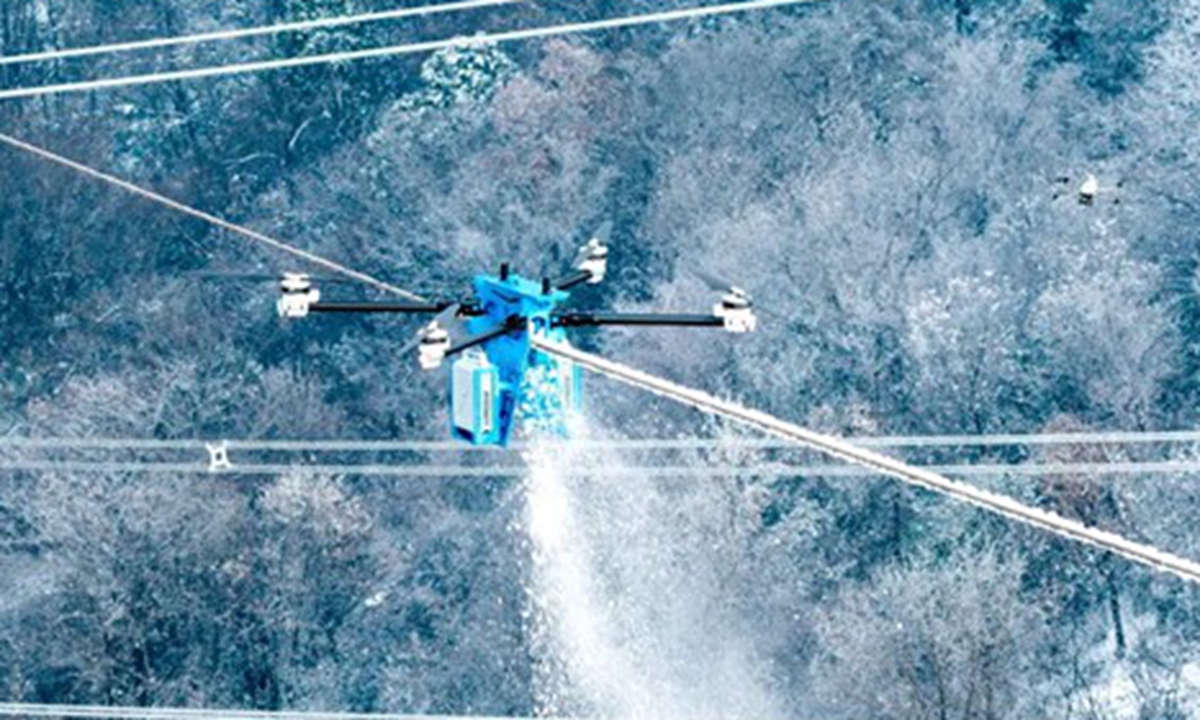
A drone cleans ice from cables of transmission towers in Wuhan, Central China's Hubei Province on January 21, 2026. Photo:Courtesy of State Grid Corporation of China
Drones, de-icing robots and other high-tech equipment are being widely deployed across China to help ensure stable power supply and production safety as a strong cold wave brings snow and freezing conditions to many regions.
On Wednesday, an integrated operation combining "drone delivery and intelligent de-icing robots" was used for the first time on sections of the 35-kilovolt Songping transmission line in Shennongjia of Wuhan in Central China's Hubei Province, operated by State Grid Corporation of China. The operation cleared key ice-covered sections on four transmission towers in just one hour and 30 minutes, providing strong technological support for the stable operation of the power grid.
Earlier, a 500-kilovolt DC ice-melting system at the Guanshan mountain substation in East China's Anhui Province, also operated by State Grid, was urgently activated. The device melted ice on transmission lines through resistive heating generated by electric current.
In Southwest China's Sichuan Province, power operators adopted a combination of heavy-lift drones, de-icing robots and DC ice-melting technologies to precisely tackle line icing. A total of 706 online icing monitoring devices have been deployed in heavily iced areas across the province, and 57 regional icing observation stations have been established, according to a report from people.cn. These measures have provided full coverage of icing-prone sections on transmission lines of 110 kilovolts and above, offering solid data support for scientific ice prevention and power protection.
Beyond the power sector, drones have also been deployed to safeguard agricultural production in snow-hit regions.
Xiaoxian County in Anhui Province was blanketed by heavy snowfall, with total precipitation reaching 12.9 millimeters and maximum snow depth measuring 11 centimeters, reported China National Radio on Wednesday. To protect agricultural facilities, local authorities employed drones and other technological means to remove snow and ice from greenhouses.
At a family farm's fruit and vegetable base in Xiaoxian, rows of greenhouses were covered by thick snow, increasing structural load and raising the risk of collapse. To ensure greenhouses' safety and allow vegetables to reach the market on schedule, agricultural technicians deployed drones to spray salt and detergent over the greenhouse roofs. After about one hour of flight operations, snow accumulation on some greenhouses was effectively reduced.
Li Fengsheng, a drone operator working at the base, told the Global Times on Thursday that demand for drone-based snow removal has surged not only in Xiaoxian but also across parts of Jiangsu, Hubei and Henan provinces as widespread snow and freezing rain hit southern China.
"From Tuesday night until now, my phone hasn't stopped ringing. I've taken more than 30 orders and still can't keep up," Li said.
He explained that there are currently three main technical approaches to drone snow removal. The first is to use rotor downwash to blow snow away, which is the most common and cost-effective method, suitable for 5 to 10 centimeters of fresh snow. The second is to install snow-blowing equipment onto drones, ideal for thicker or wetter snow exceeding 15 centimeters. The third one involves spraying de-icing agents to chemically melt ice, mainly used in already frozen conditions.
Sun Xu, head of the design section at Senyuan Company in Anshan, Northeast China's Liaoning Province, told the Global Times that the firm's newly developed intelligent unmanned snow and ice removal robot is turning the concept of "unmanned snow clearing" into reality. The robot integrates cameras, LiDAR, GPS and other sensing and positioning systems, enabling continuous operation in temperatures ranging from minus 30 C to 70 C. Its applications cover high-speed rail station plazas, highway service areas and large industrial parks.
In Wuhan, relevant departments have also introduced smart equipment to protect frontline workers responding to the cold wave. BeiDou navigation smart helmets, intelligent heated vests with automatic temperature adjustment, and drones have been put into use to support snow and ice removal operations.
Zhang Na, a company representative, delivered 33 sets of smart heated vests developed by her firm to sanitation workers at a worksite in Qingshan district, Wuhan on Tuesday. The lightweight vests feature built-in heating systems powered by ordinary power banks and can warm up within 10 seconds. With three temperature settings ranging from 30 C to 50 C, the vests automatically adjust heat output based on body temperature through built-in sensors.
Using nano-materials and infrared heating, the vests have passed safety tests. Sanitation workers who tried them on said the vests heated up quickly, were light and did not hinder movement, making them highly practical in extreme cold.
RELATED ARTICLES