Beijing exhibition highlights rapid growth, global reach of China’s commercial space sector
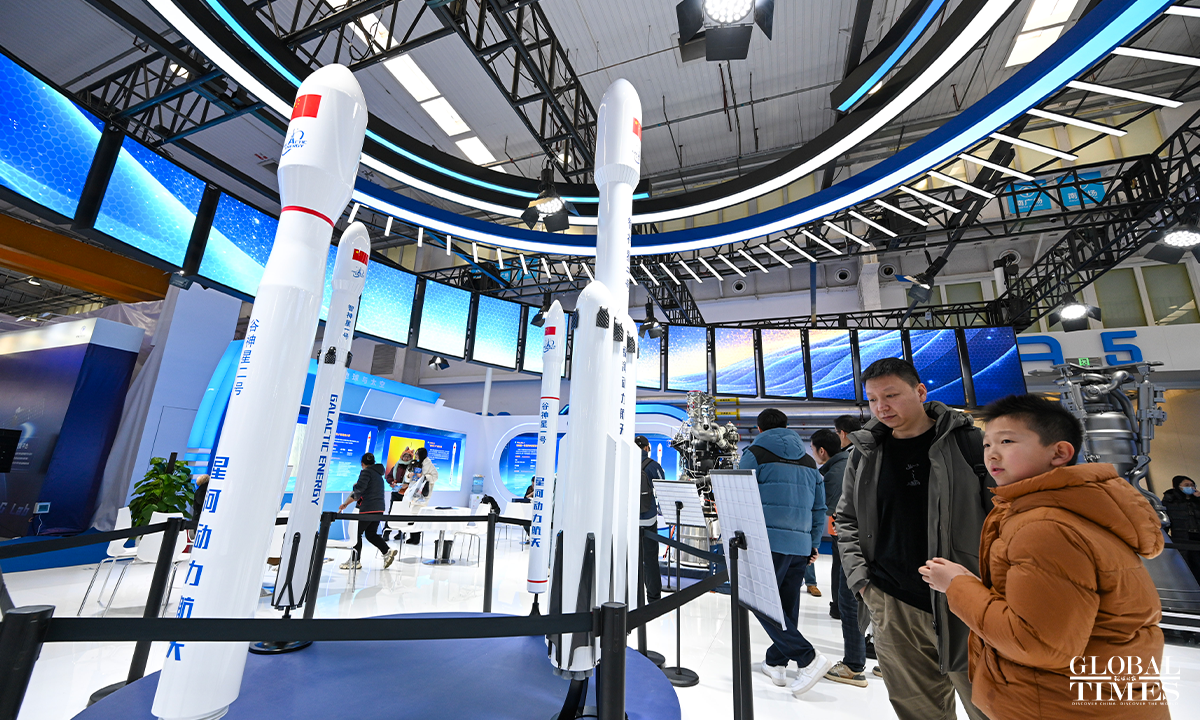
Photo: Chen Tao/GT
Diplomatic representatives from Argentina, Peru, Canada and other countries stationed in China also showed strong interest and active engagement, highlighting the growing international attention surrounding China's rapidly expanding commercial space industry.
Held under the theme "Gathering Global Resources to Promote the Development of Commercial Aerospace," the exhibition brought together more than 300 commercial aerospace enterprises and industry-chain institutions from China and abroad.
Spanning an exhibition area of about 20,000 square meters, the event covered the full industrial chain, including launch vehicles, satellite manufacturing, space applications, aerospace services and supporting facilities, as well as aerospace investment and financial services.
Several of China's most closely watched commercial space companies made prominent appearances. LandSpace showcased a model of the improved version of Zhuque-2 carrier rocket — the world's first methane-propelled rocket to successfully fly into orbit — as well as the Zhuque-3 model, which has already completed China's first orbital-stage reusable rocket launch verification in the commercial space sector.
At the exhibition site, Galactic Energy displayed a range of launch vehicles, including its Pallas series orbit-capable, reusable liquid-fueled rockets and the Ceres series solid propellant launch vehicles.
Galactic Energy aims to use the exhibition to present its latest rocket products and engines while engaging with suppliers and potential customers, Wu Yue, a representative of the company, told the Global Times. She said the showcased "Pallas" rocket is scheduled for its maiden flight this year, while the "Ceres" series has already completed main engine tests and is preparing for its first launch.
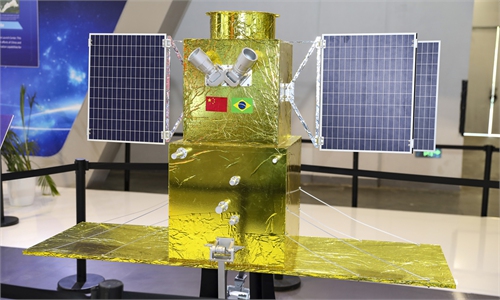
In the field of space applications and exploration, GalaxySpace presented Lingxi-03, China's first flat-panel satellite equipped with flexible solar wings, as well as a model of its satellite equipped with advanced phased array, demonstrating frontier breakthroughs in satellite internet technology.
Geovis Technology Co., Ltd. showcased its digital Earth platform, which integrates artificial intelligence and big data to build a comprehensive system covering data, computing and applications, advancing the intelligent development of space-air-ground information services.
"Our main purpose for joining the exhibition is to further promote our new products, position ourselves as a leading commercial company in the satellite industry, and meet with existing partners—many of whom are attending today's event, including some from overseas," Huang Heping, general manager of international business development at GalaxySpace, told the Global Times at the exhibition.
Participating companies also discussed international market expansion and new directions under China's upcoming 15th Five-Year Plan (2026-30). Hao Xuetao, vice president of Geovis Technology and general manager of its commercial aerospace strategy department, told the Global Times that while the company's core business focuses on satellite applications and digital Earth technologies—serving sectors such as agriculture, forestry, water resources, urban management and broadband—it is further expanding into geographic information satellite applications, commercial aerospace products and low-altitude economy during the 15th Five-Year Plan period, with plans to accelerate internationalization.
"We brought a model of our flat-panel communication satellite, which is being developed to provide internet access via satellites in space," Huang from GalaxySpace said. "We plan to deploy such satellites and cooperate with global partners for telecom services."
He added that during the exhibition he had met visitors from Kazakhstan representing a leading local company and would soon meet a partner from Thailand.
International exhibitors also underscored China's appeal as a hub for innovation and collaboration. Adrian Totu, owner and CEO of Romanian company Mazarom Impex SRL, told the Global Times that he traveled from Romania to Beijing to exhibit his company's newly developed satellite structure. Compared with traditional CubeSats, the structure offers a significantly smaller volume.
"This is a concept I want to share and promote in China, as China has so many companies and so many people who can develop and be involved in this project," Totu said, adding that he hopes more Chinese companies and students can participate in the research and development.
"China is the future," Totu said when asked why he chose China to promote his product. "I'm from a small country; we don't have such power like here. Maybe I could also develop this in Europe, but China is very fast. If a new product can be developed in China in a month, in Europe it may take a year."
China's commercial space sector is expanding at a rapid pace. According to information previously released by the China National Space Administration and cited by the People's Daily, China's commercial space industry maintained strong momentum in 2025, completing 50 launches throughout the year—accounting for 54 percent of the country's total space launches.
These included 25 commercial launch vehicle missions, nine launches from the Hainan commercial spacecraft launch site after it entered operation, and 16 launches of other commercial satellites. A total of 311 commercial satellites were placed into orbit, representing 84 percent of all satellites launched by China in 2025.
"I believe commercial space will see robust growth during the 15th Five-Year Plan period," Hao said. "Our country places great importance on commercial space as a new productive force and has provided strong support. Relevant government departments and ministries are assisting us from scientific research, capacity building, as well as qualification and standards perspectives."
RELATED ARTICLES