Nvidia CEO Jensen Huang visits Shanghai wet market, attends company’s annual event; experts link trip to H200 outreach in China
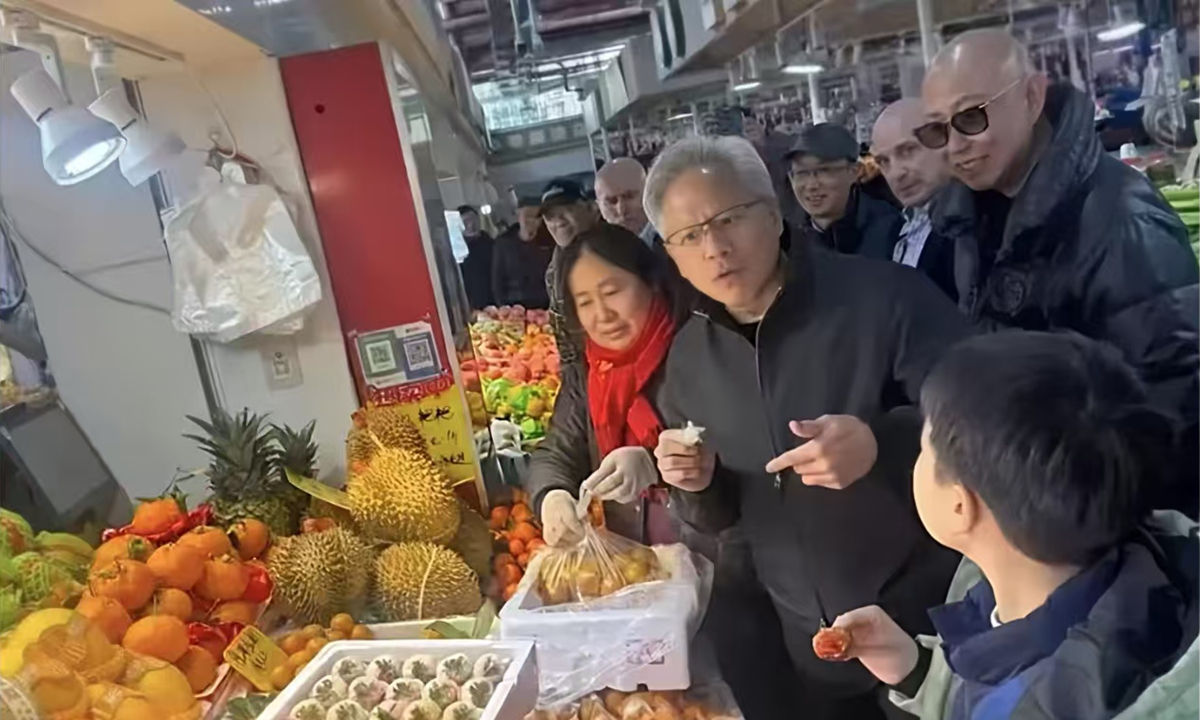
Nvidia CEO Jensen Huang (second from left) visits a local wet market in Shanghai on January 24, 2026. Photo: Screenshot of ThePaper.cn's report
Nvidia CEO Jensen Huang was spotted by many local residents after arriving in Shanghai on Friday, according to ThePaper.cn, as the US chip giant faces fierce competition from local rivals. Chinese experts said Huang's visit is aimed at projecting a "China-friendly" image and boosting morale among local employees, while also seeking to engage Chinese authorities and key clients in an effort to secure large buyers capable of making prompt payments for H200 chips.
On Saturday, Huang was seen visiting the Rushan Road local vegetable market in Shanghai's Lujiazui area, where he sampled and bought fruits and handed out New Year red envelopes to several vendors, according to ThePaper.cn.
Huang attended an Nvidia event on Saturday, according to posts by some users on Chinese lifestyle-sharing platform Xiaohongshu, who claimed the oranges he bought at a local wet market were intended to be handed out to employees at the company's annual gathering.
Ma Jihua, a veteran industry observer, told the Global Times that that Huang's increasingly frequent visits to China in recent years — whether wearing traditional Chinese attire or visiting local markets — reflect a carefully calibrated form of expression aimed at conveying a more China-friendly image while navigating political sensitivities in the US, a practice also seen in visits by other US technology executives.
Ma added that Huang's latest trip is widely viewed as an effort to engage Chinese authorities and key customers, with the aim of identifying large buyers able to move forward quickly on purchases of H200 chips.
After his Shanghai trip, Huang is set to travel to Beijing, Shenzhen and the island of Taiwan, according to Reuters, citing a person familiar with the issue.
Huang traveled to China at least three times in 2025 and met with China's Commerce Minister Wang Wentao in July, and returned again at the start of 2026. Experts said his repeated visits highlight the importance he places on the Chinese market and his hope to maintain stable and constructive trade engagement with China.
Zhou Mi, a senior researcher at the Chinese Academy of International Trade and Economic Cooperation, told the Global Times that Huang's visits to China around Nvidia's New Year events have become a routine, especially as Nvidia's position has grown more sensitive amid a complex external environment. Huang has repeatedly signaled his desire to stay engaged with the China market. Zhou noted that this trip is primarily aimed at boosting morale within Nvidia's China team, reassuring staff and partners, and gathering first-hand feedback on market demand to help guide the company's future development.
Zhou added that the H200 chip is another key issue, as China has compliance and security concerns that Nvidia needs to address. He said that strong computing performance alone is not enough if related risks remain unresolved, and that meeting regulatory and compliance requirements is essential. Given the strong appeal of the China market, how Nvidia responds to these concerns will be critical to its ability to pursue stable, long-term development in China.
The US administration earlier this month cleared sales of Nvidia's H200 chips, one of its most advanced products, while taking a 25 percent government cut from those sales, according to the BBC.
However, due to the deeply rooted anxiety held by some US politicians about China's progress in high-tech sectors, the US has displayed a contradictory approach toward exports of high-end chips to China.
On Wednesday, a US House committee focused on foreign affairs approved bipartisan legislation calling for arms-sale-style Congressional oversight of advanced artificial intelligence (AI) chip exports, Bloomberg reported.
According to Bloomberg, under the legislation, the administration would be required to notify Congress of advanced AI chip sales before they are approved, giving lawmakers the power to review and block export licenses to China, Russia, Iran and other so-called adversaries through a joint resolution.
On January 15, in response to a question regarding US President Donald Trump's earlier statement that the US government would approve Nvidia H200 AI chip sales to China and would collect a roughly 25 percent fee on the chip sales, Chinese Foreign Ministry spokesperson Mao Ning said that China has repeatedly made its position clear on US chip exports to China and related tariff issues.
Commenting on reports that the Chinese government has told some technology companies it would approve purchases of H200 chips only under special circumstances, He Yongqian, a spokesperson for China's Ministry of Commerce, said on Thursday, "I am not aware of the situation you mentioned."
While China's semiconductor industry welcomes positive China-US exchanges in technological innovation and industrial development in line with both sides' regulations, it must remain highly vigilant regarding the US' erratic stance on exports of high-end chips, Wei Shaojun, a deputy head of the China Semiconductor Industry Association, told the Global Times in a recent exclusive interview.
Wei pointed out that the US' stance - alternately easing restrictions and applying pressure on high-end chips - makes it difficult for others to discern its true strategic intentions: Is the recent "relaxation" a genuine signal to promote positive interaction, or is it a new tactic aimed at disrupting our development pace and lulling us into complacency?
"China's semiconductor industry must remain highly vigilant toward this, resolutely refuse to be deceived by superficial appearances, and, even more importantly, must not waver in its confidence and determination to persist on the path of indigenous development in advanced process technologies and other key areas," Wei said.
China welcomes all foreign companies, including Nvidia, to deepen their presence in the Chinese market, but core concerns on China's side must also be addressed by Nvidia for cooperation to be sustainable, experts said.
RELATED ARTICLES