China’s stability message resonates following Davos as global media, analysts spotlight US-driven uncertainty
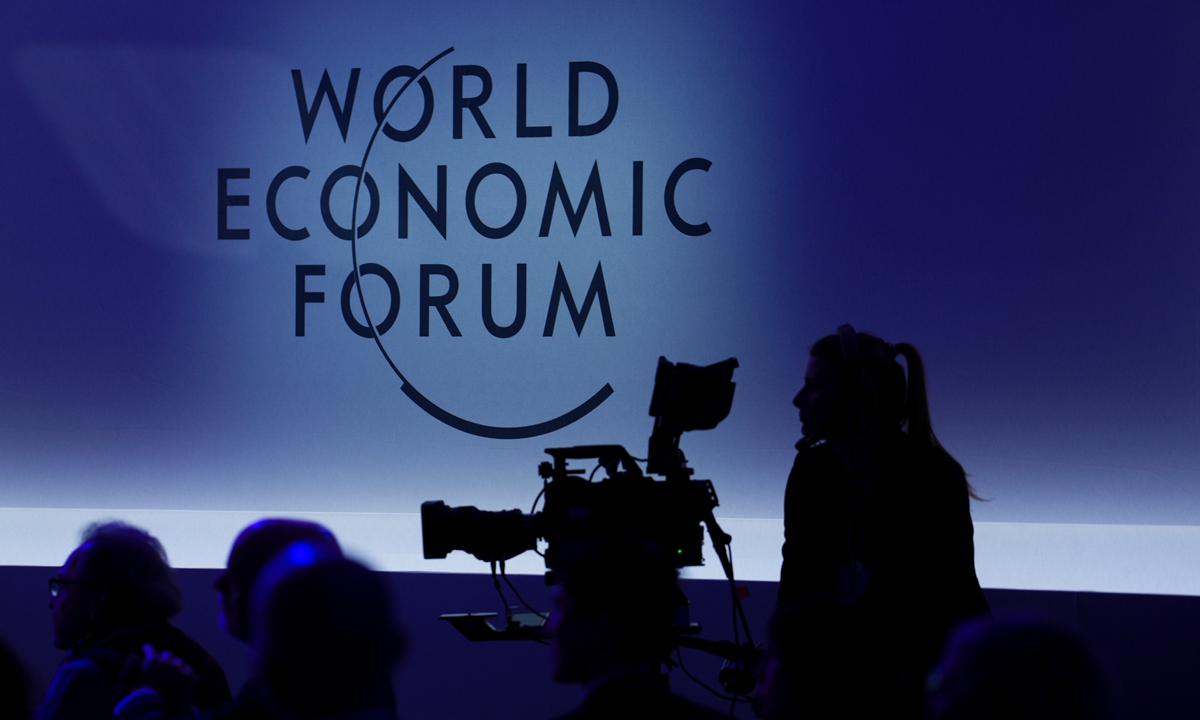
A camera person films as Canada Prime Minister Mark Carney delivers a speech at the World Economic Forum in Davos, Switzerland on January 20, 2026. Photo: VCG
Media outlets and analysts worldwide have been closely watching accelerating economic, geopolitical and power shifts following the conclusion of World Economic Forum (WEF) Annual Meeting 2026 in Davos. As post-forum assessments unfold, the stark contrast between China's message of stability and multilateralism, and the uncertainty driven by US policies, has become a focal point of international discourse.
With traditional US allies reevaluating their strategic positions and businesses prioritizing predictable partnerships, the Davos outcomes are appearing to reshape the trajectory of global economic cooperation.
CNBC on Sunday local time published a report headlined "China didn't grab many headlines at Davos, but it's the elephant in the room," noting that China used the forum to contrast its message of stability with US trade and security uncertainty.
Quoting a Chinese analyst, CNBC described this year's Davos as a "watershed" moment. Hai Zhao, a director of international political studies at the Chinese Academy of Social Sciences, was cited as saying that countries are likely to shift toward regional trade rather than a global economy centered on the US.
During last week's forum, Chinese Vice Premier He Lifeng on Tuesday called on the global community to firmly support multilateralism and free trade, and stay committed to win-win cooperation, according to Xinhua News Agency.
Speaking at the forum, He, also a member of the Political Bureau of the Communist Party of China Central Committee, said that the world should also adhere to win-win cooperation, be committed to maximizing the fruits of cooperation, and jointly solve development problems. He also highlighted mutual respect and equal consultation, and called on all countries to make good use of dialogues to properly manage differences and resolve issues, according to Xinhua.
CNBC contrasted vice premier He's remarks with a speech by US President Donald Trump that included what it described as "making personal jabs at foreign leaders," and noted that China was the first major economy to retaliate against so-called "Liberation Day" tariffs back in April, "increasingly casting itself as a stabilizing force for the world."
The report also referenced recent and upcoming visits to China by leaders including Irish Taoiseach Micheál Martin, South Korean President Lee Jae-myung and Canadian Prime Minister Mark Carney, as well as reportedly planned trips by UK Prime Minister Keir Starmer.
"What is unique this year is that global turbulence doesn't come from failed states, terrorists or global conflicts. The epicenter of turbulence and insecurity is the most powerful nation in the world," former UN under-secretary-general Erik Solheim told the Global Times when asked to compare this year's WEF with previous meetings.
"China, India and the Global South are now the pillars of global stability and lead the search for a new order when the old is in tatters," Solheim said.
Global attention on the shift
The message highlighted by CNBC is far from isolated. Media outlets and observers around the world have noted the sharp contrast. China is seen "controlling the dynamic through stillness", according to Reuters, citing a senior global business leader.
In an article titled "China Wins as Trump Cedes Leadership of the Global Economy," The New York Times argued that Trump's speech "pronounced last rites on American leadership of the liberal democratic order forged by the US and its allies after World War II."
The paper added that China is "invested in economic values that Trump has renounced: engagement in multilateral institutions to advance its causes, faith in the wealth-enhancing powers of global trade and recognition that no country is large enough or powerful enough to go it alone."
Spain's El País reported that the WEF showed how Trump's policies are alienating traditional allies and giving more space to China. The report contrasted Trump's frictions with European countries in Davos with a growing number of nations reassessing their views on China, saying that "China is gaining ground in its efforts to position itself as a responsible player at the negotiating table," and that many countries are looking at China with new eyes.
Reuters reported that China's low-key approach in Davos this year "could not have been more different" from that of the US.
In another report, Reuters quoted Canadian Finance Minister François-Philippe Champagne as saying that countries were diversifying their commercial relations and doing more at a regional level to make their economies more resilient to trade policy shocks.
"When you talk to CEOs today, what do they want? Stability, predictability, and the rule of law. I would say it's in short supply," Champagne said, days after Canada and China struck a deal to slash tariffs on electric vehicles and canola, according to Reuters.
China increased trade with nearly everyone else, compensating for reduced trade with the US, Solheim said, adding that the steadiness of the Chinese economy helped the world through a difficult year. It's particularly positive that China dropped tariffs for all 53 African countries that have diplomatic ties with China, helping fellow developing countries grow, he noted.
In another key area drawing attention — energy — divergences between China and the US have also come under the spotlight. Politico reported that "the world's two biggest climate polluters are racing in opposite directions: The US is chasing fossil fuels while China entrenches its dominance over clean energy," citing China's expanding wind and clean energy capacity alongside stagnating US wind installations and Washington's withdrawal from global climate organizations and agreements, as well as threats including increased tariffs to push countries to drop climate policies and buy more US fossil fuels.
South African outlet Daily Maverick published a column by Steven Boykey Sidley, a professor of practice at JBS, University of Johannesburg, directly rebutting US President's claim that China manufactures wind turbines but does not use wind power. Citing data, Sidley wrote that China is the world leader in wind power and accounted for 70 percent of new global wind power in 2024.
"It's sad that the US has withdrawn from numerous global institutions promoting common action on environment, health, combatting poverty and a lot more," Solheim said.
"There is no way President Trump can take us back to the fossil era. Even American business understands that the future is renewable. When given the choice between the American fossil agenda and the Chinese super speed into solar and wind, electric cars and batteries, the world will choose China," he added.
China's voice is receiving significant attention at the just-concluded WEF Annual Meeting 2026 because the country has many key assets in the global economy, including trade and investment connectivity, industrial transformation and supply chain resilience, responsible technology deployment and the scaling of clean energy solutions, Kimberley Botwright, deputy head of the Centre for Regions, Trade and Geopolitics at the WEF, told the Global Times in a written interview.
At the forum, participants consistently recognize China's systemic relevance, including its role in global value chains, trade linkages with emerging markets, industrial competitiveness and the scaling of innovation and clean technologies, Botwright said.
"What is distinctive at the WEF is the focus on the drivers of China's growth, not only the headline number," she added, affirming China's important role in upholding multilateralism.
RELATED ARTICLES