What divergent Western media narratives about Starmer’s potential China visit reveal
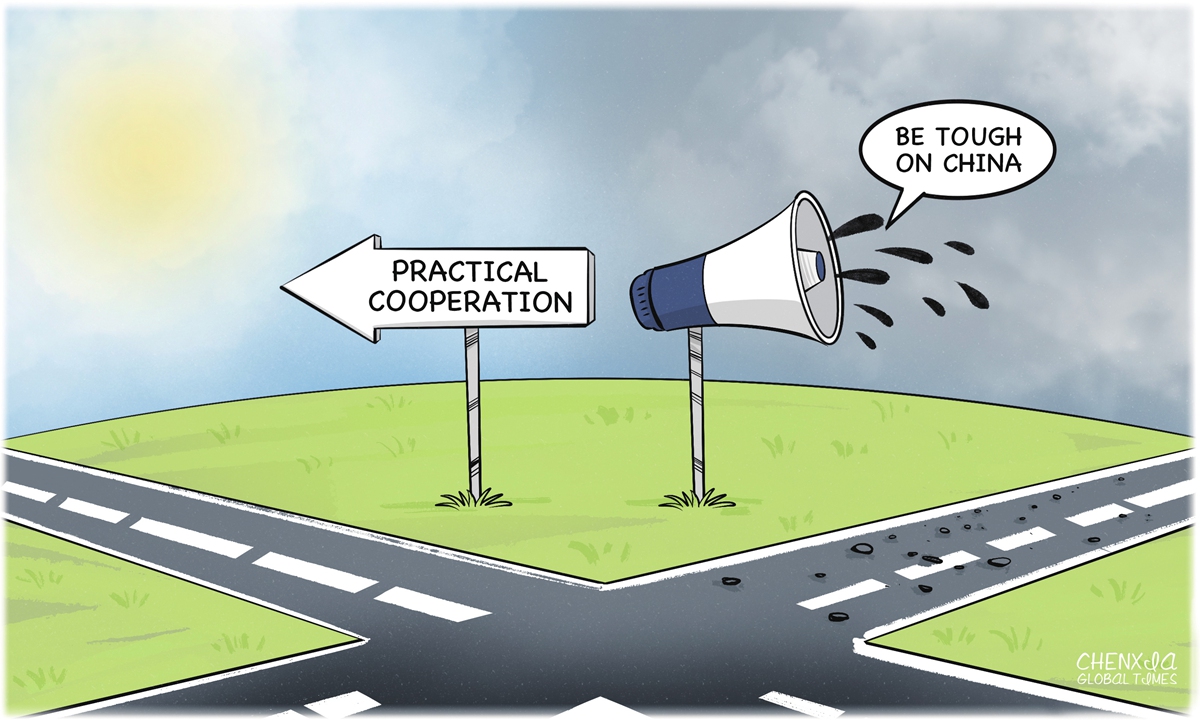
Illustration: Chen Xia/GT
As news emerged that UK Prime Minister Keir Starmer would lead a significant delegation to China, the narratives in Western media surrounding this potential visit have become both complex and divergent. Some outlets sensationalized the situation, claiming that "ignoring security threats, Starmer caves to China on mega-embassy," while others argued that the prime minister "has to play it tough in China." In contrast, there are voices emphasizing a pragmatic cooperation agenda, highlighting key initiatives such as the potential revival of a "golden era" business dialogue between the UK and China.
This disparity in narratives signals deeper tensions and ambivalence among some Europeans regarding their strategic perceptions of China versus the objective realities on the ground. Several Western media sources continue to amplify the so-called "China threat," which many view as an outdated echo of Cold War sentiments in the 21st century. "They cling to anti-China biases and interpret all of China's activities through an ideological lens, politicizing and securitizing them," stated Dong Yifan, an associate research fellow at Beijing Language and Culture University, in an interview with the Global Times.
The narratives emerging from these media outlets appear less focused on safeguarding the UK's national interests and more aimed at aligning Britain with an anti-China agenda that serves the hegemonic interests of certain countries. This perspective overlooks a fundamental reality: There is no inherent conflict of interest between China and the UK, and historically, the two nations have established numerous examples of mutually beneficial cooperation.
"In a complex international environment, the UK must consider how to mitigate the serious negative effects of recent over-politicization and over-securitization," Dong emphasized, noting that "the UK should focus on safeguarding its interests, expanding its diplomatic and economic space, and recognizing the common interests and cooperation opportunities with China."
Notably, there are also some media outlets which have highlighted the pragmatic cooperation agenda. The assertion that "Britain and China will aim to revive a 'golden era' business dialogue" has been widely reported across multiple platforms. For the UK, which currently faces growing pressures on its economic development, the significance of the Chinese market is particularly pronounced. China's vast domestic market and relatively stable development environment present reliable opportunities for British businesses seeking growth and stability.
Moreover, China plays a critical role in global industrial and supply chains, especially in emerging sectors such as new energy and high-end manufacturing. Importantly, China adheres to the principle of win-win cooperation and opposes the securitization of economic and trade issues, thereby creating ample space for dialogue and collaboration between China and the UK. This means that if the UK aims to sustain economic growth and expand its development space in today's complex international environment, cooperation with China is not only a viable choice but an unavoidable one.
According to foreign media reports, Starmer will lead a substantial ministerial and business delegation to China, with British Chancellor of the Exchequer Rachel Reeves accompanying him. This information reflects the UK government's pragmatic considerations regarding its China policy.
In a broader context, Starmer's visit illustrates a clear trend. Leaders such as King Felipe VI of Spain, French President Emmanuel Macron, German Foreign Minister Johann Wadephul, Taoiseach of Ireland Micheál Martin have recently visited China. Finnish Prime Minister Petteri Orpo just arrived in Beijing on Sunday for a four-day visit. These trips signal that deepening dialogue and cooperation has become an increasingly strategic focus for many European nations. Such pragmatic engagement does not imply a fundamental shift in position; rather, it reflects a policy reassessment based on real-world conditions.
Returning to the question, "What do the divergent foreign media narratives about Starmer's China visit reveal?" The answer is clear: The ideological narrative on China in Europe still possesses inertia, yet pragmatic engagement is increasingly becoming the practical choice. While implementing specific cooperation initiatives may still encounter obstacles, there is reason to anticipate a revival of the "golden era" of dialogue. In a turbulent international environment, pursuing dialogue and cooperation is, in itself, a positive and realistic choice.
RELATED ARTICLES