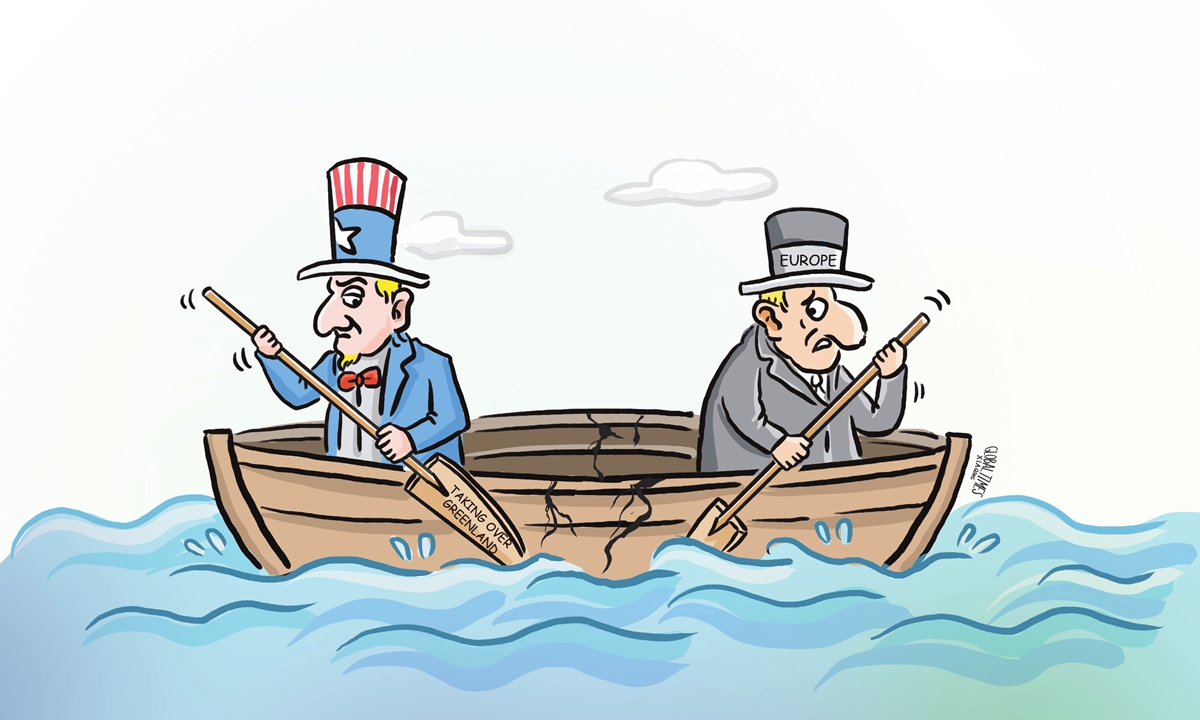
Illustration: Xia Qing/GT
Editor's Note:
The US has claimed that it has reached the framework of a deal with NATO regarding Greenland's future and has dropped the tariff threats against its European allies. Nonetheless, its undiminished ambition to control the territory fuels ongoing concerns in Europe. Against this backdrop, the Global Times (GT) has launched a commentary series, "The widening transatlantic rift," inviting scholars and experts at home and abroad to share their views. In an exclusive interview with GT reporter Li Aixin, George Galloway (Galloway), leader of the Workers Party of Britain and former member of Parliament, shared his insights.
GT: After a period of escalating tensions surrounding Greenland, the US has reached what it describes as a "framework for a future deal" regarding Greenland and the broader Arctic region with NATO during the World Economic Forum in Davos. What do you think this future deal might look like?
Galloway: First of all, the so-called negotiation was not with the owner of the territory, which is the Kingdom of Denmark. Therefore, it's hard to see what constitutional or legal propriety there can be in the US negotiating with NATO about the fate of the people of Greenland. It's unprecedented in many ways. When did NATO become a party to bilateral, binational negotiations?
We'll have to wait and see what deal emerges, whether it will be acceptable to the people of Greenland, and whether it will be acceptable to the people of Denmark. But none of that, even if there is a deal, can wipe out the sheer thuggery - really mafia-style gangsterism - of the current US administration's conduct over this matter in the last few months.
The world has never seen a situation where an ally can be so openly aggressive, belligerent and threatening toward a country like Denmark, which has been an unquestioning supporter of everything the US has ever asked of it. It was the very first country in the whole world to recognize the NATO annexation of Kosovo, when Kosovo was torn from its motherland in Serbia.
GT: What does the future look like, in both the short term and the long term, for the US-Europe relationship? Are the tensions we are seeing now only just the beginning, or are we already seeing signs of a cooling-off?
Galloway: I think relations are comprehensively ruined, and that's why European leaders who have been lecturing, badgering, and pressuring China for years are all making hasty reservations - not for a slow boat to China, but a quick one. That's why Canadian Prime Minister Mark Carney was there. That's why French President Emmanuel Macron was there. That's why British Prime Minister Keir Starmer is coming.
But the truth is, the world has fundamentally changed over the last few months. "The old world is dying, and the new world struggles to be born: now is the time of monsters." Italian Marxist theorist Antonio Gramsci once wrote these words in his prison cell under Mussolini. That was true in the 1920s and 1930s; it's true again now in the 2020s, and maybe even into the 2030s.
As Winston Churchill said, "Now this is not the end. It is not even the beginning of the end. But it is, perhaps, the end of the beginning." These tensions will continue to grow because they have a material basis in reality. The European continent, the heartland - I include Britain, which is not part of the EU but is part of Europe - has interests that are diametrically opposed to those of the US.
The US is desperately trying to hold on to its empire, on which it is losing its grip daily. It's time the US learned what the UK took far too long to learn: It is no longer the top dog. Other countries no longer take orders from it. For international amity to be assured, there has to be a win on offer for all parties involved.
GT: What strong cards does Europe hold in this situation?
Galloway: Europe should make peace and amity with China and with Russia, make new arrangements with the rising powers in the world, instead of clinging to the fading, failing powers in the world.
But their current political leadership almost certainly will not do that, because, if I can quote Shakespeare in Macbeth - they are steeped in blood so far that it is difficult to know whether to go on or to go back. Either course is bloody.
However, that is what they should do. The world has changed. Carney told us at Davos that the so-called rules-based order is not just fading; it was always a lie. He said the rest of us knew that it was a lie, but we went along with it because it benefited us to do so.
This is a remarkable admission. I'm not sure whether there has been a more remarkable admission in modern history than this. Some clear-sighted politicians and observers have been saying it all along, for which they were insulted, marginalized or even punished, but this view is now being openly acknowledged by a member of NATO, and by the prime minister of a Five Eyes country.
It's definitive. It's official. The so-called rules-based order - in which there was no real order, no written rules, and which turned out to be based in Washington, DC - is now dead.
But the Europeans are up the Yangtze without a paddle. They have ruined their own economies, and deindustrialized their own countries. They have fundamentally changed, and not for the better, the character of their societies. They are in cultural, social, economic and political crisis.
GT: That seems a bit pessimistic. Is there an optimistic lens through which we can view Europe?
Galloway: The optimism is to be found in the East. The sun has risen in the East. The wise thing for people in the West would be to recognize that reality rather than cling to the past. Europe should try to get closer to where the sun is, obtaining some warmth and nourishment from it.
GT: Where do you think the future of international relations are unfolding?
Galloway: We are already in the law of the jungle. We are already in a new era. When I was young, everybody in the Western world knew the name of the secretary-general of the United Nations. The news would carry updates about the UN all the time. It was part of the normal discourse in political life. Now, nobody thinks about or talks about the UN at all. The UN is suffering the same fate as the League of Nations between WWI and WWII.
I believe that BRICS, the SCO and organizations of the Global South - the African Union, ASEAN - have to be the font of new international relations, new international agreements and new international directions.
I think that's the course we are on. ASEAN is doing extremely well. BRICS is getting bigger and richer. The SCO contains most of the people in the world and most of the wealth in the world. That's really the best basis for improving the international order.
RELATED ARTICLES