Trump announces tariff hike to 25% on South Korean imports citing ‘legislative delay’; Chinese expert says move creates uncertainty
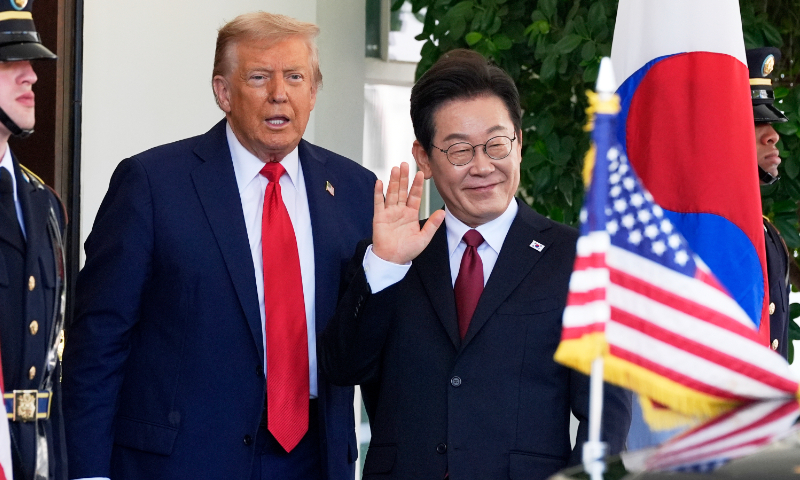
US President Donald Trump (left) greets South Korean President Lee Jae-myung upon his arrival at the White House, on August 25, 2025, in Washington. Photo: VCG
US President Donald Trump said on Monday (local time) that tariffs on some South Korean imports would rise from 15 percent to 25 percent, citing a "delay" in South Korea's legislature approving a trade deal with the US last summer.
A Chinese expert characterized this move as an example of US policy prioritizing domestic political demands over international trade rules, while creating more uncertainty to global markets.
On Monday, Trump posted on Truth Social that "Because the Korean Legislature hasn't enacted our Historic Trade Agreement, which is their prerogative, I am hereby increasing South Korean TARIFFS on Autos, Lumber, Pharma, and all other Reciprocal TARIFFS, from 15 percent to 25 percent."
According to the Yonhap News Agency, the agreement that Trump referred to was a bill submitted to the South Korean National Assembly in November to implement the bilateral trade and investment deal, which has yet to pass through the legislature.
The agreement included South Korea's commitment to investing $350 billion in the US and other pledges in return for Washington's lowering of reciprocal tariffs and auto levies on South Korea to 15 percent.
The Korea Times reported that Trump's latest threat, if enacted, would reverse that. The auto industry accounts for 27 percent of South Korea's exports to the US, which takes in nearly half of the country's car exports.
However, the Chosun Ilbo reported that the US trade agreements with South Korea, Japan and the EU are in the nature of a "framework" that does not specify concrete purchase targets. The fact sheets they concluded with the US do not have the legal force of a treaty or agreement. They are closer to written "political commitments."
Cheong Wa Dae, South Korea's presidential office, said it has not received an official notice or explanation from the US related to Trump's tariff hike announcement, adding that it will soon hold an emergency interagency meeting to discuss the government's response, according to Yonhap.
South Korea's presidential spokesperson Kang Yu-jung said in a written statement on Tuesday that "the tariff increase requires administrative actions to take effect. Accordingly, our government plans to convey to the US side our commitment to implement the tariff agreement while remaining calm and responsive."
However, the Ministry of Science and ICT of South Korea announced that it had received a letter from the US two weeks ago urging the implementation of follow-up measures to the Korea-US trade agreement, KBS reported on Tuesday.
The ministry added that it could not disclose the specific contents of the letter or the South Korean government's position due to it being a diplomatic matter, according to the KBS report.
The Chosun Ilbo reported that some interpreted the move less as an "immediate effect" than as a political signal aimed at pressuring the Korean side to respond, given that there has been no official notice or executive order.
Meanwhile, South Korean Industry Minister Kim Jung-kwan, who has been on a visit to Canada, was set to head for Washington, where he will discuss the matter with his US counterparts, his office said, adding that a meeting with US Commerce Secretary Howard Lutnick was being arranged, Yonhap reported.
Shin Won-kyu, a chief analyst at the Korea Economic Research Institute, said "Trump's move could be stemming from heightened anxiety with an array of issues bursting out, including criticism over his immigration policy and ambitions over Greenland, as well as escalating tensions with the EU and Canada," according to Yonhap.
"Such tariff actions undermine trust-based US-South Korea economic ties and send a highly risky signal to global markets," Li Yong, an executive council member of the China Society for WTO Studies, told the Global Times.
"Unilateral measures force inefficient supply-chain restructurings worldwide, imposing heavy uncertainty premiums on businesses. Over time, this erodes the US' international credibility," said Li.
The latest US move echoed earlier threats against Canada, where tariffs were weaponized to interfere in sovereign decisions, Li noted.
"These policies introduce profound uncertainty, damaging not only bilateral relations but also trilateral dynamics and broader global stability," Li pointed out.
In market reaction, South Korea's benchmark KOSPI index fell 0.7 percent in early trading on Tuesday before recovering, with shares of major automakers such as Hyundai experiencing initial volatility. The South Korean won also weakened slightly against the US dollar amid the uncertainty.
RELATED ARTICLES