UK PM to visit China after a gap of 8 years; engagement shows pragmatic approach in relaunching serious communication at senior level: experts
By , Ma Jingjing and Zhang Yiyi Published: Jan 27, 2026 10:37 PM

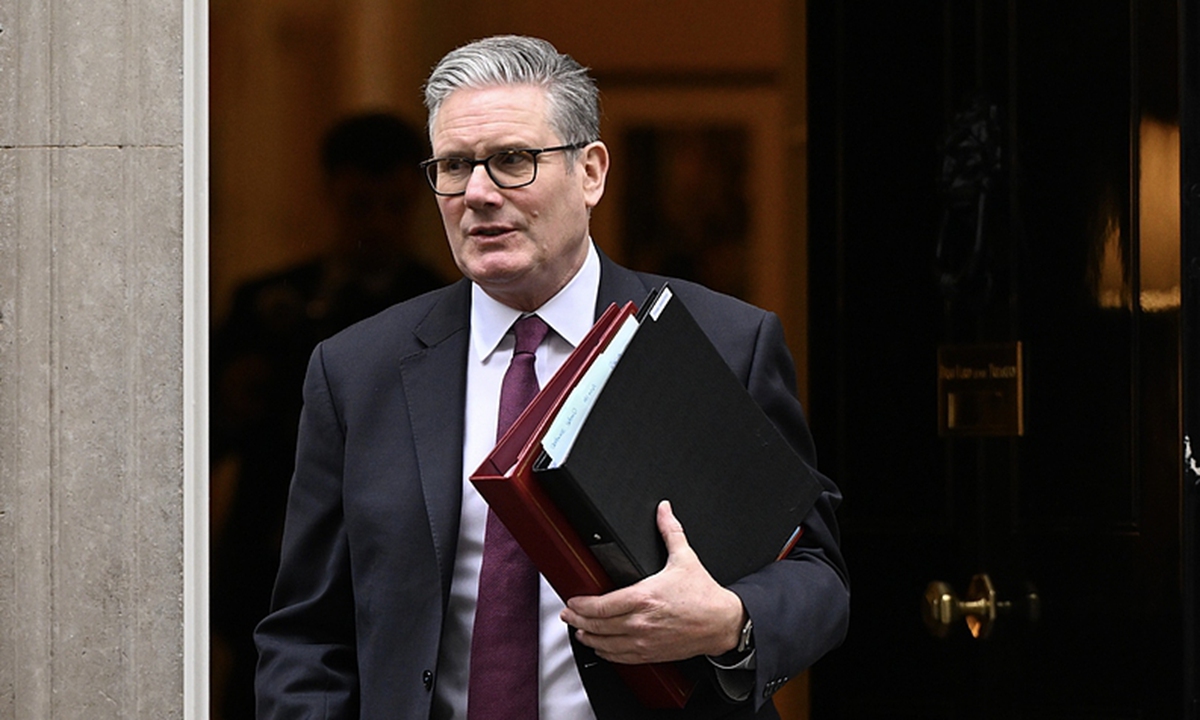
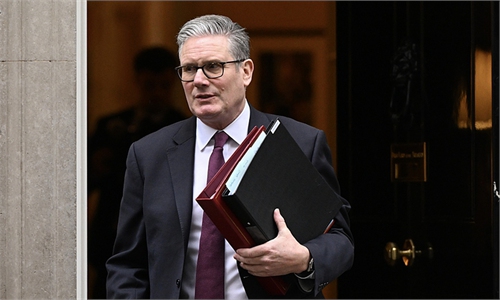
UK Prime Minister Keir Starmer leaves 10 Downing Street to attend the weekly Prime Minister's Questions session at Parliament in London, United Kingdom, on January 21, 2026. Photo: VCG
At the invitation of Chinese Premier Li Qiang, UK Prime Minister Keir Starmer will pay an official visit to China from Wednesday through Saturday, a Chinese Foreign Ministry spokesperson announced on Tuesday.
Elaborating on Starmer's visit, spokesperson Guo Jiakun said on Tuesday that Starmer's visit marks the first visit to China by a UK prime minister in eight years. During the visit, President Xi Jinping will meet with him.
Premier Li Qiang and Chairman of the National People's Congress Standing Committee Zhao Leji will hold talks and meet with him respectively for in-depth exchanges of views on bilateral relations and issues of mutual interest, Guo said.
After taking office, the Labour government has expressed clear willingness to develop relations with China in a consistent, long-term and strategic way and has actively promoted dialogue and cooperation between the two countries, the spokesperson said.
In August, 2024, President Xi held a phone call with Prime Minister Starmer at the latter's request and they met during the G20 Summit in Rio de Janeiro that same November, steering China-UK relations on a track toward improvement and development, according to Guo.
The international landscape is witnessing turbulence and transformation. It serves the common interest of both peoples and contributes to promoting global peace, stability, and development for China and the UK, as two permanent members of the UN Security Council, to maintain communication and enhance cooperation, the spokesperson said.
China stands ready to take this visit as an opportunity to enhance political mutual trust with the UK, deepen practical cooperation, open a new chapter of sound and steady development of China-UK relationship and together make due efforts and contributions to world peace, security, and stability, he said.
Apart from Beijing, Prime Minister Starmer will also visit Shanghai, Guo said.
Before setting off, Starmer, in an interview with Bloomberg on Monday local time, dismissed questions about whether he was seeking stronger ties with China at the expense of the UK's relationship with its closest allies by saying that he will not be forced to "choose between" relations with the US or China.
"We've got very close relations with the US - of course, we want to - and we will maintain that business, alongside security and defense," Starmer said, arguing Britain could enjoy the best of both worlds. "Equally, just sticking your head in the sand and ignoring China, when it's the second-biggest economy in the world and there are business opportunities wouldn't be sensible," he said, according to the report.
"For years we have blown hot and cold," he said. "We had the golden age, which then flipped to an Ice Age. We reject that binary choice."
Practical pivot
Starmer's visit comes on the heels of a similar delegation by Canadian Prime Minister Mark Carney that resulted in a number of productive deals including consensus reached on the EVs and canola tariff issues.
The trip also comes after UK government approved plans by China to build a new embassy in the heart of London, rejecting the objections from some UK politicians, according to Reuters.
Analysts said that recent visits by leaders of some major Western countries particularly some US close allies reflect a shift in the global geopolitical landscape -an increasing number of these countries are pivoting to a more pragmatic approach in engaging with China, the world's second-largest economy.
Starmer's visit was closely watched by international media outlets.
Reuters reported that Britain wants closer economic and trade ties with China to help Starmer honor his pledge to improve living standards through investment in public services and the economy and reduce its dependence on an increasingly unpredictable US. But the report also noted the strategy has drawn scrutiny from some British and US politicians.
In recent years, the UK has made frequent allegations of espionage and cyberattacks, which China deplored.
The Associated Press reported that Starmer is heading to China seeking "a thaw in relations but risking a rift with the US." The New York Times said that "Britain seeks trade with China without triggering Trump's Fury."
"Starmer's visit may be the first by a UK prime minister in eight years, but it's the latest in a line of Western leaders heading out to Beijing in the past few months. At a time of geopolitical uncertainty, it's no surprise that leaders are looking to reopen communication channels." Ruby Osman, China expert at the Tony Blair Institute for Global Change, said in a statement sent to the Global Times on Tuesday.
"If the UK wants a say in the emerging international order, it needs to stay engaged with the major players. Dialogue doesn't have to mean complete alignment with Beijing - in fact it's the best way to push for constructive change on those areas where our interests don't align," said Osman, whose think tank was founded in 2016 by former British Prime Minister Tony Blair.
Jian Junbo, director of the Center for China-Europe Relations at Fudan University's Institute of International Studies, told the Global Times on Tuesday that the UK PM's upcoming visit to China, as well as his remarks on valuing ties with both the US and China, reflected a pragmatic choice, as London increasingly recognizes China's growing weight in the global economy, noting that recent US tariff threats underscore the limits of traditional alliances in addressing its economic challenges.
An opportunity to restore rhythm
According to China's Ministry of Commerce (MOFCOM), Starmer will be accompanied by over 50 executives from major British companies in sectors like finance, pharmaceuticals, manufacturing, culture and creative industry, which fully underlines the British side's earnest expectations for deepening bilateral economic and trade ties with China.
Against the backdrop of rising global trade protectionism, both China and the UK adhere to free trade and uphold multilateral trading system. Both sides are committed to economic and trade cooperation featuring complementarity and mutual benefit, according to MOFCOM.
The two sides will work to promote the coordinated development of trade in goods and services, advance two-way investment cooperation and expand cooperation space in fields such as green energy, healthcare, creative industries, and smart manufacturing, MOFCOM spokesperson said.
The British prime minister's visit to China will be strongly welcomed by the UK business community and is widely seen as an important signal that China-UK relations are entering a new stage, John N M Mclean OBE, chair of the China UK Business Development Centre, told the Global Times on Tuesday.
A key moment will be the meeting between the leaders of the two countries, sending a strong message to global markets that the UK-China business partnership has been refreshed and relaunched in 2026, Mclean added.
The China-UK bilateral economic and trade relationship is regaining momentum in a realistic and constructive way, with strong cooperation opportunities in sectors such as high technology, life sciences, clean energy, advanced manufacturing, financial services, and education, Jack Perry Junior, chairman of the 48 Group Club and CEO of London Export Corp (LEC), told the Global Times in an interview on Tuesday.
Starmer's visit is an opportunity to restore rhythm and confidence in engagement with China, Perry said, noting that the most important outcome will not be a single announcement, but the re-establishment of regular, serious communication at senior levels.
Jian stressed that the key lies in whether the UK can reduce restrictions and disruptions toward China and gradually rebuild mutual trust to ensure stable ties.
Chinese Ambassador to the UK Zheng Zeguang penned down an article on The Times on Tuesday, stating that "China and Britain don't see eye to eye but we share many interests."
In the article, the Chinese ambassador stressed that the two countries "should seek common ground while managing differences" and "We will find that our common ground far outweighs our differences, and that many issues can, in fact, be resolved or managed better."
"I am confident this visit [by PM Starmer] will help both sides to expand common ground and reduce frictions," Zheng wrote.
RELATED ARTICLES