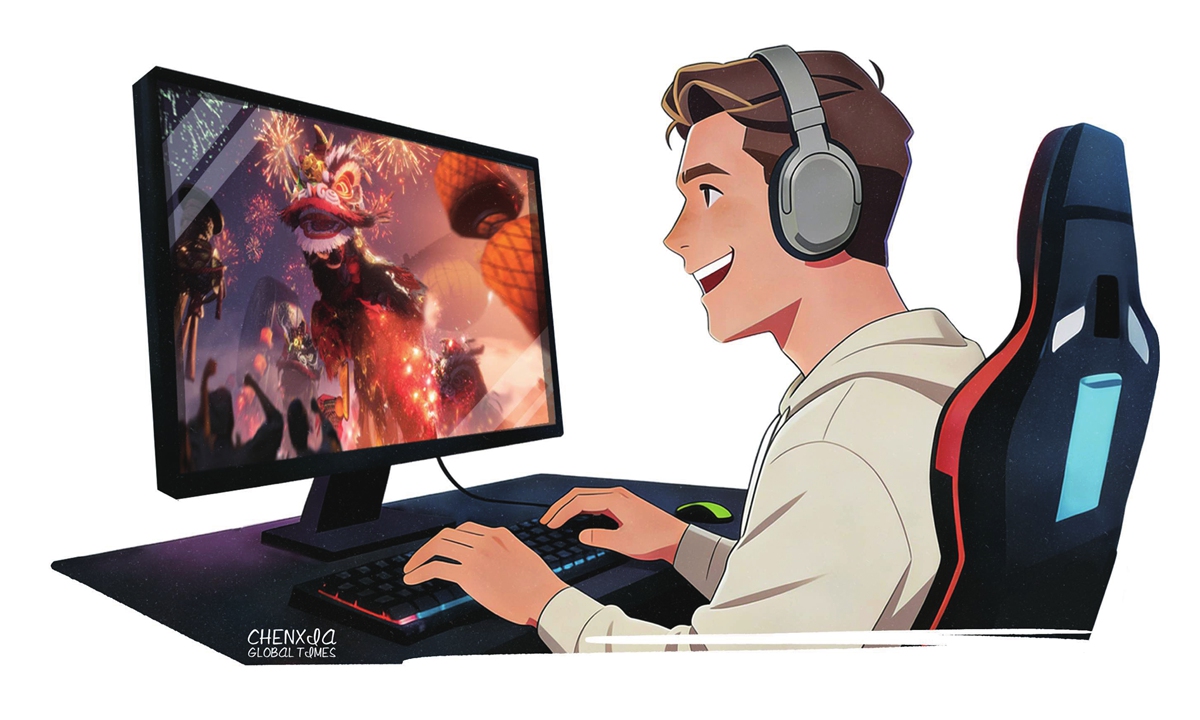
Illustration: Chen Xia/GT
Chinese games are making waves across the global market. According to data released Tuesday by marketing cloud platform AppsFlyer, China-headquartered publishers accounted for 35 percent of global gaming user acquisition spending outside China in 2025, marking a year-on-year increase of 22 percent. This surge has made China a key driver of growth in the global gaming industry.
Beyond Black Myth: Wukong, a growing number of Chinese games are capturing attention globally. A gameplay demonstration video for Where Winds Meet has garnered more than 50 million views on overseas platforms. During its public beta, Persona 5: The Phantom X topped the iOS free games charts in 35 countries and regions. Meanwhile, Delta Force mobile debuted globally in April last year and quickly claimed the No.1 spot on Apple's free game charts in 169 countries and regions.
Behind the global expansion of Chinese games lies the rapid advancement of China's technology sector, strong policy support, and robust domestic demand. At the 2025 Game Developers Conference, companies such as Tencent and miHoYo showcased cutting-edge topics including artificial intelligence and game design, attracting significant attention from developers worldwide. In April 2025, China's State Council approved a plan to expand comprehensive pilot programs aimed at accelerating the opening-up of the services sector. The plan explicitly called for developing game export businesses and building an integrated industry chain spanning IP creation, game development, publishing, and overseas operations.
China is also home to around 680 million gamers and a domestic market valued at over 350 billion yuan. As one of the world's largest player bases, this massive market compels developers to continuously iterate on technology and innovate in content, providing an unparalleled proving ground before entering overseas markets.
As China's gaming industry continues to mature, Chinese games are gaining increasing recognition among international players. This is driven not only by technological advances, but also by the outward expression of the growing influence of traditional Chinese culture. An increasing number of high-quality titles are constructing a distinctly Chinese "digital aesthetic." For example, Where Winds Meet uses advanced rendering technology to faithfully reproduce intricate architectural details. He Wei, a professor at the School of Arts and Media at Beijing Normal University, notes that for young audiences overseas, Chinese games are becoming a fashionable form of digital cultural experience.
While these achievements deserve recognition, it is equally important to remain clear-eyed about the challenges ahead. China's international competitiveness in gaming still has room for improvement. In areas related to single-player games - such as technical depth, industry experience, and market maturity - China remains a relative newcomer. On the path to global expansion, Chinese game developers continue to face significant hurdles in marketing, team building, and regulatory compliance.
In fact, the overseas success of Chinese games represents more than the triumph of a single industry. It powerfully illustrates China's push toward innovation-led, high-quality development and stands as a compelling example of the deep integration of culture and cutting-edge technology. The story of Chinese games going global is both a narrative of industrial progress and a chapter in cross-cultural dialogue. Every steady step forward adds a new footnote to the evolving story of "Created in China."
As "Created in China" gains momentum around the world, its impact is no longer limited to advantages of scale within global supply chains. Instead, it signals China's transformation from the "world's factory" into a true innovation powerhouse.
In recent years, we have seen the breakout success of games like Black Myth: Wukong, alongside the global rise of Chinese new-energy vehicle brands such as BYD, which have outpaced competitors in overseas markets through proprietary technologies and sustained innovation. At the same time, the international expansion of designer toy brands like Pop Mart - amplified by social media - has been reshaping global consumer tastes through fresh, creative storytelling.
Taken together, these vivid examples show how today's "Created in China" is crossing linguistic and cultural boundaries, projecting a confident, innovative, and dynamic new image of Chinese brands on the global stage.
RELATED ARTICLES