Illustration: Tang Tengfei/GT
Data released on Wednesday by the China Federation of Logistics & Purchasing (CFLP) indicates that China's cold-chain logistics sector continued to expand in 2025, supported by the steady release of consumer demand, according to CCTV News. Both market scale and infrastructure capacity increased last year.Although cold-chain logistics may seem like a technical and highly specialized segment, its recent trajectory offers a useful micro-level lens through which to observe evolving consumption patterns in China, particularly shifts in what consumers buy, how they buy it, and where demand is emerging.
CFLP data shows that total cold-chain logistics volume reached 381.4 million tons in 2025, up 4.5 percent year-on-year, while total cold storage capacity rose to 267 million cubic meters, an increase of 5.53 percent. More notably, the sector is gradually placing greater emphasis on automation and more intelligent management, suggesting a maturing phase in which efficiency and operational quality are becoming important alongside scale.
Taken together, these developments appear closely aligned with changes underway in China's consumer market. The expansion of cold-chain logistics reflects more than a sector-specific upgrade and appears to be evolving in parallel with changing consumption patterns. Several underlying trends are becoming clearer, providing context for how demand is shifting and where new growth may emerge.
First, one of the clearest indicators of evolving consumer behavior is the growing appetite for higher-quality fresh products. Freshness and traceability are growing in importance among many consumers, rather than remaining confined to niche segments. Improvements in cold-chain logistics allow products sensitive to temperature and time - such as fresh produce, seafood, and dairy - to reach a wider range of consumers with greater consistency.
Second, the growth of online and instant retail channels is creating new demand for cold chain logistics. E-commerce platforms, online grocery services, and on-demand delivery operators have expanded rapidly in recent years, with delivery options including same-day and even minute-level fulfilment. Qin Yuming, secretary-general of the cold-chain logistics committee of the CFLP, was quoted by CCTV News as saying that cold-chain logistics maintained steady growth in 2025, with infrastructure networks largely taking shape. The rapid expansion of online and instant retail channels has created new demand for cold-chain services.
Third, as cold-chain infrastructure extends into smaller cities and regions, it is reaching a wider pool of consumers. This expansion is increasing the number of households with reliable access to fresh, temperature-sensitive products, helping to sustain more consistent and widespread demand. In turn, it reinforces the importance of maintaining both speed and quality across the supply chain.
Steady progress in China's cold-chain logistics network is creating new opportunities for imports, particularly fresh food, meat, and seafood. Upgrades in the cold-chain industry, combined with the adoption of new technologies, have helped reduce logistics costs while improving efficiency, enabling imported fresh and frozen products to reach lower-tier cities more quickly and at competitive prices. This expansion is enhancing access to quality imports in third- and fourth-tier markets, effectively supporting broader consumption upgrading.
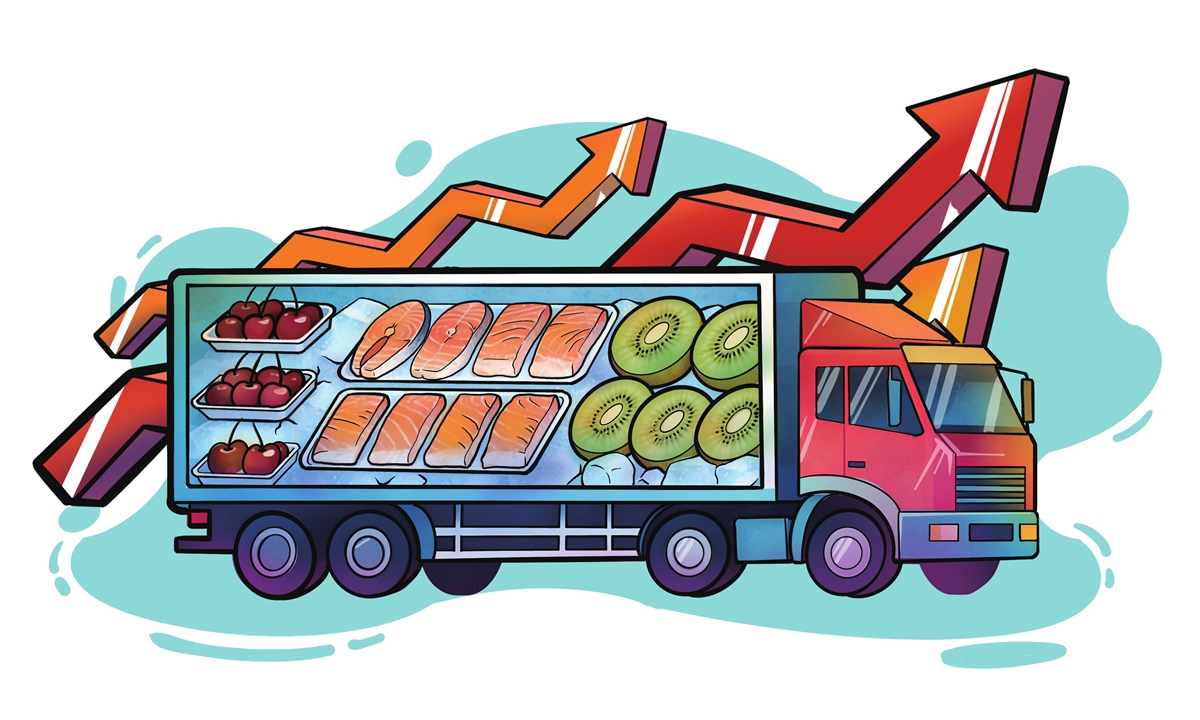
As the Spring Festival approaches, Chilean cherries, Norwegian salmon, and New Zealand kiwifruit have become increasingly common among Chinese consumers, with freshness now widely regarded as a baseline expectation. For foreign exporters, the efficiency of China's cold-chain system points to growing opportunities to expand their presence in the market.
For instance, the harvest season for Chilean cherries runs from November to February, coinciding with the off-season for domestic fruit production in China and the peak period for holiday consumption. After harvesting, the fruit is rapidly cooled to preserve freshness, sealed in nitrogen- or carbon-dioxide-controlled packaging, and then shipped to China over a journey of more than 20 days, according to the People's Daily.
Taken as a whole, the evolution of China's cold-chain logistics system points less to a single sectoral success than to a broader reorientation in how consumption is organized and valued. As demand moves toward higher standards of freshness, reliability and speed, logistics capacity increasingly influences what consumers can access, where, and at what cost. For domestic producers and foreign suppliers alike, this is giving rise to a market environment that is evolving, marked by higher expectations as well as expanding opportunities for participation, in which product freshness and quality are playing a more prominent role in consumer decision-making.
The author is a reporter with the Global Times. bizopinion@globaltimes.com.cn
RELATED ARTICLES