'Global Dialogue - China-EU Resonance' media, think tank forum held in Brussels
Event forges consensus based on public opinion, expands cooperation from past achievements
By Zhang Tingge, , Niu Xiaoman and Shao Qunyu in Brussels Published: Jan 28, 2026 11:55 PM

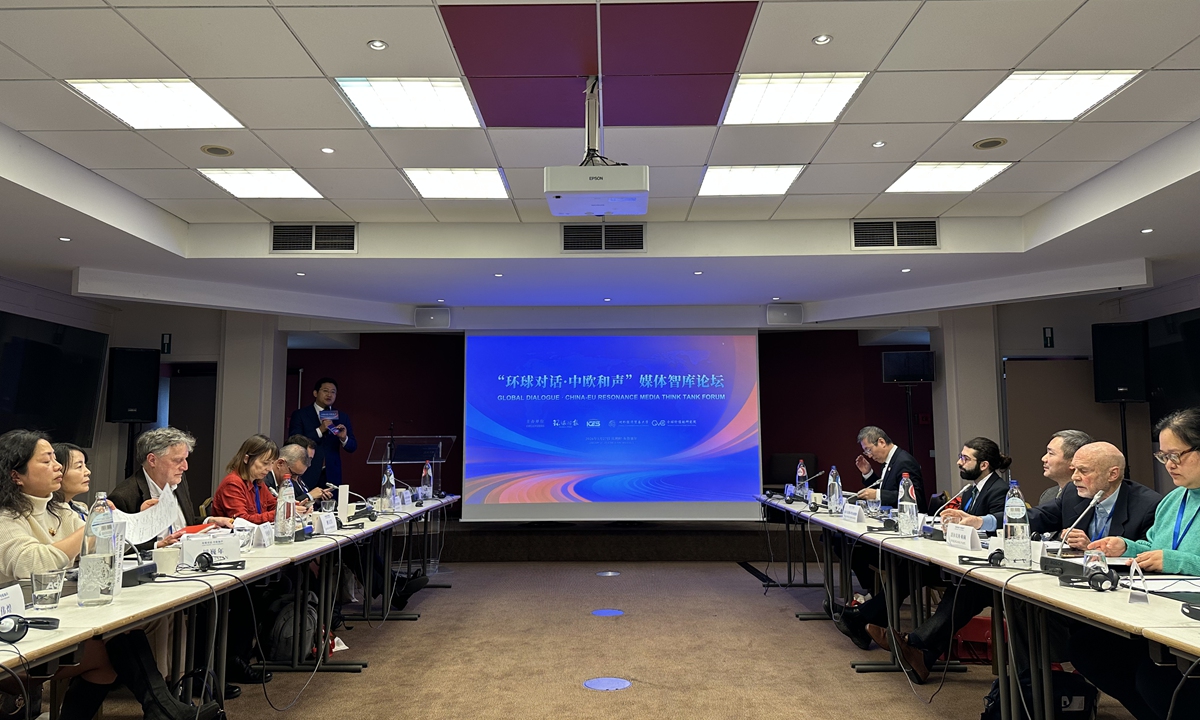
The Global Times, in cooperation with the Institute for China-Europe Studies and the Institute of State and Regional Affairs of the University of International Business and Economics, holds the "Global Dialogue - China-EU Resonance" media and think tank forum in Brussels on January 27, 2026. Photo: GT
The "Global Dialogue - China-EU Resonance" media and think tank forum was held in Brussels, Belgium, on January 27. Dozens of guests from Chinese and European think tanks, media outlets and business communities engaged in in-depth discussions on topics including the historical experience of China-EU relations, public opinion support, the current state of cooperation and future pathways.
The international landscape is continually undergoing profound changes with the resurgence of unilateralism, the spillover of geopolitical conflicts and the global governance deficit overlapping. As two major forces promoting multipolarity, two key markets supporting globalization, and two great civilizations championing diversity, how China and the EU can deepen expectations for cooperation and play a stabilizing role in this complex environment has become an important issue that continuously attracts the attention of the international community.
Against this backdrop, the Global Times, in cooperation with the Institute for China-Europe Studies and the Institute of State and Regional Affairs of the University of International Business and Economics, held the "Global Dialogue - China-EU Resonance" media and think tank forum in Brussels. Based on the results of a public opinion survey conducted by the Global Times Institute on the theme of the 50th anniversary of the establishment of diplomatic relations between China and the EU, the forum focused on two main topics: "China-EU Mutual Perceptions: Practical Experiences and Public Opinion Foundations," and "Moving Forward through Understanding: Diverse Cooperation and Future Pathways." The forum explored how China and the EU can build on public opinion and expand cooperation in the future.
In his opening remarks, Bai Long, deputy editor-in-chief of the Global Times, said that mutual understanding between China and the EU is no longer merely a "soft issue" at the level of communication, but a crucial variable in maintaining the stability of bilateral relations and avoiding misjudgments. This event aims to provide a realistic reference for mutual understanding between China and the EU from the dimensions of public opinion, perceptions and narratives, Bai said. He said that the Global Times stands ready to continue serving as an open platform, working together with European media and think tank partners to offer more solid and realistic support in terms of perception for the long-term development of China-EU relations.
In a keynote speech, Chen Su, minister counsellor of the Mission of China to the EU, said that amid a turbulent and changing world, the development of China-EU relations carries more strategic significance and global impact than ever before. There are no fundamental conflicts of interest or geopolitical contradictions between China and the EU. China has always viewed and developed China-Europe relations from a strategic and long-term perspective, regarding Europe as an important pole in a multipolar world, and has consistently supported European integration and the EU's strategic autonomy, Chen noted.
Chen put forward three suggestions on enhancing mutual understanding between China and the EU: First, upholding political mutual trust; second, promoting openness and cooperation; third, responding to both sides' people's needs for more communication and interactions.
Fei Shengchao, Chinese Ambassador to Belgium, congratulated the release of the survey's results, noting that as the first large-scale poll conducted by a Chinese media organization on mutual perceptions between China and the EU, it is of great significance. Fei stated that what is most lacking between China and Belgium as well as the EU at present is precisely direct communication and direct engagement. Although China has long been the subject of intense attention in Belgium and in Europe, many perceptions of China in Belgium and Europe still primarily stem from indirect sources of information. One key significance of the survey lies in highlighting this real-world issue and providing a reference for bridging the perception gap, the ambassador said.
Fei emphasized that a stronger and more prosperous China, alongside a stronger and more united Europe, is exactly what a genuine multipolar world should look like, which is conducive to promoting the international order in a more just and reasonable direction. China's development goals and policies are characterized by continuity, stability and certainty. Whatever the changes in the international situation, what remains unchanged is China's commitment to the new development philosophy, to high-quality development and high-level opening up, to continuously turning the Chinese people's aspiration for a better life into reality, and to working with countries from around the world to build a community with a shared future for humanity, Fei said.
Niu Ruifei, a reporter from the People's Daily EU Bureau, said that the long-term stability and development of China-EU relations largely depends on how the younger generation understands and cooperates with each other. She suggested that China-EU youth exchanges should place greater emphasis on long-term commitment and participation, with technological innovation and green development serving as key drivers of youth cooperation. She also recommended encouraging young people from both China and the EU to share their stories of China-EU exchanges in their own languages.
Several European attendees at the forum said the survey and related data were highly valuable, and that it was particularly significant that such a survey was initiated and led by a Chinese organization, as it helps to more comprehensively understand the perception of China-EU relations in different contexts. Narratives such as "decoupling" and "de-risking," which seem to garner support, need to be verified through research like this. The European guests generally agreed that China and the EU need to gain a deeper understanding of each other, and that both sides should continue to enhance deeper understanding through dialogue, investment in education and other efforts.
During the forum, Zhang Qi, executive director of the Global Times Institute and director of the Public Opinion Center, released the results of a public opinion poll on the theme of the 50th anniversary of the establishment of diplomatic relations between China and the EU. The poll, conducted from October 16 to November 4, 2025, covered 20 EU member states, including Denmark, Sweden, Spain, Belgium and Germany, as well as China, interviewing over 16,000 respondents.
The results showed that a majority of respondents from both China and the EU have strong confidence in the future development of China-EU trade and look forward to cooperation in areas such as high-tech and the digital economy. A relatively larger majority of EU respondents agreed that "friendship with China and strengthened cooperation" would be more beneficial to the EU's development.
RELATED ARTICLES