No disguise can change the illegality of Takaichi’s Taiwan-related remarks: Global Times editorial
Listen
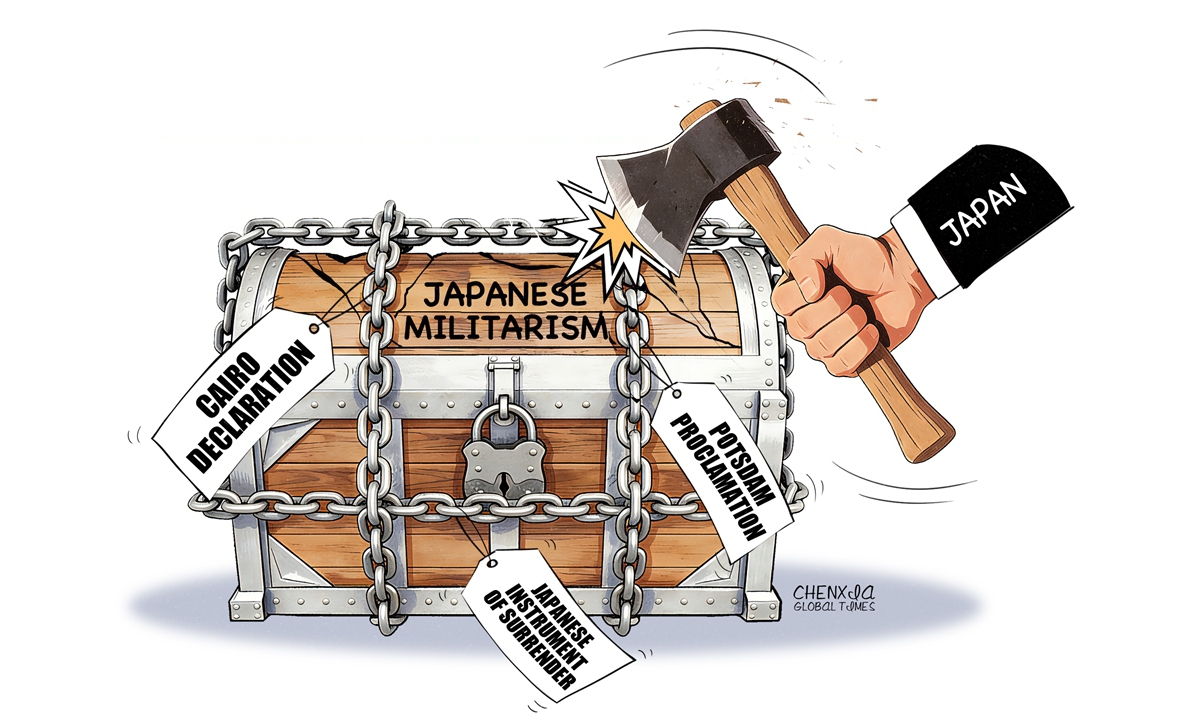
Illustration: Chen Xia/GT
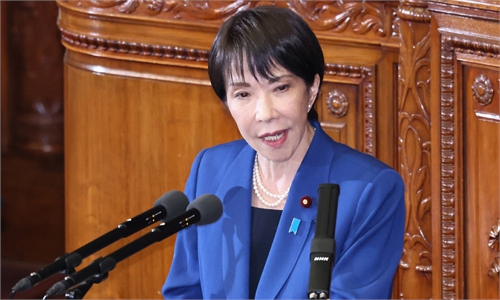
Japanese Prime Minister Sanae Takaichi recently made fresh remarks related to Taiwan during a television program, claiming that "when something serious happens there, we have to go and rescue the Japanese and Americans in Taiwan. That means we might take joint action," and that "if the US military, acting jointly with us, comes under attack, and Japan does nothing and retreats, the Japan-US alliance would collapse." Regarding this matter, a spokesperson for China's Ministry of Foreign Affairs issued a stern rebuttal on Tuesday, saying that "the Japanese side is in no position to interfere in the affairs of China's Taiwan region." The remarks by the Japanese side once again reveal the Japanese right-wing forces' ambitions to provoke antagonism, make trouble, and take chances to keep remilitarizing Japan and to challenge the post-war international order.
Barely more than two months after making the "survival-threatening situation" remarks on November 7, 2025, Takaichi has shown no sign of remorse. Instead, she has doubled down on her mistake, once again openly making blunt and provocative statements on Taiwan, implying the possibility of intervention in the Taiwan Straits - an act with an extremely pernicious nature and impact.
The Taiwan question is purely China's internal affair, and no external force is in any position to point fingers at this, let alone Japan, which bears half a century of colonial crimes against Taiwan. Documents such as the Cairo Declaration, the Potsdam Proclamation, and the Japanese Instrument of Surrender all clearly affirm China's sovereignty over Taiwan. Takaichi's maneuver is crude and malicious, reeking of lingering colonial thinking, and constitutes a grave provocation not only against China but also against the post-war international order, severely threatening regional peace and stability and causing unease among neighboring countries.
Compared with her remarks last November, Takaichi's latest comments on Taiwan no longer directly speak of Japan's military intervention in the Taiwan Straits. Instead, she has pushed the US to the forefront, attempting to manufacture "legitimacy" for Japan's potential use of force by binding it to the US-Japan alliance and under the banner of fulfilling alliance obligations.
Yet, despite donning the guise of "alliance responsibility," the essence remains the same: hyping up a "Taiwan contingency" to hunt for pretexts for armed intervention in the Taiwan Straits. Those remarks seriously violate the one-China principle and the principles laid down in the four political documents between China and Japan, gravely undermine the political foundation of China-Japan relations, and deeply hurt the feelings of the Chinese people.
This kind of "victimhood delusion" rhetoric that forcibly bundles Japan and the US together is, at its core, an extreme amplification of the "China threat" theory. It attempts to drag the US along and transplant NATO-style bloc confrontation thinking into the Asia-Pacific, revealing a resurgence of militarism and its restless stirring.
On the Taiwan question, Takaichi is engaging in a fatal gamble over Japan's national fortunes. Her provocative remarks have not only made the international community more wary of Japan, but have also triggered a series of firm countermeasures from China. Industries in Japan - such as tourism, seafood exports, and high-end manufacturing - have likewise suffered direct impacts.
According to data recently released by the Japan National Tourism Organization, the number of visitors from the Chinese mainland to Japan plunged by about 45 percent year on year, while both the number of Chinese customers visiting department stores in Japan nationwide and sales of duty-free goods dived by roughly 40 percent. This repeated testing of China's red lines lays bare the Takaichi government's strategic short-sightedness and opportunism.
For Takaichi, the only way to break out of the current predicament is to return to a correct position on the Taiwan question. First, she should stop manipulating the Taiwan question to serve domestic political needs. Takaichi's refusal to reflect on or correct her mistakes is rooted in the distorted historical views of Japan's domestic right-wing forces, and a manifestation of attempts to realize ambitions of becoming a military power through the Taiwan question. Her invocation of "protecting nationals overseas" is even more revealing of historical ignorance. As one Japanese scholar has aptly pointed out, historically Japan used the pretext of "protecting nationals overseas" to launch the September 18 Incident, the Jinan Incident, and the Shanghai Incident, taking military actions against China, infringing upon China's sovereignty, and invading Chinese territory.
Second, Takaichi should not harbor the illusion of using the US as a shield. As a bilateral military arrangement, the US-Japan alliance can in no way possess legal force that supersedes other countries' sovereignty and territorial integrity enshrined in the UN Charter. Nor can "alliance obligations" serve as a pretext for Japan to interfere in the internal affairs of other countries. Takaichi's attempt to increase leverage in strategic competition with China by binding Japan to the US is doomed to fail. The US has already refused to endorse her fallacious remarks on Taiwan, and some within Japan have also criticized her erroneous moves.
Third, Takaichi should earnestly abide by the constraints of Japan's domestic laws. Treating an attack on US forces in the Taiwan Straits as a premise of Japan being "unable to stand by" amounts to forcibly expanding Japan's interpretation of "collective self-defense" under Japan's Legislation for Peace and Security. Defining another country's issues of territorial sovereignty as a threat to it's own "survival" demonstrates a shocking disregard for China's sovereignty, a complete departure from Japan's "Pacifist Constitution" and subversion of the principle of "exclusive defense-oriented policy."
History has never shown mercy to arrogant gamblers; those who play with fire will inevitably be burned. Japan must understand that while its security relies on the US-Japan alliance, it likewise cannot do without stable China-Japan relations. On issues involving China's core interests, including the Taiwan question, there has never been room for Japan to "seek attention." Even under the guise of aligning with the US, it can neither conceal the illegality of such rhetoric nor halt the historical process of China's reunification. The Chinese people cherish peace, but they do not fear provocation. If Takaichi continues to play with fire on the Taiwan question, Japan will inevitably pay an even heavier and more unbearable price.
RELATED ARTICLES