Multiple Chinese localities set priorities for BRI construction in 2026
By Ma Jingjing and Published: Jan 29, 2026 10:39 PM

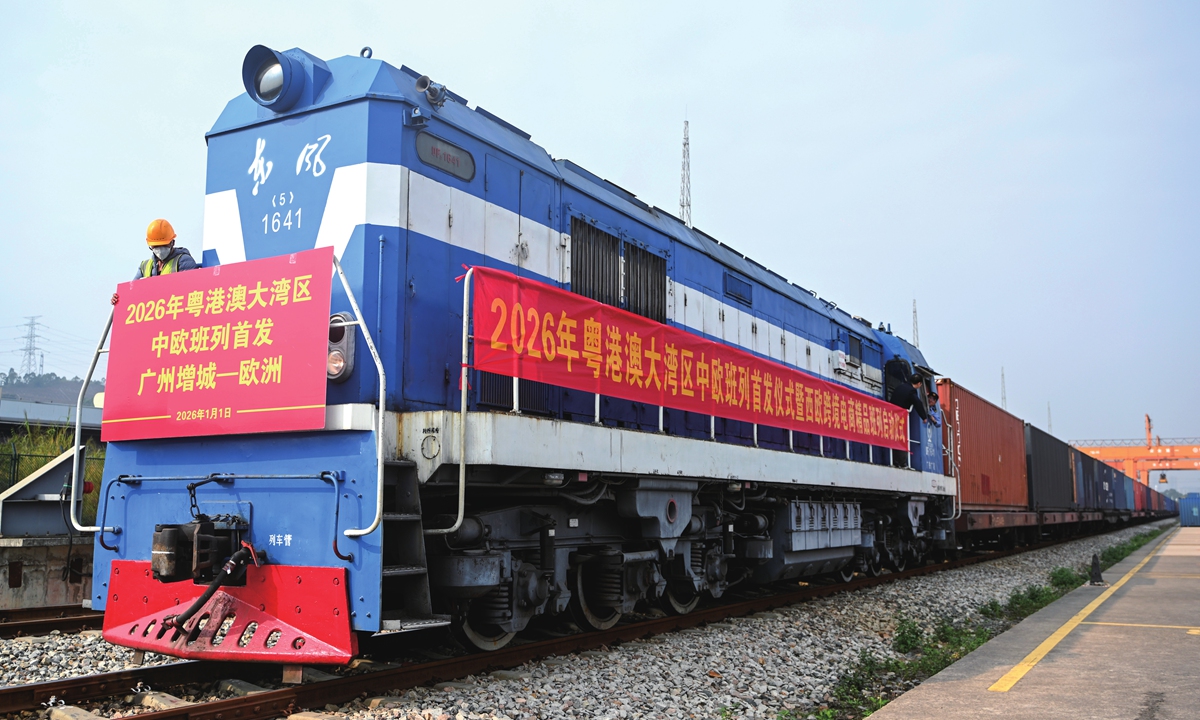
A China-Europe freight train departs from Zengcheng, Guangzhou of South China's Guangdong Province heading toward Europe via Korgos in Xinjiang Uygur Autonomous Region on January 1, 2026. The train is the first China-Europe freight train departing from the Guangdong-Hong Kong-Macao Greater Bay Area in 2026. Photo: VCG
China has entered the period of local two sessions in recent days, during which multiple localities have intensively outlined key priorities for the construction of the China-proposed Belt and Road Initiative (BRI) in 2026, with tasks including strengthening cooperation on a wider scale, accelerating "going global" efforts, and achieving further progress in the China-Europe Railway Express.
Over the past decade, especially during the 14th Five-Year Plan period (2021-25), the BRI has made solid and substantial accomplishments, becoming a widely welcomed public good and a major practical platform for advancing the building of a community with a shared future for humanity, experts said. They noted that the high-quality development of the BRI during the 15th Five-Year Plan period (2026-30) will make greater contributions to the world amid unprecedented changes unseen in a century.
Priorities outlined
The fifth session of the 14th Guangdong Provincial People's Congress kicked off in Guangzhou on Monday. The provincial government work report highlighted that Guangdong will expand high-level opening-up, demonstrate greater effectiveness in serving and integrating into the new development paradigm, serve as a base, a platform, and a channel to ensure the smooth operation of domestic and international dual circulation, and act as a national hub for high-level opening-up, local media outlet Guangzhou Daily reported on Monday.
"Dual circulation," the new development pattern that China adopted in 2020, takes the domestic market as the mainstay while allowing domestic and foreign markets to reinforce each other.
In particular, the provincial government work report stressed in-depth integration into the joint construction of the BRI and expanding the international maritime shipping route network.
"Guangdong's local government work report charts a clear direction for the high-level opening-up of the province, as four core advantages enable the manufacturing hub to participate in the high-quality development of the BRI," Xia Yang, deputy head of the China Chamber of Commerce of Import and Export of Foodstuffs, Native Produce and Animal By-products, told the Global Times on Thursday.
Xia said Guangdong's advantages lie in manufacturing and food processing capacity, extensive overseas Chinese networks, the integration within the Guangdong-Hong Kong-Macao Greater Bay Area, and digital empowerment.
According to the government work report of Northwest China's Shaanxi Province delivered on Tuesday, for 2026, the province aims to deeply integrate into the BRI framework, enhance the development of the Shanghai Cooperation Organisation agricultural base, and deepen innovative agricultural cooperation between China and Central Asia, domestic news site people.cn reported on Tuesday.
In addition, the province will develop the China-Europe Railway Express economic circle, build an international logistics hub center that integrates ports, trade, and industries, align closely with the New International Land-Sea Trade Corridor, optimize the cross-border layout of industrial and supply chains, and enhance the services efficiency of overseas facilities such as overseas warehouses, per the report.
This year, Northwest China's Gansu Province strives to seize the great opportunities brought about by the BRI and focus on building a strategic corridor for China's westward opening-up, according to the provincial government work report, local media outlet gscn.com.cn reported on Tuesday.
Gansu highlighted upgrading the capacity of open platforms such as comprehensive bonded zones, land ports and airports, and integrated pilot zones for cross-border e-commerce, while accelerating the construction of Lanzhou, the provincial capital, as a node city of the China-Europe Railway Express.
New room for win-win development
Proposed over a decade ago, the BRI has demonstrated its efficacy through the successful implementation of concrete projects across various localities - a highly positive signal for global cooperation, Wan Zhe, professor at the Belt and Road School of Beijing Normal University, told the Global Times on Thursday.
"From these local government work reports, it can be seen that local governments have been transforming a conceptual framework into tangible public good through institutional opening-up. In this process, local authorities have shown increased initiatives in developing BRI projects, leveraging their unique regional advantages to proactively facilitate two-way opening-up," Wan said.
The high-quality development of the BRI has made notable achievements in recent years. In November 2025, the Chancay Port in Peru, a flagship project of BRI cooperation between China and Peru, marked its first anniversary. Since its inauguration a year ago, the new port has grown rapidly, achieving cumulative container throughput of 270,000 standard containers and handling around 1.36 million tons of bulk and general cargo, well above initial forecasts, the People's Daily reported.
The Chinese-built Magufuli Bridge across Lake Victoria in Tanzania was inaugurated in June 2025, marking another landmark project under the BRI, the Xinhua News Agency reported.
Notably, China's trade with countries participating in the BRI became a key growth engine for China's foreign trade in 2025. Bilateral trade with BRI partner countries reached 23.6 trillion yuan ($3.4 trillion), increasing 6.3 percent year-on-year and accounting for 51.9 percent of the country's total foreign trade value, according to data released by the General Administration of Customs.
The Chinese government's efforts to promote global sustainable development are demonstrated by the active and very effective implementation of the strategic BRI, Bolat Nurgaliyev, chairman of the Board of Foreign Policy Research Institute under the Ministry of Foreign Affairs of the Republic of Kazakhstan, told the Global Times in a recent interview.
In more than a decade since its launch, almost all developing countries and some developed countries have joined the family of enthusiastic participants in the BRI. It is a practical way to resolve pressing issues of development of transportation, transit, logistical capacities of different countries and regions, Nurgaliyev said.
Looking ahead, the Recommendations of the Central Committee of the Communist Party of China for Formulating the 15th Five-Year Plan (2026-30) for National Economic and Social Development states that the country will pursue high-quality Belt and Road cooperation.
"We should strengthen strategic alignment with Belt and Road partner countries and better coordinate and manage cooperation programs. We should enhance connectivity in terms of both infrastructure and rules and standards and foster closer bonds with the people in these countries. We need to refine the multidimensional network connecting partner countries and advance both major signature projects and 'small and beautiful' public wellbeing projects," the document states.
In 2026, the BRI is expected to achieve even greater breakthroughs in soft connectivity and people-to-people exchanges, while continuing to advance hard connectivity, Wan said, noting that "by prioritizing small yet beautiful livelihood projects, the BRI will help harness the synergistic advantages of green development, digital trade, and scientific innovation to build more secure and resilient global industrial and supply chains."
RELATED ARTICLES