China, Britain agree to develop long-term, consistent comprehensive strategic partnership in Xi-Starmer meeting
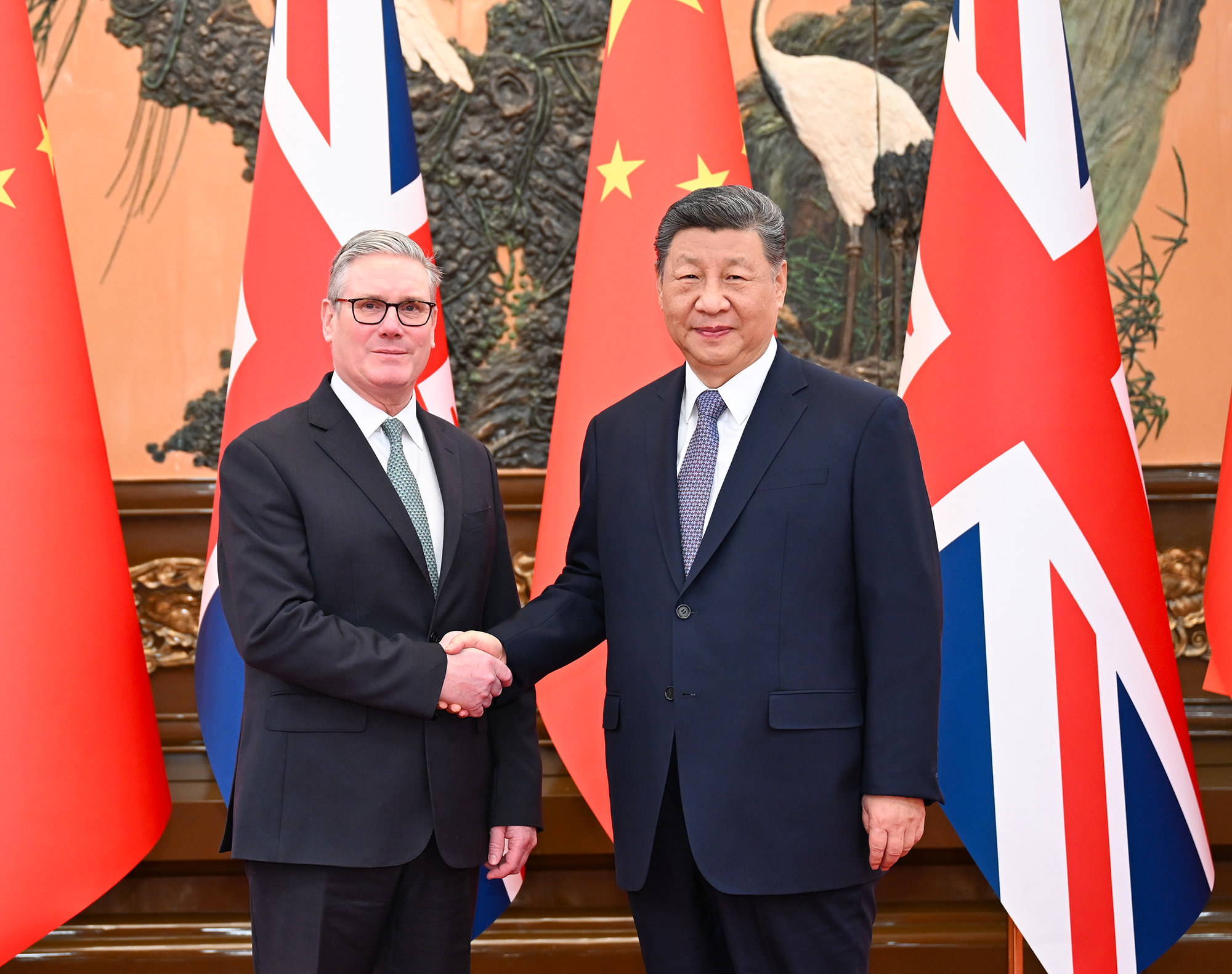
Chinese President Xi Jinping meets with British Prime Minister Keir Starmer, who is on an official visit to China, at the Great Hall of the People in Beijing, on January 29, 2026. Photo: Xinhua
Chinese President Xi Jinping and visiting British Prime Minister Keir Starmer agreed on Thursday in Beijing that the two countries should develop a long-term, consistent comprehensive strategic partnership, Xinhua News Agency reported.
According to China Central Television, noting that the Year of the Horse is just around the corner, Xi said that he believes Starmer's visit will be a success and the cooperation between the two countries will "Yi Ma Dang Xian," which literally means "a horse charging ahead" or is commonly used to mean "taking the lead."
Xi said as the world today is undergoing both changes and turbulence, China and Britain, as permanent members of the United Nations Security Council and major economies, should enhance dialogue and cooperation in order to maintain world peace and stability, while promoting the economy and people's livelihoods in both countries.
Emphasizing the need to see history from a broader perspective, Xi called on the two countries to transcend differences and maintain mutual respect, so that they can translate the promising potential of cooperation into remarkable accomplishments, and open up new vistas for China-Britain relations and cooperation to better benefit both the two peoples and the world at large.
Stressing China's commitment to peaceful development, Xi said that China has never initiated a war, nor occupied an inch of foreign land.
China will never pose a threat to other countries no matter how it grows and develops, he told Starmer, who arrived in Beijing on Wednesday for a four-day official visit, the first by a British prime minister in eight years.
Xi said mutual benefit and win-win results constitute the essence of economic and trade cooperation between China and Britain, thus the two countries should expand mutually beneficial cooperation in education, health, finance and the service industry.
He also called on the two sides to carry out joint research and industrial application in the fields of artificial intelligence, bioscience, new energy and low-carbon technologies, among others, to achieve shared development and prosperity.
"It is hoped that the British side will provide an equal, fair and non-discriminatory business environment for Chinese enterprises," Xi said, adding that both sides should enhance people-to-people and cultural exchanges, and further facilitate travel.
He said members of the British government, parliament and various sectors of localities are welcome to visit China more frequently to foster a balanced, objective, and well-grounded perception of China.
China is actively considering granting a unilateral visa waiver to British people, Xi said.
Noting that the international order has for some time suffered serious disruption, Xi said international law can only be truly effective when all countries, major countries in particular, abide by it. Otherwise, the world would risk regressing to the law of the jungle, he said.
China and Britain, as supporters of multilateralism and free trade, should jointly advocate and practice true multilateralism, and facilitate the establishment of a more just and equitable global governance system, so as to build an equal and orderly multipolar world and realize universally beneficial and inclusive globalization, Xi said.
Starmer conveyed greetings from King Charles III to President Xi. He said he was pleased to be the first British prime minister to visit China in eight years, according to Xinhua.
The UK and China are major global economies and permanent members of the UN Security Council, and under the current turbulent and fragile international situation, it is crucial for the UK, in the spirit of mutual respect and mutual trust, to build a long-term, consistent comprehensive strategic partnership with China, said Starmer.
The UK's long-standing policy on the Taiwan question has not changed and will not change, Starmer noted.
Chinese Premier Li Qiang also met with Starmer on Thursday in Beijing.
The Global Times has learned that during British Prime Minister Keir Starmer's visit to China, the two countries reached a series of significant outcomes aimed at restarting and deepening bilateral ties.
Key achievements included the resumption of the China-UK High-Level Security Dialogue, the convening of a new round of the China-UK Strategic Dialogue and Economic and Financial Dialogue, and the holding of a China-UK Entrepreneurs Committee meeting.
In addition, the two sides signed 12 inter-governmental cooperation documents covering fields such as economy and trade, agriculture and food security, culture, and market regulation.
Business cooperation
During the visit, Starmer described China as a "vital player on a global scale," adding that he "looks forward to taking [both countries'] relationship further," according to the BBC.
He also said he sought a "more sophisticated" relationship with China, CNN reported.
Later on Thursday, multiple media outlets reported that Starmer visited Beijing's Palace Museum, where he said the UK's relationship with China is in a "good, strong place." He described his meeting with the Chinese president as "very good" and "constructive," saying it would lead to a "strengthening of the relationship," according to Sky News.
Also on Thursday, UK drugmaker AstraZeneca announced that it would invest $15 billion in China through 2030 to expand medicines manufacturing and research and development, marking the biggest deal so far during the trip, according to Reuters.
Starmer's visit augurs a reset of a relationship that, a decade ago, was enjoying what was widely described as a "golden age," but which has since become fractured and overly politicized, John Quelch, executive vice chancellor and distinguished professor of social science at Duke Kunshan University, told the Global Times in a written interview on Thursday.
This visit signals an intention to move beyond that impasse and to reestablish a more mature and sophisticated conversation between China and the UK—one that is grounded in realism rather than rhetoric, Quelch said.
Starmer is the latest western leader to engage in a flurry of diplomacy with China as nations hedge against unpredictability from the US under President Donald Trump, The Guardian reported. For the UK, the trip comes at a time of weak economic growth and an urgent need to attract overseas investment, the BBC noted.
Notably, China has hosted a number of Western leaders and officials recently, including French President Emmanuel Macron, Canadian Prime Minister Mark Carney and British Prime Minister Starmer, while German Chancellor Friedrich Merz is also expected to visit China soon, which means leaders from four of the G7 countries visited or about to visit China.
China and the UK enjoy broad prospects for cooperation in the economic sphere, and at a time when the international order is facing challenges, the two countries can work together to take the lead in safeguarding the international law and global cooperation, Li Guanjie, a research fellow at the Shanghai Academy of Global Governance and Area Studies under Shanghai International Studies University, told the Global Times on Thursday.
Such cooperation can advance true multilateralism—one based on cooperation among countries without external interference—rather than power politics driven by hegemonic interests, Li said.
Ahead of the visit, Starmer released a video on social media previewing his trip, saying it marked the first visit to China by a British prime minister in eight years. "We've got 60 CEOs of businesses and cultural organizations coming with us to drum up business, take opportunities and deliver for the United Kingdom," he said, underscoring the commercial focus of the visit.
"The size and seniority of the accompanying business delegation show that this is not merely symbolic," Quelch said. "The UK faces pressing growth challenges, and deeper trade and investment ties with China can play a constructive role."
A visit with a human touch
While Starmer's high-profile China visit has focused on political, economic cooperation and people-to-people exchanges, it has also featured warmer, more human moments. One widely shared scene showed the British prime minister dining at a Yunnan cuisine restaurant in Beijing that had previously hosted former US Treasury Secretary Janet Yellen.
The restaurant, known for its mushroom-based dishes and specialties from Southwest China's Yunnan Province, told the Global Times in an exclusive interview that Starmer arrived with a delegation of around 140 people, including officials, media representatives and business leaders. The atmosphere was described as "very lively, cheerful and relaxed."
The restaurant said it was the first time it had hosted such a large group of foreign guests, adding that "almost everyone used chopsticks, which made the scene quite special."
According to a video released by the restaurant on its social media account, a staff member presented Starmer with a traditional Chinese New Year woodblock print symbolizing prosperity and success in the Year of the Horse after the meal. The staff member thanked him in English, and Starmer responded in Chinese by saying "xie xie" (thank you). He then turned to those around him to confirm whether his pronunciation was correct.
Another video circulating on Chinese social media showed him receiving flowers from a young girl at the airport after greeting Chinese Finance Minister Lan Fo'an, with the girl saying, "Welcome to China."
Ahead of his arrival, Starmer's decision to release preview videos reflects both personal image management and the communication style increasingly adopted by Western politicians, Zhao Junjie, a senior research fellow at the Institute of European Studies at the Chinese Academy of Social Sciences, told the Global Times on Thursday. The move also underscores the importance Starmer attaches to the visit and his intention to convey its significance to a broader audience, Zhao said.
Starmer later posted another video filmed at the Palace Museum, a UNESCO World Heritage site, in which he reflected on Thursday's leader-level summit, saying the meeting would "open up more opportunities for our businesses, for our culture and our sports."
"The key question always for me is 'does this deliver back at home?'" Starmer said, adding that he would attend more meetings in Beijing on Thursday evening and Friday morning before traveling to Shanghai.
Starmer's approach mirrors that of other Western leaders, including Finnish Prime Minister Petteri Orpo, who has also documented his China visit through social media posts showing not only official meetings but street scenes and interactions with local residents.
Through social media, interactions between the Chinese people and foreign officials are presented in a more direct and diverse way, said Zhao. "Videos shared by foreign leaders offer an unfiltered mirror of China's expanding openness and development potential, turning diplomatic encounters into vivid, first-hand reflections of the country's growing opportunities," Zhao said.
After touching down in Beijing, Starmer shared a video clip on social media: stepping out of the aircraft cabin, he waves to those gathered below. Before that, he tells the camera, "Right, let's go."
RELATED ARTICLES