Thumbs-up to young netizens who stood up in Pokémon incident: Global Times editorial
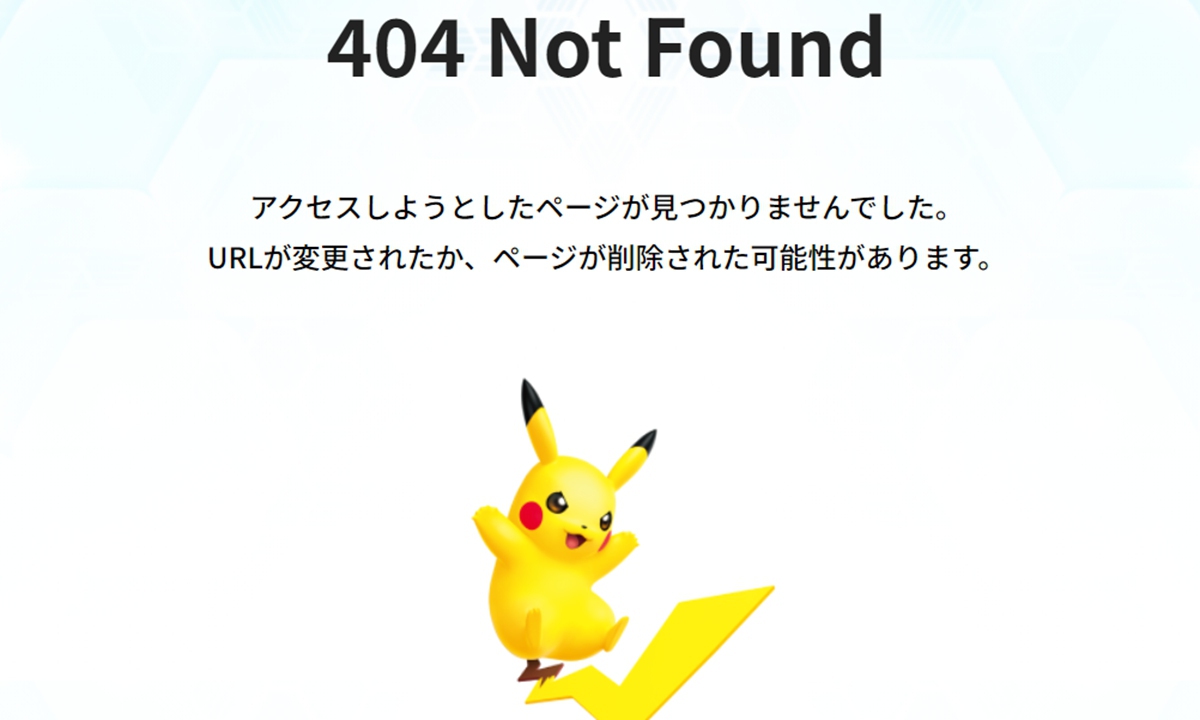
The website of Pokémon's official Japanese website shows a "404 Not Found" error.
Japan's well-known game IP Pokémon announced recently on its official webpage that it was planning to hold relevant event on January 31 at Yasukuni Shrine, which honors Class-A war criminals, triggering a major public outcry. Although the official organizer of the event was not Pokémon, and the event page was quickly taken down amid questioning from both Chinese and foreign netizens, neither Pokémon nor its parent company, Nintendo, has so far offered any explanation.
The Yasukuni Shrine is a symbol of Japanese militarism and it honors Class-A war criminals who bear grave responsibility for war crimes committed against the peoples of Asian countries. Any entertainment or leisure activities held at such a site constitute an open affront to historical truth, and staging events aimed at children there is even more egregious. A major reason the Pokémon IP has become a worldwide phenomenon is its cute image and its friendly positioning that appeals to all ages. Now, people are compelled to ask: as a game company with global influence, what values is Pokémon actually projecting to the world?
Some have argued that the event was independently applied for by players, and that the official side neither directly provided the venue nor staff, and therefore it has nothing to do with Pokémon and Nintendo. This argument is fundamentally untenable. The fact that the event information passed backend review and was openly posted on Pokémon's website means that responsibility cannot be shirked. Moreover, this is not the first time Pokémon has "crossed the line" on the Yasukuni Shrine issue. In 2016, its mobile game Pokémon Go designated Yasukuni Shrine as an in-game "gym"; in 2019, employees of the Pokémon production company publicly "ghost worshipped" at the shrine. These actions drew heavy criticism. There is reason to suspect that this time, too, it is unlikely to have been a mere "accidental oversight."
Since the establishment of diplomatic relations between China and Japan, cultural exchanges have remained a vital source of interaction between the two countries, even at times when bilateral ties were "deeply frozen." Nintendo entered the Chinese mainland market in the 1990s, sparking a gaming craze among young people in China. This not only brought the company recognition, but also inspired many Chinese players to develop an interest in Japanese culture, thereby promoting people-to-people exchanges between the two countries. Such exchanges are valuable. If it is sacrificed on the altar of militarism, the losses will not be limited to Nintendo alone.
In this incident, the swift, rational and resolute response of China's young netizens deserves high praise. They were the first to identify the problem and continued to speak out on social media with a strong sense of justice. Growing up during a period of China's vigorous development, Generation Z has demonstrated a clear boundary of national interest and a deep sense of patriotism when confronted with matters of principle. They have diverse and wide-ranging interests, but this never blurs their grasp of historical justice. This attitude of "games are games, principles are principles" is a vivid reflection of the patriotic spirit of Chinese youth in the new era. Proficient in digital skills and adept at using social media and other new tools, they defend national interests and dignity in ways that belong to this time, becoming an emerging force in external interactions that cannot be ignored.
This collective action by young Chinese netizens is not an isolated case. From the wide-ranging "cost-of-living comparison" on social network platform Xiaohongshu to debates sparked by the "US kill line"; from public outrage over cultural offenses by Western luxury brands to questions faced by some foreign companies over Taiwan-related questions, young people have played a significant role in many hotspot events. Behind this lies the awakening of national pride among the younger generation, the outward expression of cultural confidence, and also an important sign of the growing maturity of the Chinese market.
They prove with their actions that the once-popular Western prediction that "Chinese youth would be brainwashed by Western culture" was completely wrong. The Chinese youth in the new era is a generation with the nation in their hearts, a clear sense of right and wrong in their eyes, and a strong sense of responsibility on their shoulders.
Now, calls from netizens for Pokémon and Nintendo to respond directly are growing. Pokémon and its affiliated companies enjoy a vast fan base and substantial commercial interests in China. This is due to China's open market environment and the support of several generations of Chinese consumers.
However, commercial success in no way justifies hurting the feelings of the Chinese people. We urge Pokémon and Nintendo to take this incident seriously, promptly provide a sincere explanation and apology to Chinese consumers for lapses in review and for hurting the feelings of the Chinese people, and remain vigilant against attempts by certain ill-intentioned forces to stir up trouble.
China's vast market is a great opportunity for the world. We welcome companies from all countries, including Japan, to share in the enormous dividends of China's trillion-level market. However, foreign companies operating in China should also abide by Chinese laws and respect the national sentiments of the Chinese people.
This is the most basic principle that any company should follow when investing, operating, and conducting cooperation in other countries. Only by doing so can credibility be earned and win-win outcomes achieved.
RELATED ARTICLES