Illustration: Chen Xia/GT
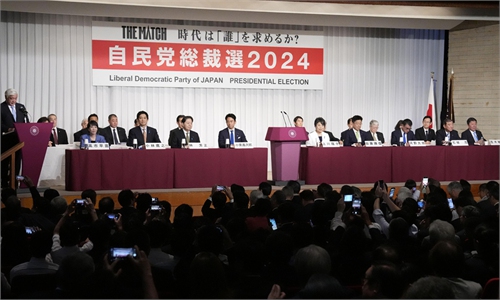
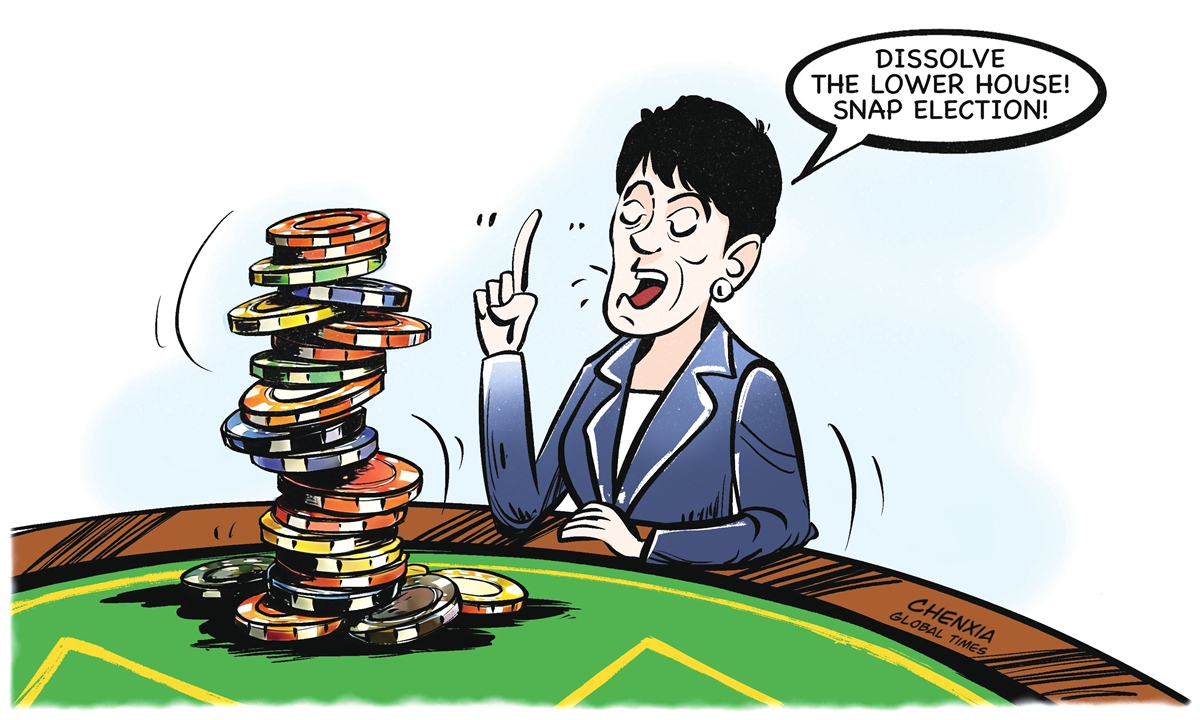
Campaigning for Japan's House of Representatives election has officially begun, and Prime Minister Sanae Takaichi's core objective is clear: to seize power through this election. Her decision to dissolve the lower house and call an early election is, without doubt, a political gamble launched under a misreading of inflated approval ratings. The move faces multiple challenges and is likely to accelerate the restructuring of Japan's party landscape toward a more pluralistic and competitive configuration.
An NHK opinion poll released on January 26 shows the approval rate for the Takaichi cabinet at 59 percent, down three points from two weeks earlier, and the disapproval rate at 26 percent, up five points. Nearly half of respondents said the decision to dissolve the lower house was inappropriate.
A closer look suggests that the seemingly solid approval ratings the Takaichi cabinet has maintained since taking office are in fact a temporary aggregation of attitudes from several heterogeneous groups: core supporters, provisional acquiescence from coalition partners, observers among supporters of other parties, and voters with no party affiliation.
Support from the latter three groups is often fluid and conditional and does not represent stable endorsement of Takaichi's domestic or foreign policies. Public attitudes toward the Takaichi cabinet are largely characterized by short-term "tolerance" or strategic expectations. The approval rating is thus more an illusion than evidence of substantive support for the LDP. Converting these inflated figures into actual votes is the first major challenge Takaichi faces.
Another challenge lies in the structural impact of Komeito's departure from the ruling coalition. A split with Komeito not only deprives the LDP of a long-standing ally that provided stable organizational votes, but also means that some of those votes are likely to flow to the LDP's competitors, creating a magnified "vote diversion" effect. On the eve of the lower house dissolution, Komeito joined forces with the largest opposition party, the Constitutional Democratic Party of Japan (CDP), to form a Centrist Reform Alliance (CRA) for the election. Though hastily assembled, the alliance clearly aims to consolidate centrist and reform-minded voters. It objectively strengthens the cohesion of the anti-LDP camp while giving Komeito's traditional supporters a clear new electoral direction, narrowing the LDP's room to win them back.
To cope with these difficulties, the Takaichi cabinet has sought to adjust its policy orientation to attract voters from camps such as the Democratic Party for the People (DPP) and Sanseito — an approach that carries notable risks. Takaichi's signal at the time of dissolution that she intends to "end excessive austerity" in fiscal policy has been interpreted as an attempt to blunt the issue advantage of opposition parties such as the DPP, which is advocating tax cuts. At the same time, the LDP has continued to shift rightward on issues such as immigration and foreign policy, with an increasingly populist tone, in an effort to appeal to conservative voters on the right. These moves are intended to narrow the policy distance between the LDP and specific opposition constituencies.
However, such vote-driven strategic adjustments contain inherent contradictions. First, data suggest that the number of votes that might shift from the LDP to these other parties is actually limited, with complex underlying causes that cannot be reduced to a single ideological factor. Second, excessive accommodation of conservative issues to win over right-wing voters risks alienating the centrist electorate and business community on which the LDP has long relied, while also further straining relations with neighboring countries. Moreover, frequent or abrupt reversals of policy directions pursued by successive administrations for short-term electoral gain could undermine public confidence in policy continuity.
The opposition camp faces challenges as well. While the CRA seeks to integrate opposition forces, its hasty formation has resulted in low public recognition. Unless the alliance rapidly raises its profile during the campaign, it may struggle to effectively consolidate centrist or anti-LDP votes. At the same time, other opposition parties such as Sanseito and the DPP see the election as an opportunity to expand their influence. Competition among them could disperse votes in some districts, partially offsetting the LDP's disadvantage from losing Komeito's support.
In addition, the election faces several constraints. Policy positions among major parties have become increasingly homogeneous on key issues, depriving the campaign of clear focal points. Frequent winter rain and snow not only hinder rallies but may also dampen voter turnout. Moreover, this is the third major national election within two years, raising the risk of voter fatigue.
With multiple factors intertwined, uncertainty surrounding the election outcome has intensified. Regardless of the final seat distribution, the election process itself reflects the ongoing fluidity and restructuring of Japan's party system — developments whose impact will extend beyond a single contest to shape future policy directions and the broader political landscape.
The author is a lecturer at Inner Mongolia Normal University. opinion@globaltimes.com.cn