Chinese team identifies Asia's first Middle Jurassic amphibian tracks in Beijing, first discovered by a 12-year-old primary school student
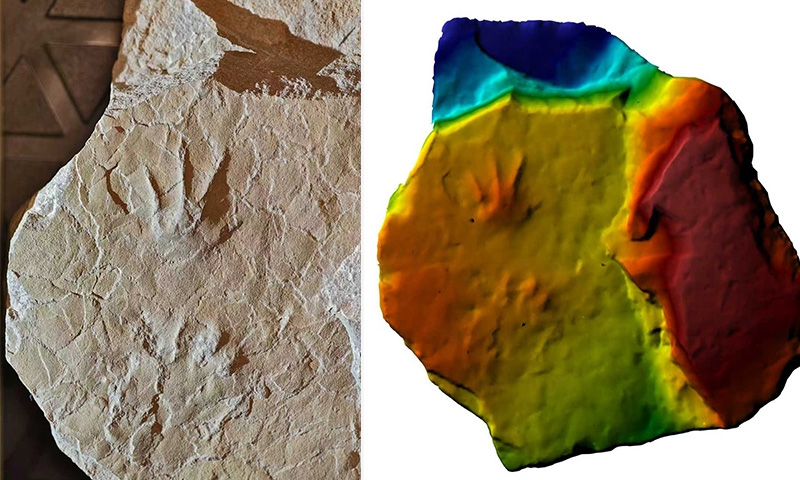
Footprint fossil specimen (left) and its 3D image of the amphibian track. Photos: Courtesy of Xing Lida
A Chinese-led research team has identified Asia's first recorded amphibian footprint fossils from the Middle Jurassic period in Beijing, filling a major gap in the study of Jurassic amphibian trace fossils in China and the wider region. The findings were published online on Friday in the academic journal Ichnos.
"This is the first scientifically described amphibian footprint fossil from Jurassic strata in both China and Asia," according to Xing Lida, an associate professor and doctoral advisor at the School of Earth Sciences and Resources, China University of Geosciences, Beijing (CUGB). He noted that previous Jurassic vertebrate footprint records in the Beijing area mainly involved dinosaurs and turtles, with no amphibian tracks previously reported.
The fossil was initially discovered by Ni Jingchen, who was only 12 years old at the time and was a primary school student in Beijing. He is now studying at a middle school in the capital, Xing told the Global Times.
The fossil consists of two footprints preserved on the same slab of rock, discovered on a roadside slope near Jiulong Road in Longquan town, Mentougou district in Beijing. The two prints form a connected forefoot-hindfoot trackway, likely left by the same animal during continuous movement. One well-preserved print, identified as a left forefoot, shows four distinct toes in a fan-shaped pattern. The footprint measures just 1.5 centimeters long and 1.3 centimeters wide, with slender toes and pointed tips.
To extract detailed information from the tiny traces, the team used photogrammetric three-dimensional modeling to generate high-resolution digital models, revealing subtle surface features. After careful analysis, the researchers concluded that the trackmaker was most likely belonged to the salamander suborder, the most species-rich group of modern tailed amphibians, including salamanders and axolotls.
The discovery also indicates that during the Middle Jurassic Yaopo Formation, around 160 million years ago, small amphibians adapted to terrestrial activity already inhabited lake-marsh environments in the Beijing region, alongside ferns, ginkgoes and cycads, forming a complex ecosystem.
"This provides important evidence for understanding the paleogeography, paleoecology and biodiversity of North China during the Middle Jurassic," Xing said.
RELATED ARTICLES