‘Greenlandic children will grow up believing that the US cannot be trusted as a political actor’ : Greenlandic politician
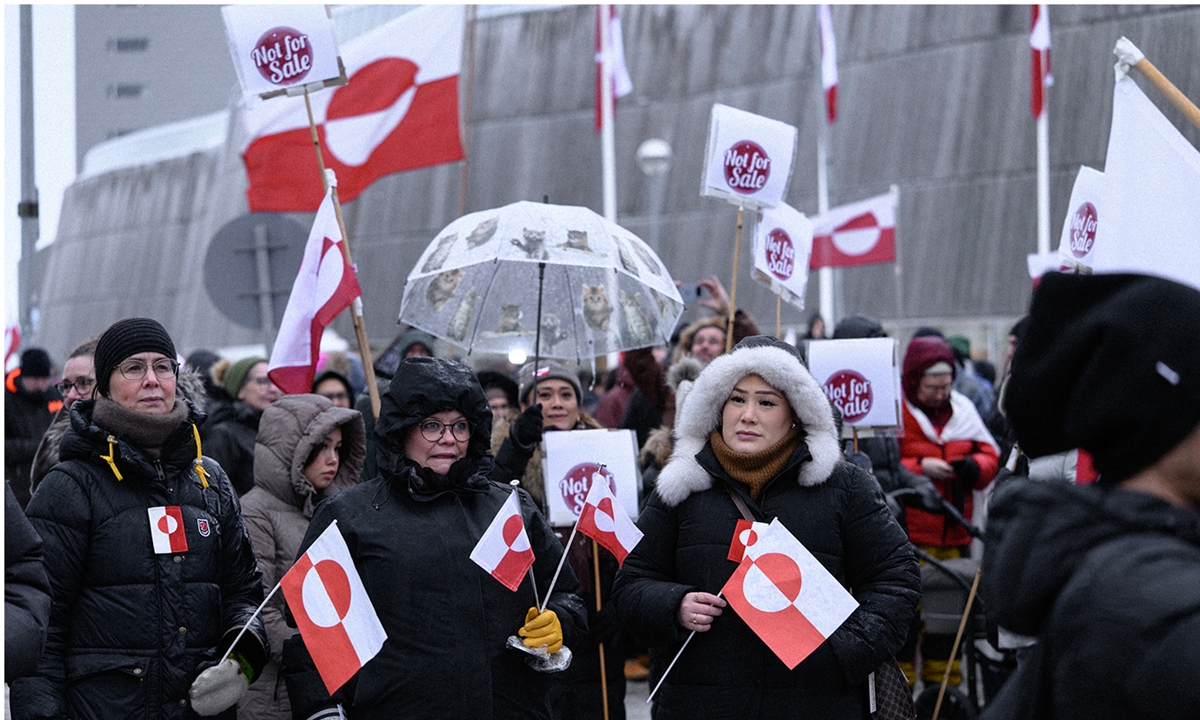
People protest against the US plan to take over Greenland in Nuuk, Greenland, on January 17, 2026. Photo: Courtesy of Martinussen
Editor's Note:The crisis surrounding the US threat of a takeover of Greenland continues to exacerbate. US, Danish and Greenlandic officials met on January 28 to discuss a new framework deal regarding Greenland. Thousands of people in Greenland and Denmark have protested against the US takeover plan recently. How do Greenlanders view this escalating takeover rhetoric and what has changed in their daily lives since this self-governing island, with around 57,000 inhabitants, became the center of global attention? Global Times (GT) reporters Chen Qingqing and Bai Yunyi interviewed Greenlandic politician and co-founder of the territory's liberal Cooperation Party, Tillie Martinussen (Martinussen), to understand how local residents perceive this rapidly changing geopolitical landscape.
GT: Since the US ramped up attempts to take over Greenland, have you noticed any changes in daily life in Nuuk, Greenland's capital? For example, have there been any changes in local conversations or in the mood of the community?
Martinussen: At first, there was widespread disbelief - people were shocked and thought it must be a joke. That quickly turned into anger, with many feeling deeply outraged. Then a sense of fear set in: the fear that we could suddenly be invaded by an ally.
Rifle stores here have sold out, and emergency generators, power banks and solar chargers are either almost gone or already sold out. The Greenlandic government has advised people to ensure they have enough food, water and necessary medicines for five days - just in case, they say, even though such a scenario is unlikely. At the same time, we have seen an increased presence of soldiers from European countries and NATO, and Denmark has rapidly and significantly stepped up its presence here. This appears to be about understanding what is happening on the ground and preparing for any possibility, even the unthinkable scenario of confronting the US - something no one wants.
The sense of normalcy has been disrupted. We've suddenly seen foreign journalists arriving from all over the world - which has been a stunning surprise for Greenlanders. Given that our total population is only about 57,000, with another 17,000 Greenlandic people living in Denmark, this sudden attention has been overwhelming. Many people feel unsettled and tired and just want things to calm down so they can return to their everyday lives.
Greenlanders are usually very peaceful. Firearms here are traditionally used for hunting, which is an important part of our culture and something our ancestors relied on. But now, in contrast to how things normally are, some people are even talking about the possibility of street fights if an invasion were to happen. It's been a shocking and chaotic change compared to the calm we're used to.
GT: Could you share more details about the recent protests in Greenland opposing the US takeover claims?
Martinussen: Greenland is an autonomous part of the Kingdom of Denmark. We have our own parliament, our own government and our own prime minister. Even raising the idea of "buying" us treats us as if we were property. No one wants to be bought like cattle. Matters escalated further when President Donald Trump began talking about taking Greenland by force. That is when the anger truly erupted.
I should add that Greenlanders serve in the Danish Armed Forces, which is where we receive military training. Although service is voluntary, Denmark - including Greenlandic soldiers - has consistently stood alongside the US in international conflicts under alliance agreements. In some of those wars, which were not even ours, Denmark suffered among the highest casualties per capita, alongside the US. We honored our commitments, respected international law and acted as loyal allies. We also have veterans here who fought in those conflicts, with many losing their lives.
That is why the talk of buying us, invading us or dismissing our military contributions feels not only frightening but deeply insulting and confusing. It has angered people across Europe as well. I don't know what is happening with the Trump administration, but I can say clearly that this approach is not popular - here or elsewhere.
For such a small nation to suddenly be threatened by a superpower we have been loyal to for nearly 80 years is unbelievable. It has fundamentally shaken trust in the US, perhaps permanently. Future generations of Greenlandic children will grow up believing that the US cannot be trusted as a political actor.
GT: We all know that NATO is led by Washington. How do you see an invasion playing out? Does NATO have the capability to protect Greenland?
Martinussen: It really depends on how an invasion would happen. If it were massive airstrikes - bombing us indiscriminately - there would be very little we could do. But if it were a ground invasion with large numbers of troops, the situation would be different. NATO has made it clear that they would fight on our side, at least for a time, and given that US forces are already stretched across multiple fronts, we believe we could put up a meaningful resistance.
If it came down to street fighting or prolonged resistance - similar to what we have seen in places like Syria - it would not be as easy as they might expect. That said, realistically, we would probably still lose in the end.
What matters right now is that others are standing up for us. We have seen a significant increase in allied troops here, and we are immensely grateful for that support.
At the same time, many of us in Greenland feel that we are witnessing the emergence of a new world order. We never expected Greenland to be anywhere near the center of such a critical moment, yet history seems to be shifting in real time. The global landscape is likely to change significantly - especially in terms of trade partnerships and security arrangements - because the US government has shown a willingness to abandon long-standing agreements.
Everyone wants peace. No one wants war. I don't believe the American people want a war with Greenland, and I don't even think the US as a whole wants one. But trust has been broken, and the environment has fundamentally changed.
GT: Do you trust that countries like France and Germany will stand up for Greenland and its people, even if their own interests are at risk?
Martinussen: Yes - and here is why. If Greenland were to fall, Canada could be next. After that, attention could turn to places like Cuba or Mexico. Suddenly, every small country would be living in fear of being invaded by a larger power. If that is what the new world order looks like, then we are effectively moving backward to a time before WWII. That is exactly why institutions like the UN and NATO were created - to ensure that no country could act like Nazi Germany did, and that nothing like Adolf Hitler's expansionism would ever happen again. Denmark understood this clearly, which is why it became one of the founding members of NATO.
What we do not want is foreign ownership of our land or control over our natural resources. We do not want any outside power to dominate our minerals. Cooperation is possible, including on issues like the Northeast Passage, but only if partners are trustworthy, fair to the Greenlandic people and responsible toward the wider world. That is the line for us.
GT: Some US officials have said that both the growing Russian and Chinese influences in the Arctic pose a threat. From your perspective and observation, how irrational is this assessment?
Martinussen: At the moment, there is absolutely no party threatening us other than the US itself. We have seen no threats from China at all. We haven't seen Chinese warships, we haven't heard aggressive statements, and we haven't observed any hostile actions of any kind here. So hearing China used as an excuse is frankly baffling to us. From our perspective, China is simply being used as a pretext - something the US can point to in order to justify talking about invading Greenland. There is no basis for that claim. Neither Greenland nor Denmark has ever raised China as a security threat here, and we certainly do not support that narrative in any way.
RELATED ARTICLES