Photo: Xia Qing/GT
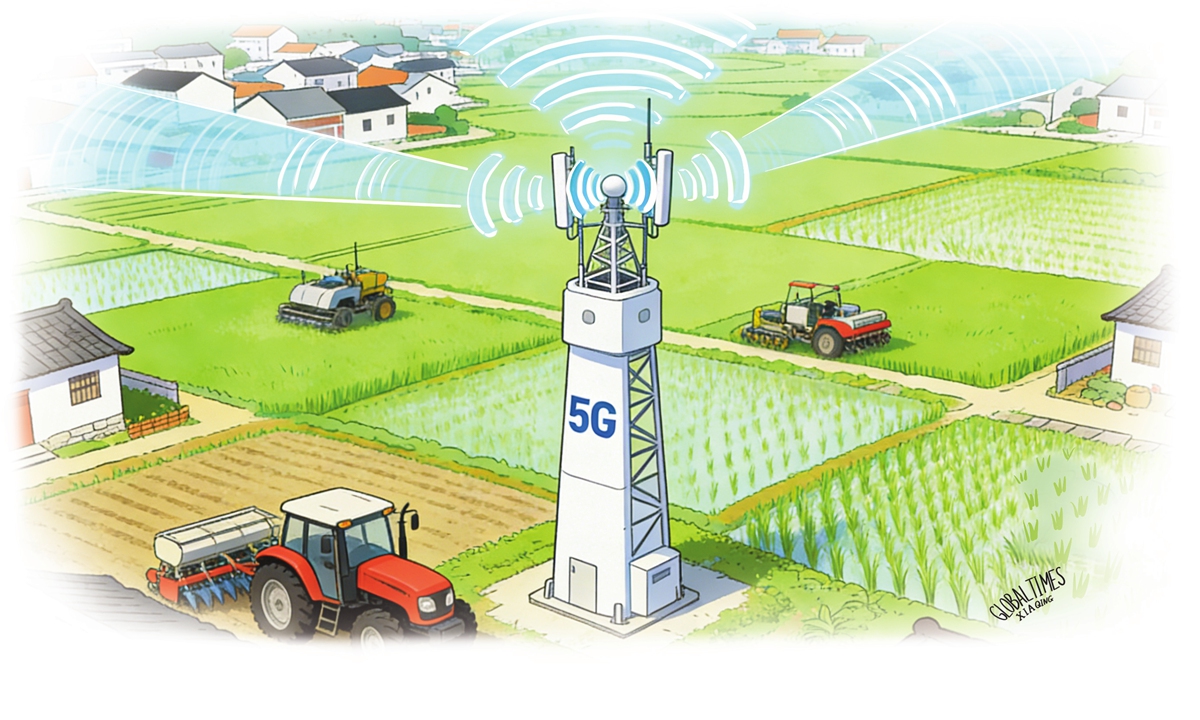
As China's 5G network continues to extend into rural and remote areas, improved connectivity is increasingly shaping digital consumption patterns beyond major Chinese cities.
The CCTV News reported on Sunday that, as of 2025, 95 percent of China's administrative villages had access to advanced 5G networks. The figure does not, by itself, indicate a change in consumer demand, but it provides a useful reference for examining how digital infrastructure is spreading across China's lower-tier markets - third-tier cities, smaller urban centers and rural areas - which are drawing increasing attention as a potential source of incremental consumption.
The pace of 5G network roll-out has varied across regions, with some local deployment advancing faster than some industry observers might expect.
For instance, Ren Min You Dian reported a case from the mountainous area of Shangluo, where, shortly after the 2026 New Year's Day, a villager surnamed Wang received a winter coat delivered by drone to a village service station. The delivery was part of a locally established "air logistics corridor" supported by 5G-Advanced (5G-A) infrastructure. While such examples remain limited in scale, they highlight how enhanced network capacity can improve access to goods and services in rural areas.
The roll-out of 5G and 5G-A is beginning to influence economic activity in rural areas. Improved connectivity allows for more efficient data collection, remote monitoring, and coordination of equipment in agricultural operations. Some local producers are experimenting with greater digitalization and new technologies to enhance efficiency and reduce production risks. These changes are gradual rather than immediately transformative, but increased stability in output and income can shape household expectations and, over time, affect consumption patterns.
Improved connectivity is also altering how rural residents engage with goods and services. More reliable networks make e-commerce platforms, digital payments, and online services easier to incorporate into daily routines. Livestream commerce, online education, and digital entertainment are finding uses that fit local spending patterns. Rather than simply extending urban consumption models, the services are being tailored to local conditions, producing a more varied and segmented consumer landscape across lower-tier markets.
First, rural e-commerce has grown alongside the new shifts in consumer behavior. The roll-out of digital infrastructure, particularly 5G, has facilitated rapid growth in online commerce. According to cctv.com, in 2025 rural online retail sales grew by 6.7 percent year-on-year, while online sales of agricultural produce rose by 9.9 percent year-on-year.
Second, the development of 5G networks is enabling remote services to reach rural consumers, creating new opportunities for consumption. Tele-medicine, online tutoring, and remote technical support are becoming more accessible in rural markets.
Third, faster networks are facilitating the spread of short-form videos and social media in rural areas. This exposure is introducing elements of contemporary lifestyle, encouraging emotion-driven and trend-driven spending, and adding a new dimension to consumer behavior in lower-tier markets.
Reports indicate that lower-tier markets account for roughly 70 percent of China's population and around 60 percent of total retail sales of consumer goods, highlighting their potential to support domestic consumption.
According to the National Bureau of Statistics, per capita consumption expenditure among rural residents rose by 5.1 percent in 2025, and by 5.3 percent in real terms, after adjusting for prices, outpacing growth in urban populations. These figures underscore the growing contribution of lower-tier markets to China's domestic consumption.
China's lower-tier markets are evolving, with consumption steadily rising despite some challenges, including disparities between urban and rural areas in certain sectors. These challenges reflect differences in infrastructure and access to services, but they also highlight opportunities for further investment. By addressing these gaps, it is possible to unlock further consumption potential and foster more balanced economic development across lower-tier markets.
Over the next five years, mobile network coverage in rural and remote areas is expected to expand further, while connectivity quality is projected to improve. These developments are likely to release additional consumption potential and foster more diverse economic activity across lower-tier markets.
The maturation of the rural markets presents greater opportunities for both domestic and international companies. As rural consumers become increasingly connected and their spending patterns evolve, businesses able to adapt to local conditions and new avenues for growth are to be developed, reflecting a broadening and increasingly sophisticated landscape for China's domestic consumption.
The author is a reporter with the Global Times. bizopinion@globaltimes.com.cn
RELATED ARTICLES