Uruguayan president’s China visit signals assertion of economic independence, policy autonomy
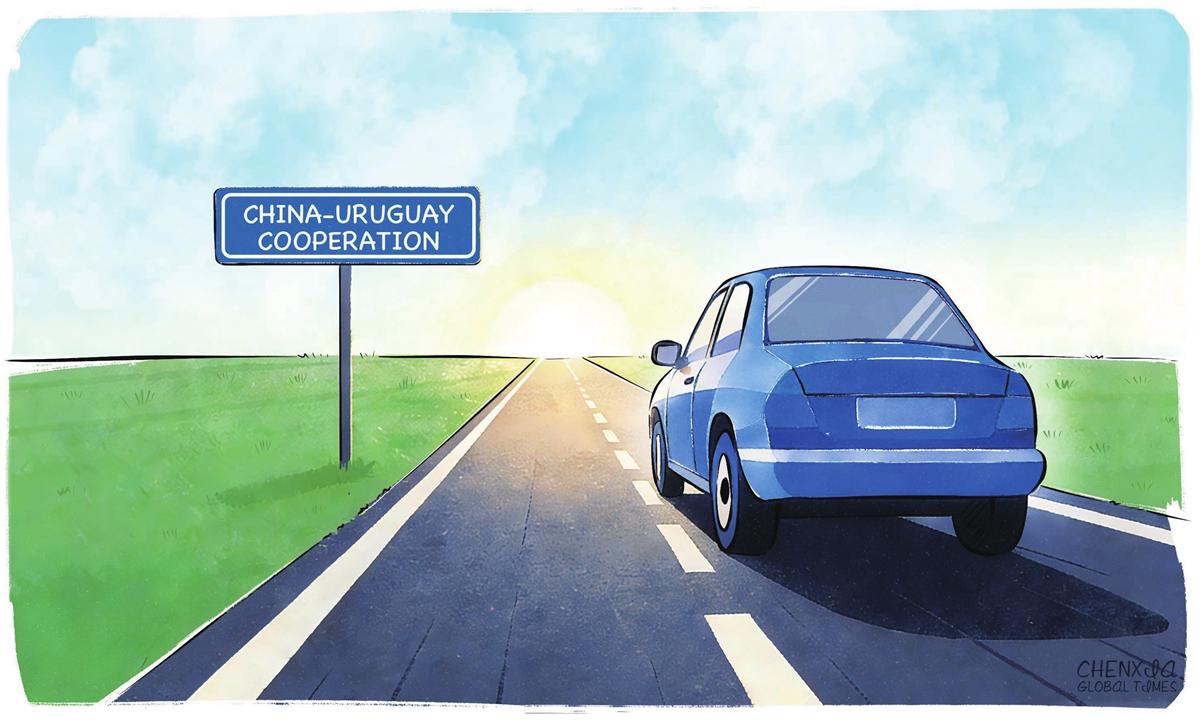
Illustration: Chen Xia/GT
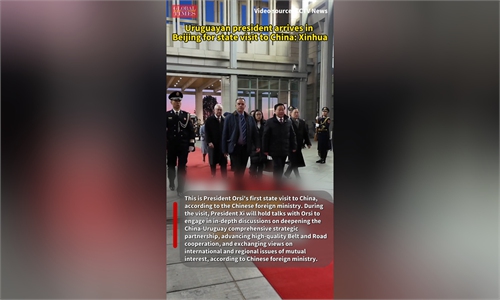
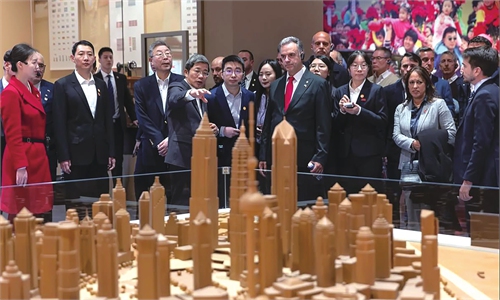
President of the Oriental Republic of Uruguay Yamandu Orsi arrived in Beijing on Sunday for a seven-day state visit - his first as head of state. The two sides will discuss deepening the China-Uruguay comprehensive strategic partnership, high-quality Belt and Road cooperation, and international and regional issues of mutual interest during a leaders' meeting, according to Xinhua. This visit offers a useful snapshot of how parts of Latin America's relationship with China are beginning to change in tone, content and political management.
What stands out is the shift in framing. The politics of predictability also matter. A seven-day state visit and a formal leaders' meeting are instruments of reassurance: to domestic constituencies that the government is cultivating major markets; to investors that policy is not improvisational; and to external powers that the country seeks agency, not dependency. Orsi's delegation - roughly 150 people, including cabinet ministers, state agencies, provincial leaders, and representatives from companies and business chambers - is designed to turn symbolism into concrete deals.
China has been Uruguay's largest trading partner for over a decade, accounting for roughly a quarter of its exports. Yet the language now surrounding this economic relationship emphasizes stability and institutional depth. The term "comprehensive strategic partnership" signals an effort to place ties on a steadier footing, less vulnerable to electoral cycles or commodity swings. For a small, open economy like Uruguay, that language means: China is not simply a buyer of what we sell today, but a long-term variable in national development planning.
Equally striking is the qualifier now routinely attached to Belt and Road cooperation: "high-quality." The early phase of China's engagement across Latin America was judged by volume - how much trade expanded, how quickly loans were disbursed, and how many projects were announced. The next phase is more likely to be judged by texture: financing terms, environmental and social standards, local content, technology governance, and the capacity of institutions to supervise complex infrastructure.
The agenda is also broadening. According to Xinhua, leaders will exchange views on "international and regional issues." China-Latin America ties used to be easier to keep in the economic lane, but they are now harder to quarantine from geopolitics. The timing of Orsi's visit is notable: It comes as US President Donald Trump returns to the "backyard" logic.
A South American head of state spending seven days in Beijing, accompanied by more than 100 business leaders, discussing "strategic partnership" and "international issues," is itself a signal - not necessarily of confrontation, but of assertion that economic survival and development planning cannot be entirely subordinated to another power's conception of spheres of influence. For a country like Uruguay, the risk is securing greater policy autonomy without provoking Washington. That balancing act is becoming an increasingly visible feature of Latin America's engagement with China.
Uruguay is a small economy with a tradition of pragmatic diplomacy and strong incentives to institutionalize ties with its largest markets. Orsi's visit is best read not as evidence of a continental pivot, but as one example of how a subset of governments may try to professionalize engagement with China while preserving room to maneuver.
Latin American countries will continue to seek the benefits of China's market and capital. But they are also trying to build narratives, rules and buffers to cope with the volatility - commercial and geopolitical - that comes with greater proximity.
The focus is shifting to project quality and strategic dialogue, which truly matter. Countries will interact according to their own terms and within the framework of their own constraints. Developing relations with China, under the watchful eye of the major power of the US that still views Latin America as its sphere of influence, is more about breaking through and diversifying its own political and economic security. This is the truly compelling part of the Latin American story.
RELATED ARTICLES