IN-DEPTH / IN-DEPTH
GT investigates: From Western Hemisphere to Persian Gulf, how the US seeks to impose hegemonic control over ‘key regions’
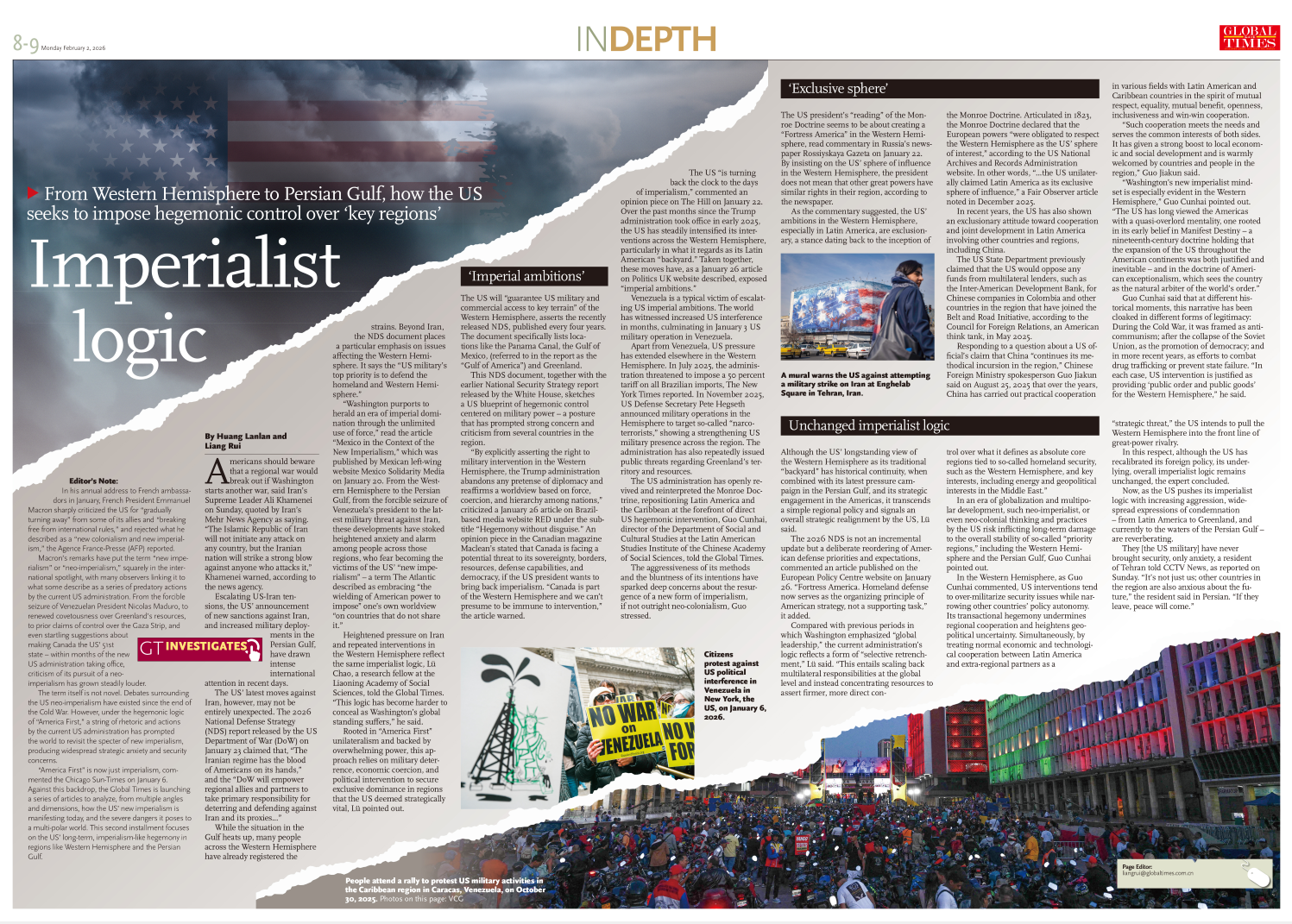
Imperialist logic
By and Liang Rui Published: Feb 01, 2026 11:02 PM

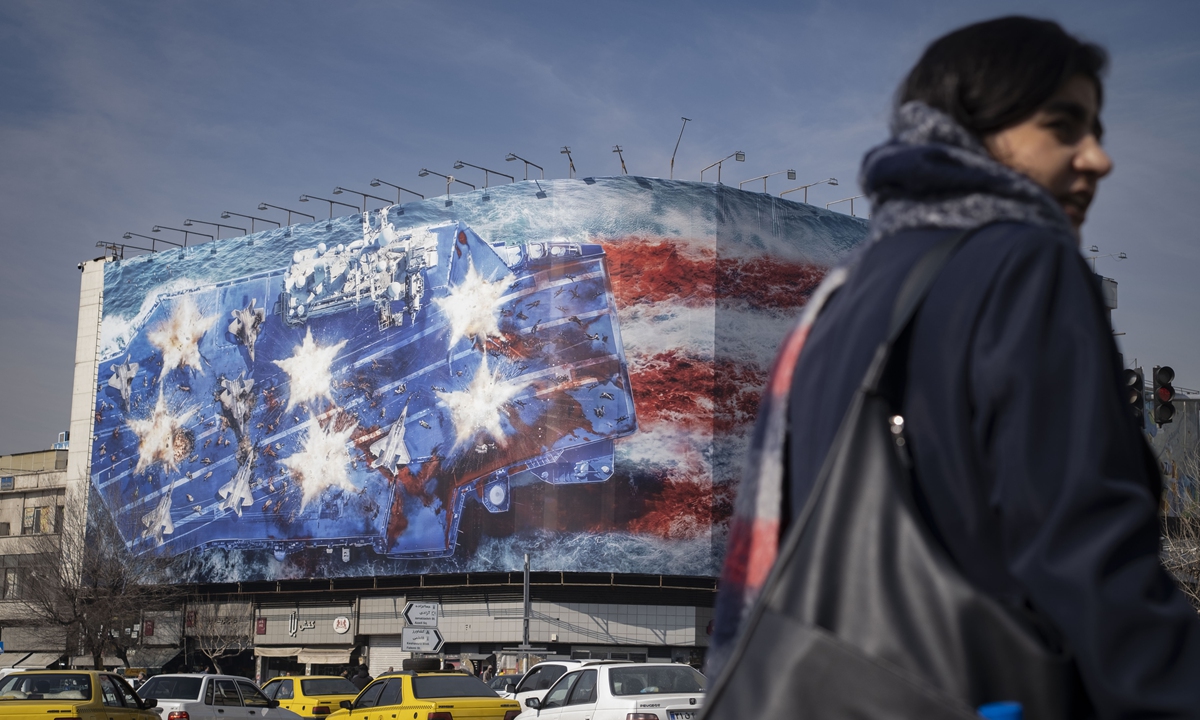
A mural warns the US against attempting a military strike on Iran at Enghelab Square in Tehran, Iran.
Editor's Note:
In his annual address to French ambassadors in January, French President Emmanuel Macron sharply criticized the US for "gradually turning away" from some of its allies and "breaking free from international rules," and rejected what he described as a "new colonialism and new imperialism," the Agence France-Presse (AFP) reported.
Macron's remarks have put the term "new imperialism" or "neo‑imperialism," squarely in the international spotlight, with many observers linking it to what some describe as a series of predatory actions by the current US administration. From the forcible seizure of Venezuelan President Nicolas Maduro, to renewed covetousness over Greenland's resources, to prior claims of control over the Gaza Strip, and even startling suggestions about making Canada the US' 51st state - within months of the new US administration taking office, criticism of its pursuit of a neo-imperialism has grown steadily louder.
The term itself is not novel. Debates surrounding the US neo-imperialism have existed since the end of the Cold War. However, under the hegemonic logic of "America First," a string of rhetoric and actions by the current US administration has prompted the world to revisit the specter of new imperialism, producing widespread strategic anxiety and security concerns.
"America First" is now just imperialism, commented the Chicago Sun-Times on January 6. Against this backdrop, the Global Times is launching a series of articles to analyze, from multiple angles and dimensions, how the US' new imperialism is manifesting today, and the severe dangers it poses to a multi-polar world. This second installment focuses on the US' long-term, imperialism-like hegemony in regions like Western Hemisphere and the Persian Gulf.
Americans should beware that a regional war would break out if Washington starts another war, said Iran's Supreme Leader Ali Khamenei on Sunday, quoted by Iran's Mehr News Agency as saying. "The Islamic Republic of Iran will not initiate any attack on any country, but the Iranian nation will strike a strong blow against anyone who attacks it," Khamenei warned, according to the news agency.
Escalating US-Iran tensions, the US' announcement of new sanctions against Iran, and increased military deployments in the Persian Gulf, have drawn intense international attention in recent days.
The US' latest moves against Iran, however, may not be entirely unexpected. The 2026 National Defense Strategy (NDS) report released by the US Department of War (DoW) on January 23 claimed that, "The Iranian regime has the blood of Americans on its hands," and the "DoW will empower regional allies and partners to take primary responsibility for deterring and defending against Iran and its proxies..."
While the situation in the Gulf heats up, many people across the Western Hemisphere have already registered the strains. Beyond Iran, the NDS document places a particular emphasis on issues affecting the Western Hemisphere. It says the "US military's top priority is to defend the homeland and Western Hemisphere."
"Washington purports to herald an era of imperial domination through the unlimited use of force," read the article "Mexico in the Context of the New Imperialism," which was published by Mexican left-wing website Mexico Solidarity Media on January 20. From the Western Hemisphere to the Persian Gulf, from the forcible seizure of Venezuela's president to the latest military threat against Iran, these developments have stoked heightened anxiety and alarm among people across those regions, who fear becoming the victims of the US' "new imperialism" - a term The Atlantic described as embracing "the wielding of American power to impose" one's own worldview "on countries that do not share it."
Heightened pressure on Iran and repeated interventions in the Western Hemisphere reflect the same imperialist logic, Lü Chao, a research fellow at the Liaoning Academy of Social Sciences, told the Global Times. "This logic has become harder to conceal as Washington's global standing suffers," he said.
Rooted in "America First" unilateralism and backed by overwhelming power, this approach relies on military deterrence, economic coercion, and political intervention to secure exclusive dominance in regions that the US deemed strategically vital, Lü pointed out.
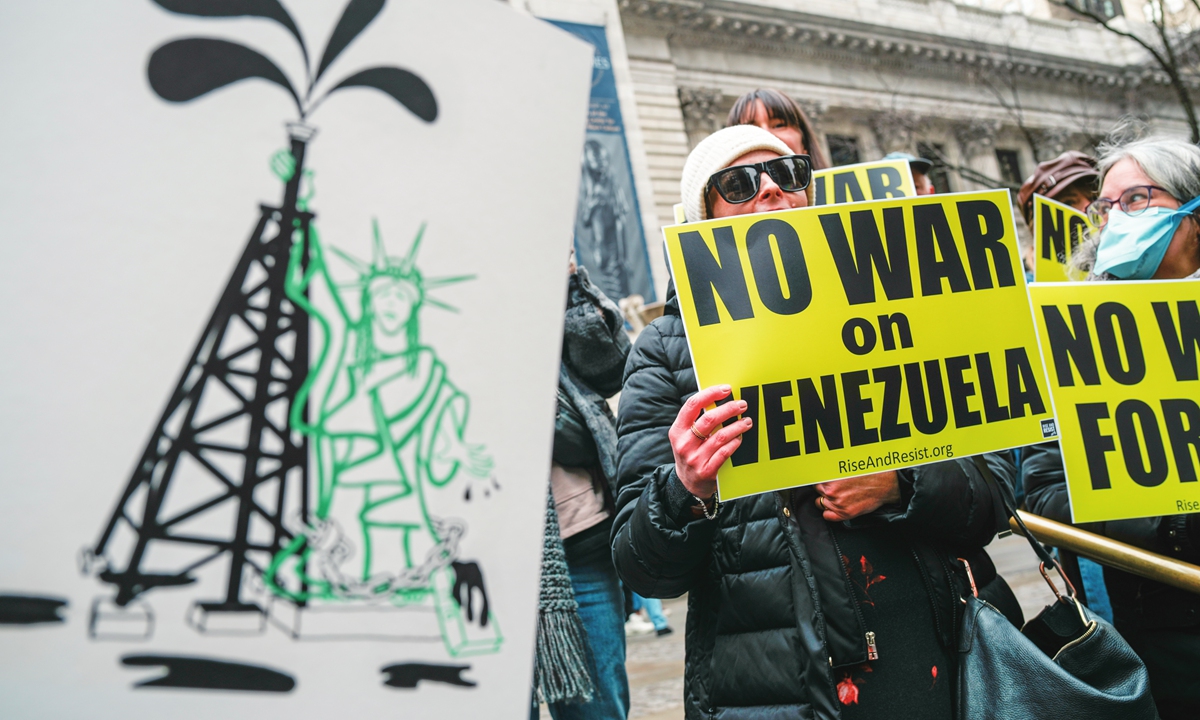
Citizens protest against US political interference in Venezuela in New York, the US, on January 6, 2026.
'Imperial ambitions'
The US will "guarantee US military and commercial access to key terrain" of the Western Hemisphere, asserts the recently released NDS, published every four years. The document specifically lists locations like the Panama Canal, the Gulf of Mexico, (referred to in the report as the "Gulf of America") and Greenland.
This NDS document, together with the earlier National Security Strategy report released by the White House, sketches a US blueprint of hegemonic control centered on military power - a posture that has prompted strong concern and criticism from several countries in the region.
"By explicitly asserting the right to military intervention in the Western Hemisphere, the Trump administration abandons any pretense of diplomacy and reaffirms a worldview based on force, coercion, and hierarchy among nations," criticized a January 26 article on Brazil-based media website RED under the subtitle "Hegemony without disguise." An opinion piece in the Canadian magazine Maclean's stated that Canada is facing a potential threat to its sovereignty, borders, resources, defense capabilities, and democracy, if the US president wants to bring back imperialism. "Canada is part of the Western Hemisphere and we can't presume to be immune to intervention," the article warned.
The US "is turning back the clock to the days of imperialism," commented an opinion piece on The Hill on January 22. Over the past months since the Trump administration took office in early 2025, the US has steadily intensified its interventions across the Western Hemisphere, particularly in what it regards as its Latin American "backyard." Taken together, these moves have, as a January 26 article on Politics UK website described, exposed "imperial ambitions."
Venezuela is a typical victim of escalating US imperial ambitions. The world has witnessed increased US interference in months, culminating in January 3 US military operation in Venezuela.
Apart from Venezuela, US pressure has extended elsewhere in the Western Hemisphere. In July 2025, the administration threatened to impose a 50 percent tariff on all Brazilian imports, The New York Times reported. In November 2025, US Defense Secretary Pete Hegseth announced military operations in the Hemisphere to target so-called "narco-terrorists," showing a strengthening US military presence across the region. The administration has also repeatedly issued public threats regarding Greenland's territory and resources.
The US administration has openly revived and reinterpreted the Monroe Doctrine, repositioning Latin America and the Caribbean at the forefront of direct US hegemonic intervention, Guo Cunhai, director of the Department of Social and Cultural Studies at the Latin American Studies Institute of the Chinese Academy of Social Sciences, told the Global Times.
The aggressiveness of its methods and the bluntness of its intentions have sparked deep concerns about the resurgence of a new form of imperialism, if not outright neo-colonialism, Guo stressed.
'Exclusive sphere'
The US president's "reading" of the Monroe Doctrine seems to be about creating a "Fortress America" in the Western Hemisphere, read commentary in Russia's newspaper Rossiyskaya Gazeta on January 22. By insisting on the US' sphere of influence in the Western Hemisphere, the president does not mean that other great powers have similar rights in their region, according to the newspaper.
As the commentary suggested, the US' ambitions in the Western Hemisphere, especially in Latin America, are exclusionary, a stance dating back to the inception of the Monroe Doctrine. Articulated in 1823, the Monroe Doctrine declared that the European powers "were obligated to respect the Western Hemisphere as the US' sphere of interest," according to the US National Archives and Records Administration website. In other words, "...the US unilaterally claimed Latin America as its exclusive sphere of influence," a Fair Observer article noted in December 2025.
In recent years, the US has also shown an exclusionary attitude toward cooperation and joint development in Latin America involving other countries and regions, including China.
The US State Department previously claimed that the US would oppose any funds from multilateral lenders, such as the Inter-American Development Bank, for Chinese companies in Colombia and other countries in the region that have joined the Belt and Road Initiative, according to the Council for Foreign Relations, an American think tank, in May 2025.

People attend a rally to protest US military activities in the Caribbean region in Caracas, Venezuela, on October 30, 2025. Photos on this page: VCG
Responding to a question about a US official's claim that China "continues its methodical incursion in the region," Chinese Foreign Ministry spokesperson Guo Jiakun said on August 25, 2025 that over the years, China has carried out practical cooperation in various fields with Latin American and Caribbean countries in the spirit of mutual respect, equality, mutual benefit, openness, inclusiveness and win-win cooperation.
"Such cooperation meets the needs and serves the common interests of both sides. It has given a strong boost to local economic and social development and is warmly welcomed by countries and people in the region," Guo Jiakun said.
"Washington's new imperialist mindset is especially evident in the Western Hemisphere," Guo Cunhai pointed out. "The US has long viewed the Americas with a quasi-overlord mentality, one rooted in its early belief in Manifest Destiny - a nineteenth-century doctrine holding that the expansion of the US throughout the American continents was both justified and inevitable - and in the doctrine of American exceptionalism, which sees the country as the natural arbiter of the world's order."
Guo Cunhai said that at different historical moments, this narrative has been cloaked in different forms of legitimacy: During the Cold War, it was framed as anti-communism; after the collapse of the Soviet Union, as the promotion of democracy; and in more recent years, as efforts to combat drug trafficking or prevent state failure. "In each case, US intervention is justified as providing 'public order and public goods' for the Western Hemisphere," he said.
Unchanged imperialist logic
Although the US' longstanding view of the Western Hemisphere as its traditional "backyard" has historical continuity, when combined with its latest pressure campaign in the Persian Gulf, and its strategic engagement in the Americas, it transcends a simple regional policy and signals an overall strategic realignment by the US, Lü said.
The 2026 NDS is not an incremental update but a deliberate reordering of American defense priorities and expectations, commented an article published on the European Policy Centre website on January 26. "Fortress America. Homeland defense now serves as the organizing principle of American strategy, not a supporting task," it added.
Compared with previous periods in which Washington emphasized "global leadership," the current administration's logic reflects a form of "selective retrenchment," Lü said. "This entails scaling back multilateral responsibilities at the global level and instead concentrating resources to assert firmer, more direct control over what it defines as absolute core regions tied to so-called homeland security, such as the Western Hemisphere, and key interests, including energy and geopolitical interests in the Middle East."
In an era of globalization and multipolar development, such neo-imperialist, or even neo-colonial thinking and practices by the US risk inflicting long-term damage to the overall stability of so-called "priority regions," including the Western Hemisphere and the Persian Gulf, Guo Cunhai pointed out.
In the Western Hemisphere, as Guo Cunhai commented, US interventions tend to over-militarize security issues while narrowing other countries' policy autonomy. Its transactional hegemony undermines regional cooperation and heightens geopolitical uncertainty. Simultaneously, by treating normal economic and technological cooperation between Latin America and extra-regional partners as a "strategic threat," the US intends to pull the Western Hemisphere into the front line of great-power rivalry.
In this respect, although the US has recalibrated its foreign policy, its underlying, overall imperialist logic remains unchanged, the expert concluded.
Now, as the US pushes its imperialist logic with increasing aggression, widespread expressions of condemnation - from Latin America to Greenland, and currently to the waters of the Persian Gulf - are reverberating.
They [the US military] have never brought security, only anxiety, a resident of Tehran told CCTV News, as reported on Sunday. "It's not just us; other countries in the region are also anxious about the future," the resident said in Persian. "If they leave, peace will come."
Imperialist logic
RELATED ARTICLES