IN-DEPTH / IN-DEPTH
Claims of Venezuelan strike ‘success’ expose widening political, intellectual and social divisions within the US
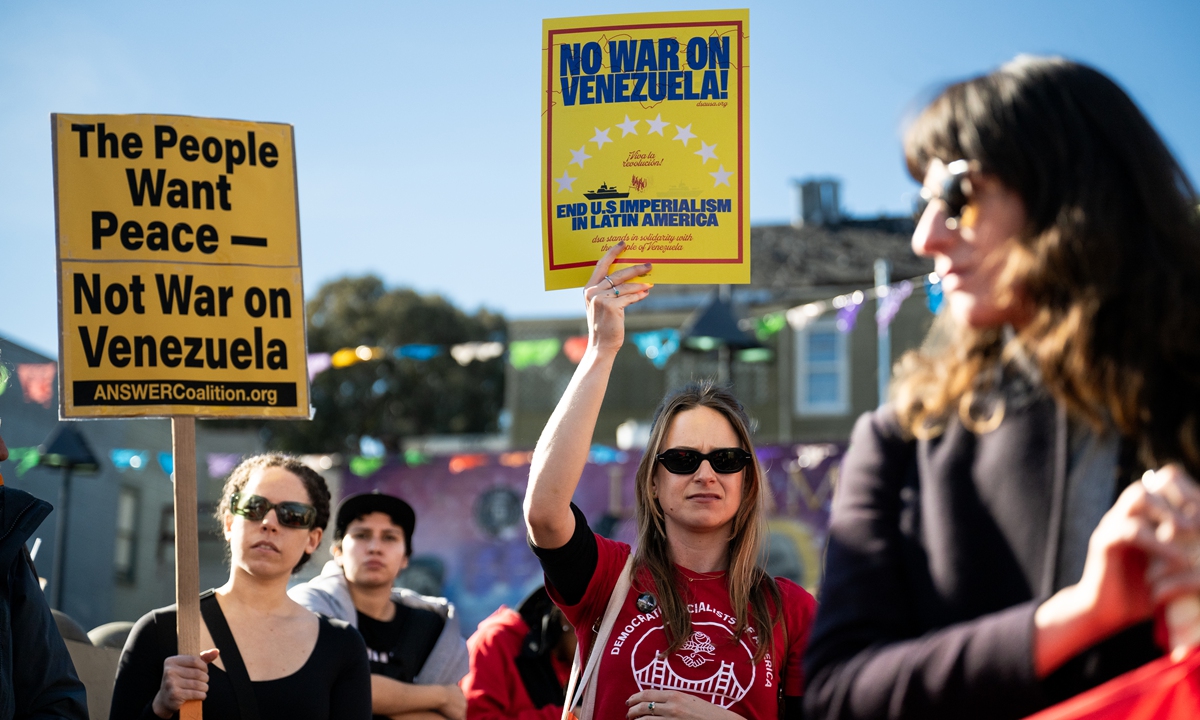
People in San Francisco participate in a demonstration to protest against the US military operation in Venezuela and to oppose the violent law enforcement actions of the US federal law enforcement officers in Minnesota, on January 10, 2026. Photo: VCG
A success to celebrate or a heavy cost the US is paying? The recent US military strike against Venezuela and the forcible seizure of President Nicolás Maduro and his wife have triggered two sharply opposed and deeply irreconcilable narratives within American society.While the Trump administration hails the military strike as a success, it has instead ignited fierce national debate, deepening the divide between two opposing visions of America: one that praises muscular, unilateral action as proof of renewed strength, and another that condemns it as reckless overreach that undermines democratic norms and severely damages the US' image as the "moral leader" it has long sought to project in its foreign interventions.
The US president's "crude 'might is right' language has broken the code of hypocrisy that allowed old habits of empire to continue," said an article in The Observer on Sunday, capturing the clash between the old and new paradigms in US policy.
This clash was evident in a recent Fox News interview, where US Vice President JD Vance offered a blunt assessment of the implications of the Venezuelan military operation. He claimed in the interview, "We control the energy resources, and we tell the regime, you're allowed to sell the oil so long as you serve America's national interest, you're not allowed to sell it if you can't serve America's national interest," per Reuters.
In reality, not all Americans share the high-level enthusiasm of the Trump administration. Across political, media, academic, public spheres, significant opposition has emerged, highlighting concerns over the costs of the intervention. This growing rift was also evident in a tense exchange between US Defense Secretary Pete Hegseth and a CNN reporter, who pressed him with the question "how much does the mission cost American taxpayers." Hegseth accused the network of being "disingenuous" in its coverage and retorted, "You're trying to find any angle possible to undermine the success of one of the most historic military missions the world has ever seen," according to report from The Hill.
"Trump administration officials have openly described the action against Venezuela as being for oil and national interests. This means that the US has voluntarily abandoned the narrative it long used to package its foreign interventions — one centered on 'democracy, human rights, and international order.' This stark, naked expression of self-interest has delivered a major shock to those segments of American society that still believe in or portray the US as 'a moral leader,'" Lü Chao, a professor at the Liaoning Academy of Social Sciences, told the Global Times, adding that the divide manifests sharply across political, intellectual, media, and societal lines in the country.
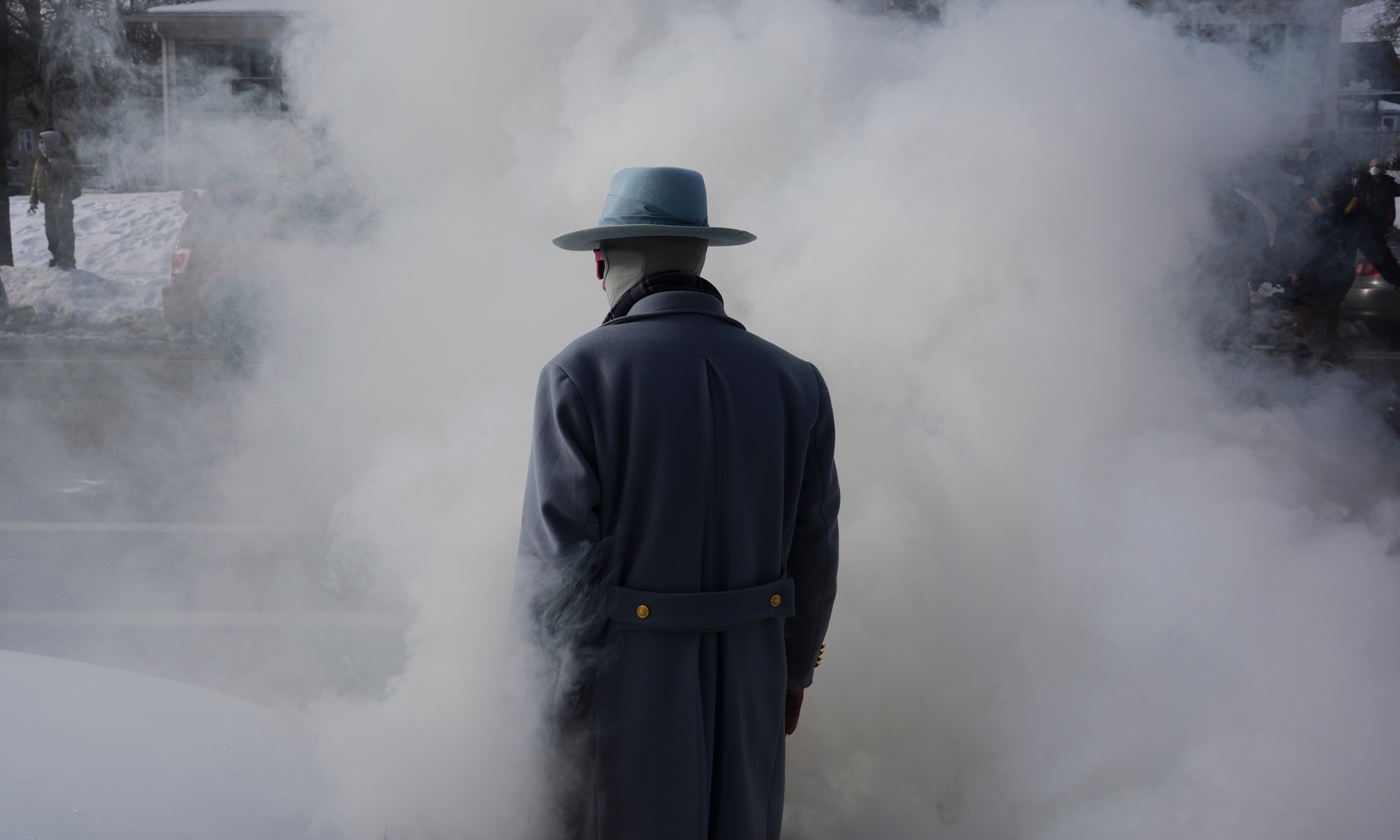
A man walks into smoke from tear gas dispersed by federal agents during a protest in Minneapolis, the US, on January 12, 2026. Photo: VCG
Political polarization
The US military operation in Venezuela has triggered widespread international condemnation and sent shockwaves through American political circles, exposing deep divisions over executive power, congressional oversight, and foreign intervention.
On January 3, US Senator Andy Kim posted on X: "Secretaries Rubio and Hegseth looked every Senator in the eye a few weeks ago and said this wasn't about regime change. I didn't trust them then and we see now that they blatantly lied to Congress."
Jeanne Shaheen, a Democrat on the Senate Foreign Relations Committee, criticized the Trump administration for having "consistently misled" lawmakers, leaving Congress without insight into any US "long-term strategy" regarding Venezuela.
Criticism has not been limited to Democrats; it has also come from some Republicans, including former Trump loyalists. On January 4, Republican Representative Marjorie Taylor Greene, whom the BBC described as "a former Trump loyalist who broke with the president after accusing him of abandoning his political base," wrote on X: "Americans disgust with our own government's never ending military aggression and support of foreign wars is justified because we are forced to pay for it and both parties, Republicans and Democrats, always keep the Washington military machine funded and going. This is what many in MAGA thought they voted to end."
On January 9, US lawmakers advanced a bipartisan resolution aimed at restricting future US military force in Venezuela without congressional approval. The resolution gained support from five Republican senators, the Associated Press reported.
The internal rifts extend beyond Venezuela. former Trump White House adviser and infamous figure Steve Bannon remarked on his "War Room" podcast on January 5, according to The Hill: "I'm just noticing that when Maduro was taken from the Brooklyn detention through lovely parts of Brooklyn and I think some of the Bronx, the US looks worse than Caracas," adding, "Maybe some of that focus should be here." Caracas is the capital of Venezuela.
Lü analyzed to the Global Times that the opposition from the Democrats and some Republicans is not simply because they oppose the use of tough measures, but because they fear that such rhetoric would fundamentally destroy the "moral foundation" that the US has long relied upon to maintain its alliances and international influence.
"In their view, the US may use force, but it must not openly admit that it is merely a great power acting out of resource and geopolitical self-interest. Otherwise, the US would be downgraded from a 'rule-maker' to a 'naked predator,'" Lü said.
Besides the divisions in foreign policy, political polarization is also apparent in domestic matters, as evidenced by the recent fatal ICE shooting in Minnesota, which has heightened tensions between the federal government and Democratic-led states regarding law enforcement authority and National Guard deployment, as reported by The New York Times.
Mayhem of media
From early morning news to late-night shows, the American media landscape expresses its skepticism, sarcasm, and dissatisfaction in its own ways - either seriously or mockingly - sometimes leading to intense clashes in its reporting.
For instance, CNN has been at one of the forefronts of scrutinizing the Trump administration's "amazing military achievement" in the Venezuela operation, questioning its legality, long-term risks, and especially the costs to taxpayers.
This scrutiny reached its peak in the heated January 6 exchange — as mentioned earlier — between Hegseth and CNN chief congressional correspondent Manu Raju on Capitol Hill, which focused on the cost of the military operation.
An editorial piece from the New York Times commented that "rather than the moralistic imperialism of George W. Bush, Trump's foreign policy is imperialistic gangsterism. As one administration official put it to me, there's "something refreshing about Trump just saying, 'Yeah, we are taking the oil.'"
NBC published an article on Sunday stating that in Venezuela right now, "few things are certain," mentioning growing worries among residents of the country, which stands in stark contrast to Trump's declaration on social media that the country is "rich and safe again."
At the same time, there are still some supportive voices that have provoked backlash from the outside world. The British newspaper The Guardian recently published an article titled "Some US media are cheerleading Trump's Venezuela raid. That's not their job," explicitly calling out Fox News as "leading a full-on cheering squad."
Meanwhile, several late-night shows turned the administration's self-proclaimed "historic victory" into sharp satire, often linking it to domestic distractions.
Jon Stewart, host of "The Daily Show," also lamented that the US President "did so much crazy stuff over the last two weeks, it would take a nine-part Ken Burns documentary series to cover it all, but I'm going to do my best to boil it down," he said.
Ken Burns is an American filmmaker renowned for his documentary films and series, many of which explore American history and culture.
"Oil. Precious commodity, certainly - but not the reason a country, formed 250 years ago on the ideas of liberty and self-determination, would go into a country and snatch a man at night," said Stewart.
"The concentrated outbreak of news commentary, satirical programs, and public discourse is actually revealing an embarrassing truth: the US no longer tries to convince the world that it is 'the just side,' but instead is openly displaying itself as 'the stronger side.' This stark reality clashes with the moral image that the US has long cultivated for itself, resulting in widespread discomfort, mockery, and questioning across the public sphere," Lü told the Global Times.
Price of unpredictability?
The Trump administration's policies also drew criticism from academic circles, with some voicing concerns that they could undermine the US' long-term strategic interests.
According to an article on the Brookings website, Brookings' scholars pointed out that the military intervention in Venezuela is "without a clear path to strategic and political success." The US operation in Venezuela undermines the administration's ability to pursue the other major foreign policy objectives identified in its own National Security Strategy.
The conservative publication The American Conservative, a magazine run by the American Ideas Institute, commented on January 9 that the US should be more careful and judicious with its use of military force close to home than it is elsewhere. "These outcomes will undermine Trump administration's broader domestic and foreign policy agendas while also doing direct harm to US interests," read the article.
"Many American scholars of international relations and security experts are not simply opposing a single military or political operation in the US; rather, they are concerned that this kind of rhetoric causes the US to lose its most important intangible asset — credibility and predictability," Lü explained.
Lü pointed out that, in the eyes of those scholars, the measures taken by the Trump administration represent strategic myopia, which in the long run harm the US' global interests.
"A US that openly admits to intervening in other countries for the sake of oil and resources would cause its allies to question the credibility of its security commitments, make neutral countries doubt the value of cooperating with it, and hand its adversaries a powerful moral weapon for counterattacks. In the eyes of these scholars, this represents strategic myopia: it may appear tough and decisive in the short term, but in the long run it undermines the US' institutional advantages as a global leader," he said.
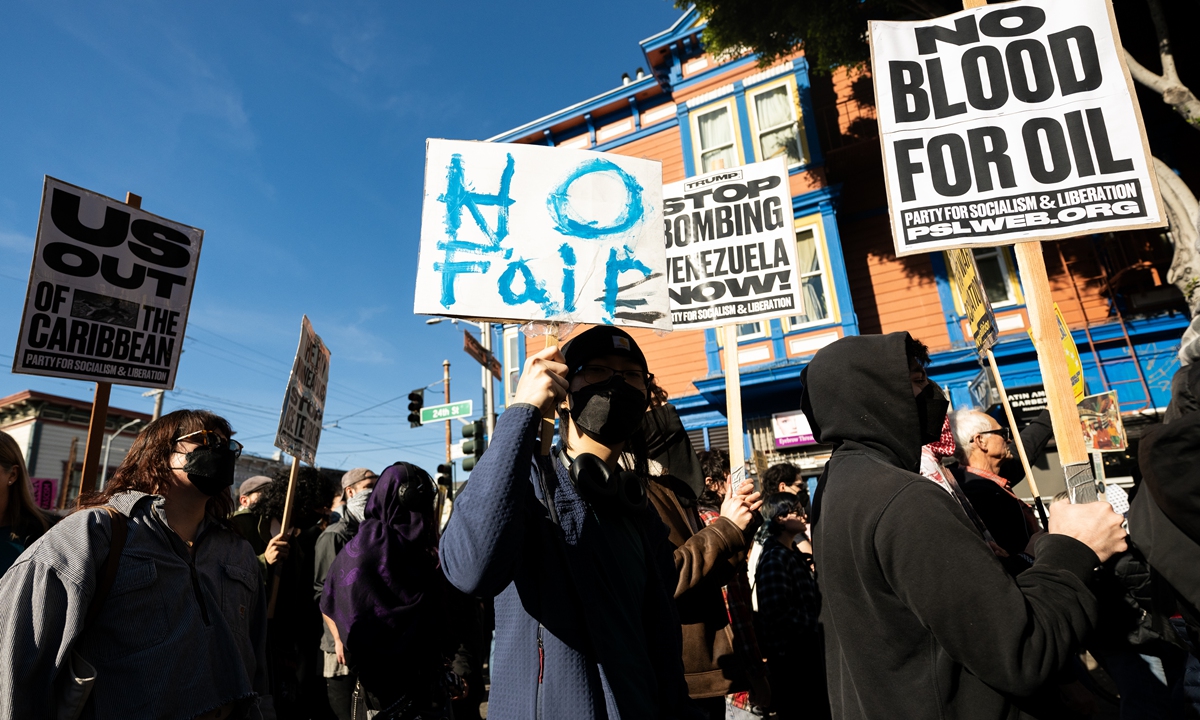
People in San Francisco participate in a demonstration to protest against the US military operation in Venezuela and to oppose the violent law enforcement actions of the US federal law enforcement officers in Minnesota, on January 10, 2026. Photo: VCG
Divided public voices
Public response to the US military operation in Venezuela has been marked by sharp polarization and a surge of nationwide protests, highlighting deepening domestic divisions.
Public opinion polls on US' Venezuela operation reflect the current polarization in the US: A Washington Post survey on January 5 found Americans almost evenly split (around 40 percent approve, 40 percent disapprove), with over 60 percent believing the operation should have required congressional approval.
A Reuters/Ipsos poll on January 6 showed only about one-third approving the strike, with 72 percent worrying the US would become "too involved" in Venezuela.
In the wake of the Venezuela strike, protests swiftly erupted across the US. Over the weekend, these demonstrations expanded to include outrage over the recent ICE shooting.
NBC reported that protests were held in Chicago on Saturday against both the Trump administration's military action in Venezuela and the ICE shooting in Minneapolis. Similar protests were also happening elsewhere in the country, according to USmedia reports.
Jeffrey Sachs, director of the Center for Sustainable Development at Columbia University, told the Global Times in a previous interview that the US administration's "New Monroe Doctrine" is cruder and more violent than it has ever been in history. He stressed that if the US tries to dominate the Americas, a lot of violence will result.
Lü warned that a deeply divided America will have profound and complex effects on the world. If the US continues to rely on aggressive power politics, it will reinforce global perceptions of American hegemony, erode trust, and face increasing resistance when exercising dominance.
Domestic political polarization could also push the US government toward short-term, visibly tough actions rather than long-term, patient strategies. US' "allies" will become more cautious and hedging. A highly polarized America whose foreign policy can swing sharply with each election no longer seen as a stable and reliable anchor, said the Chinese expert.
According to Lü, domestic strife in the US also carries spillover risks: if internal radicalization intensifies, unexpected situations could arise in places like Greenland and beyond. "In the long run, an internally divided America that has stripped away the polite veneer of its external narrative will make the world more fragmented and unstable."
RELATED ARTICLES