CCG releases videos on maritime governance, law enforcement in the sea on law anniversary
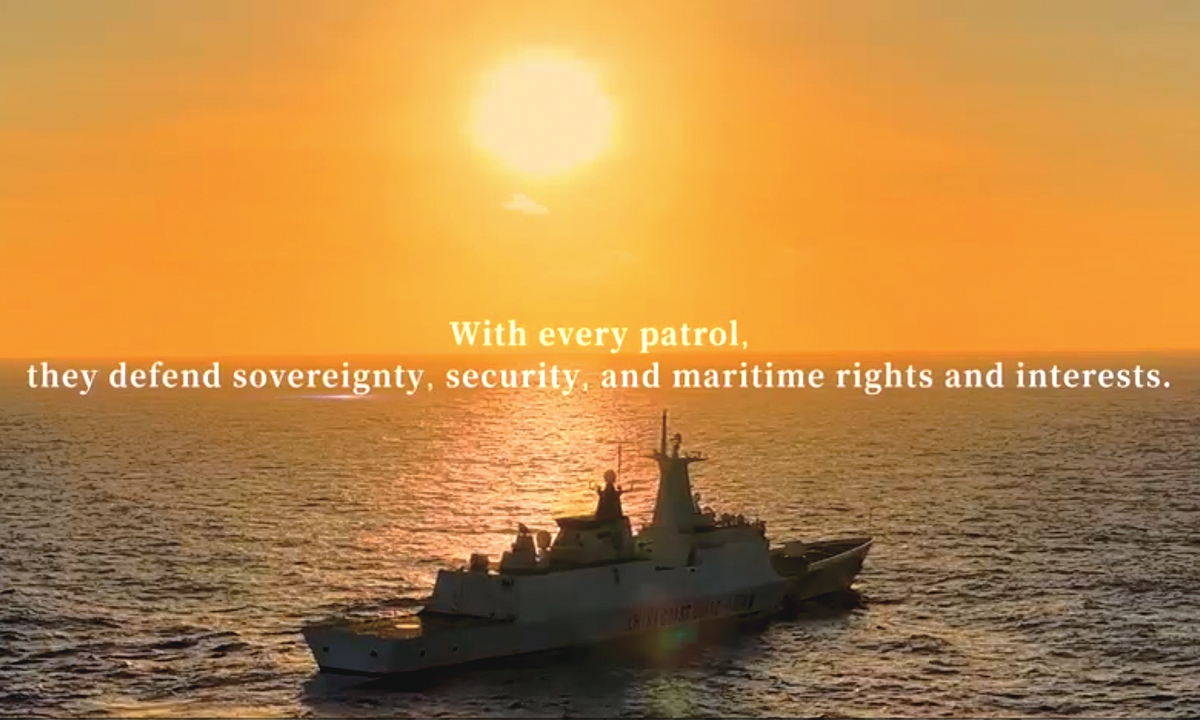
A CCG vessel sails at sea Photo: screenshot of CCG video
On the occasion of the fifth anniversary of the implementation of China's Coast Guard Law, which falls on Sunday, the China Coast Guard (CCG) released two promotional videos, "Law Enforcement in the Sea" and "Guarding the Sea," showing for the first time on-site footage of patrols around the Diaoyu Dao and joint helicopter patrols conducted by the Chinese and Russian coast guards.
The videos showcased the CCG's role and mandate to safeguard China's sovereignty and maritime rights, while maintaining regional peace and security at sea, observers said.
The CCG in action
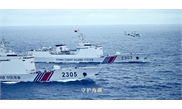
In "Law Enforcement in the Sea" video, Global Times reporters noted that the video not only contains visual evidence of CCG law enforcement operations in the South China Sea in recent years, but also publicly releases on-site footage of patrols around the Diaoyu Dao for the first time.
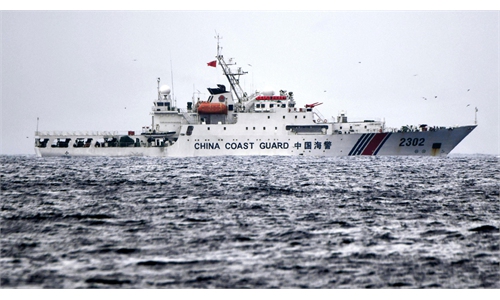
In the video, a CCG officer appears with Diaoyu Dao in the background. Though the clip is brief, it clearly captures the island's lush vegetation and scenic landscape. The bright national flag patch on the officer's arm stands out vividly against the backdrop of the sea and sky. CCG vessels 1306, 2303, and 2305, which frequently participated in patrols around Diaoyu Dao in recent years, also appear in the footage.
"The released footage shows that CCG vessels were operating very close to Diaoyu Dao, undoubtedly within its territorial waters," Yang Xiao, a maritime issues expert at China Institutes of Contemporary International Relations, told the Global Times on Monday.
Chinese netizens expressed strong interest in and support for the release. One user commented on Weibo that "We did so many days of patrol each year, there had previously been little public footage," while another reposted the remark, adding that "More content like this should be released."
At a briefing held by the CCG on January 30, Director Zhang Jianming said that over the past five years, the CCG has conducted 134 patrols in the territorial waters of Diaoyu Dao.
In 2025, patrols around the island lasted for 357 days, which "set a new record for the number of patrol days by the CCG," CCG spokesperson Liu Dejun said. This figure is one day higher than what the Japanese side observed, as it alleged to have spotted "CCG vessels near the Diaoyu Islands" for 356 days.
The CCG's effective patrols and mandate to safeguard China's interests have been noticed by the Japanese side, as Reuters disclosed on January 27 that since late 2025, some Japanese officials have been discreetly urging the country's fishermen to steer clear of Diaoyu Dao to avoid escalating a diplomatic clash with Beijing, claiming it "signaled an abrupt shift after years in which Tokyo tacitly accepted such trips."
This shift, according to some Chinese experts, reflects that China's capability and resolve to safeguard its sovereignty over the Diaoyu Dao have inevitably imposed psychological constraints on Japan's decision-makers.
Japan's Sankei Shimbun reported on Sunday, citing sources from the Japan Coast Guard, that on the occasion of the fifth anniversary of the implementation of China's Coast Guard Law, two large 5,000-ton-class vessels affiliated with the CCG were simultaneously navigating in the contiguous zone on the outer edge of territorial waters around the Diaoyu Dao. Sankei described it as "extremely unusual."
In addition to the Diaoyu Dao footage, scenes released in "Law Enforcement in the Sea" also included CCG operations in the South China Sea. A significant portion is devoted to the June 17, 2024 incident, in which the CCG handled an intrusion by Philippine military personnel near China's Ren'ai Jiao.
During the operation, CCG officers remained fearless despite being splashed with unknown liquids and confronted by armed personnel. Guided by the firm conviction that "bravery prevails when foes meet on a narrow path," they confronted the trespassing personnel head-on, seized weapons and ammunition on the spot, and successfully towed the foreign vessel away from the area in just six minutes.
The CCG's role and mandate are demonstrated in numbers. "We have deployed about 550,000 vessel sorties and 6,000 aircraft sorties on missions," Liu Dejun, spokesperson for the CCG, told the Global Times.
Over the past five years, the CCG has carried out regular, normalized rights-protection patrols in the East China Sea, South China Sea and Yellow Sea, as well as law-enforcement patrols in waters surrounding the island of Taiwan and its affiliated islands, Liu said, giving special emphasis on missions in the territorial waters and surrounding areas of Huangyan Dao, as well as in the Nansha Qundao, including Ren'ai Jiao, Xianbin Jiao and Tiexian Jiao, where the CCG, in accordance with the law, tracked, monitored, warned and expelled foreign vessels and aircraft engaged in illegal infringement and harassment.
Maintaining peace, security
Another video "Guarding the Sea" shows CCG's strong capability in maritime rescue missions, which vividly demonstrates China's image as a responsible major country.
In addition to clips of joint helicopter patrols conducted by the Chinese and Russian coast guards, the video also reveals footage of maritime rescue operations. Apart from the touching scenes of successfully rescuing 17 Filipino crew members who fell into the sea on January 22, CCG officers were also commended by the government of Jeju Province, South Korea, for successfully rescuing Korean fishermen.
Some Western media outlets constantly portray the CCG as a regional "bully." In reality, the CCG has become a "protector" for many people in neighboring countries. With advanced maritime equipment, the CCG has the capability to carry out international maritime rescue operations - and in practice, it has done exactly that, Yang said, adding that even when China has disagreements or disputes with certain countries, this does not affect the CCG's willingness to provide assistance to foreign nationals at sea.
Over the past five years, the CCG has rescued more than 7,200 people, and maritime rescue-related cases have increased by an average of 11.9 percent annually, the Global Times learned.
"The CCG is an important participant in international and regional maritime governance. In addition to conducting maritime rescues, it also plays a key role in protecting the marine ecological environment and combating crimes at sea. For many countries surrounding China, the involvement of the CCG in these efforts is highly beneficial to maintaining maritime order," Yang said.
In terms of protecting marine natural resources and the ecological environment, the CCG now places greater emphasis on data- and technology-driven empowerment, strengthening the use of aviation forces, satellite remote sensing, "Internet Plus," electronic fencing and other off-site supervision tools, according to the CCG.
Speaking about international cooperation with maritime law-enforcement agencies of neighboring countries, Liu, spokesperson for the CCG, said that over the past five years, the CCG has actively expanded such exchanges, and that in 2026 China will host the 22nd Heads of Asian Coast Guard Agencies Meeting. He added that the CCG will continue to deepen institutionalized cooperation with Russia, South Korea, Vietnam and Indonesia, and will keep organizing China-Vietnam and China-South Korea joint patrols as well as North Pacific fisheries law-enforcement patrols.
"Going forward, we will continue to fulfill the international cooperation responsibilities entrusted by the Coast Guard Law, work with partners to safeguard international and regional maritime order, fully participate in maritime governance and the building of maritime rules, and further strengthen China's role and voice in international maritime affairs," the CCG spokesperson said.
RELATED ARTICLES