KMT delegation lands in Beijing for think tank exchange, reiterating the two sides of the Straits 'are naturally family'
By Published: Feb 02, 2026 05:43 PM

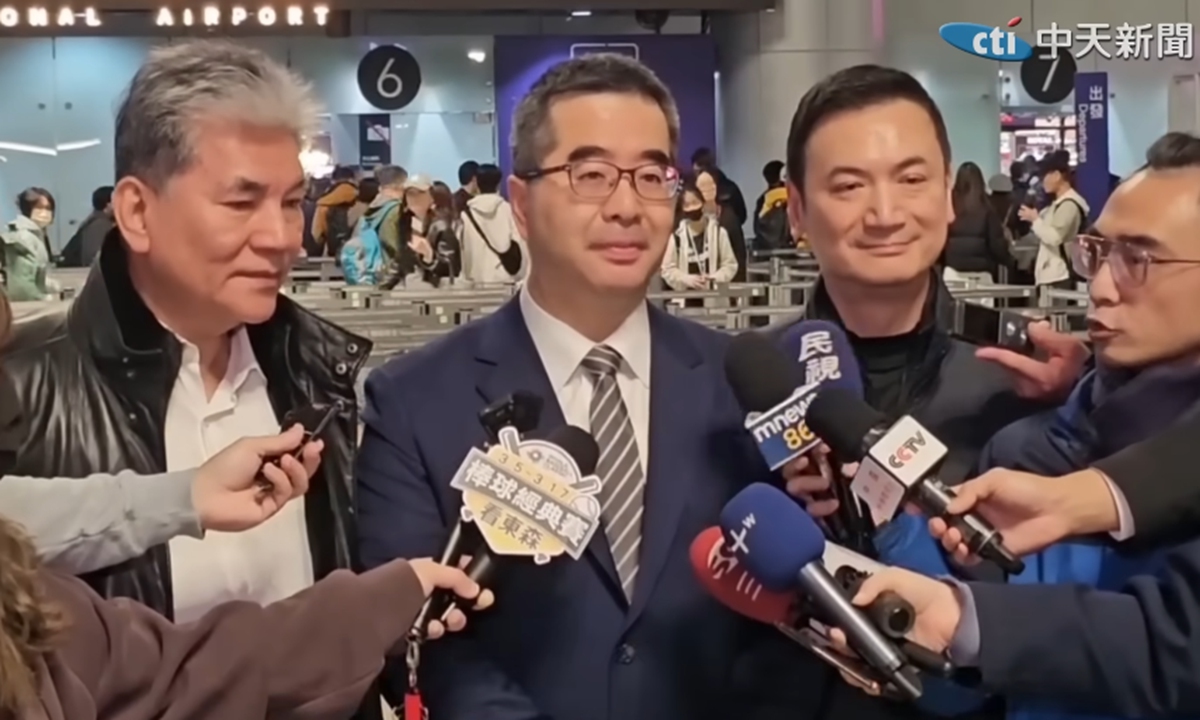
KMT deputy chair Hsiao Hsu-tsen speaks to media on February 2, 2026, at Taoyuan International Airport in Taiwan region, China. Photo: screenshot from CTI News' YouTube channel
A delegation from the Chinese Kuomintang Party (KMT) led by its deputy chair Hsiao Hsu-tsen arrived in Beijing on Monday for a think tank exchange forum with the mainland side. This marks the revival of the KMT-Communist Party of China (CPC) forum mechanism after a nine-year hiatus amid prolonged cross-Straits tensions since the secessionist Democratic Progressive Party (DPP) took office.
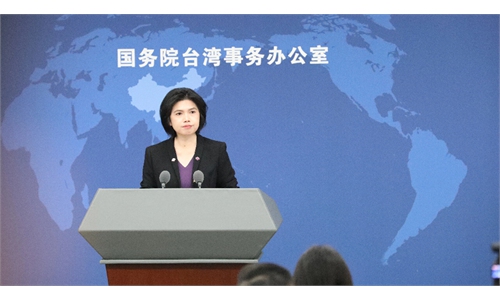
As Taiwan Affairs Office spokesperson Zhang Han introduced at a press briefing on January 28, the forum is jointly organized by the Cross-Straits Research Center of the Taiwan Affairs Office of the CPC Central Committee and the KMT-affiliated think tank "National Policy Foundation" (NPF). Representatives and experts from the CPC and KMT, along with individuals from tourism, industry, technology, medical, environmental protection, and other sectors on both sides of the Taiwan Straits, will participate in the forum.
According to Taiwan media, the delegation led by Hsiao includes Lee Hong-yuan, deputy head of NPF, along with around 40 experts and scholars. The exchanges in Beijing are expected to focus on tourism, industrial cooperation and environmental sustainability, with discussions covering topics such as flight routes, precision machinery, artificial intelligence, disaster prevention and mitigation, new energy, and carbon reduction, according to local media report.
Before departing for Beijing, Hsiao told the media at Taoyuan International Airport on Monday that attending the forum on Tuesday would be the main focus of the trip, followed by a visit to Tsinghua University in Beijing on Thursday. The delegation is also scheduled to attend a banquet hosted by the mainland's Taiwan Affairs Office on Monday evening, according to udn.com.
Hsiao said that KMT's trip has a clear positioning: acting as a communicator for Taiwan's industries, a protector of the Taiwan residents, and a promoter of cross-Straits peace.
Lee Hong-yuan told media at Taoyuan International Airport on Monday that there is significant complementary potential between the two sides across multiple industries. He said he hopes that through this exchange platform, mutual understanding can be enhanced, differences reduced, and a peaceful atmosphere gradually fostered between the two sides of the Taiwan Straits, which he said is precisely the core purpose of the forum.
Regarding KMT chairperson Cheng Li-wun's recent statement that "the mainland is our family," Hsiao said he "of course agrees," according to udn.com.
He further stated that the two sides of the Taiwan Straits "are not two separate countries," and that from the perspectives of history, culture, blood ties, and emotional connections, Taiwan and the mainland "should never be seen as severed from each other." "Both sides are naturally family. The only issue is that political differences have yet to be resolved," Hsiao said, per the udn.com.
However, some DPP politicians and pro-DPP media in Taiwan smeared Hsiao and the KMT delegation as "selling out," claiming that the cross-Straits exchanges would become "tool of united front work." Before the delegation's departure, some application from professors from Taiwan-based universities were rejected by the DPP authorities, local media disclosed.
The resumption of the forum mechanism is a vital part of party-to-party exchanges between the KMT and the CPC, which rebuilds a stable, predictable, and institutionalized platform for engagement in civilian, industrial, youth, and other fields across the Taiwan Straits, Zhang Wensheng, deputy dean and professor at the Taiwan Research Institute of Xiamen University, told the Global Times on Monday.
More crucially, against the backdrop of the DPP authorities' continuous secessionists provocations toward "Taiwan independence," their deliberate severance of cross-Straits exchanges, and relentless hype of military buildup and war preparations that gravely threaten peace and stability in the Taiwan Straits, the KMT's trip to mainland demonstrates to the Taiwan people a path of peaceful development that stands in stark contrast to DPP's confrontational and conflict-driven approach, Zhang said.
"This would secure precious dividends of peace and tangible economic development benefits for both sides of the Straits," he added.
Zhang noted that the forum's significance extends far beyond academic and policy discussions; it embodies the shared peaceful aspirations of people on both sides of the Taiwan Straits and will contribute to opening a fresh window for breaking the ice in cross-Straits relations.
Regarding the upcoming cross-Straits forum, State Council Taiwan Affairs Office spokesperson Zhang Han has said on January 28 that seeking peace, development, exchanges, and cooperation represents the mainstream public opinion in Taiwan. He said the mainland is willing, on the common political basis of upholding the 1992 Consensus and opposing "Taiwan independence," to strengthen interactions and exchanges with various political parties, groups, and people from all sectors in the Taiwan region, including the KMT, and jointly promote the peaceful development of cross-Straits relations.
RELATED ARTICLES