2026 chunyun kicks off, with 9.5bln passenger trips expected; travel surge shows transport capacity, bodes well for economy: experts
By Zhang Yiyi and Published: Feb 02, 2026 10:51 PM Updated: Feb 03, 2026 09:09 AM


Passengers hold Spring Festival-themed banners on board the G6701 high-speed train from Beijing to Handan, North China's Hebei Province on February 2, 2026, the first day of the 2026 Spring Festival travel rush. Photo: Chen Tao/GT
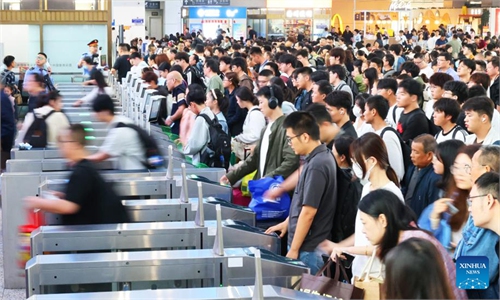
With the departure of "green-coated" regular-speed passenger train K4069 from Beijing West Railway Station for Nanchang in East China's Jiangxi Province at 12:40 am on Monday, China's 2026 Spring Festival travel rush, also known as chunyun, officially started, during which a record 9.5 billion passenger trips are estimated to be made in the 40-day festivities. Railway stations and airports across the country have sprung to life, with travelers carrying gift-laden bags setting off on homebound journeys, their faces alight with anticipation and festive joy.
Often described as the largest annual human migration on the planet, chunyun is not only a reflection of China's transportation capacity and technological progress, but also a window to observe the world's second-largest economy in multiple dimensions from consumption vitality to sociocultural trends.
Good start
President Xi Jinping said in his 2026 New Year message, "Let us charge ahead like horses with courage, vitality, and energy, fight for our dreams and our happiness, and turn our great vision into beautiful realities," Xinhua News Agency reported.
This year's Spring Festival holidays last nine days, longer than previously, while the Year of the Horse also carries positive meanings such as vitality, strength and success, which mean family reunions, active travels and holiday consumption, and culturally, a good start to the new year.
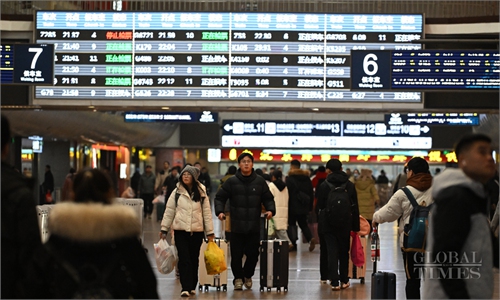
In the early hours of Monday, Global Times reporters observed at Beijing West Railway Station that hundreds of travelers were lining up in an orderly manner in the waiting hall under the guidance of railway staff. While waiting to board, passengers were pleasantly surprised as railway workers handed out small horse-themed plush toys and other gifts.
Train K4069, as it departed, was decorated with traditional Year of the Horse paper-cuts and cartoon-themed stickers displayed in one of the coaches, adding warmth and festive cheer to the homecoming journey.
A home decoration worker surnamed Li, who comes from Central China's Henan Province, told the Global Times that his backpack was filled with daily necessities and gifts for his family.
With two children aged 13 and 9 studying in his hometown in Henan and eagerly awaiting his return, Li said he bought Beijing-style yogurt, a local specialty, to share with his family.
The Global Times learned that the crew has received special training to better serve the chunyun train. Given that the route of K4069 passes major transfer hubs such as Hengshui, Fuyang and Jiujiang, crew members familiarized themselves in advance with the most convenient transfer routes and proactively guided passengers to minimize transfer times. Mobile service desks were set up in the carriages to handle inquiries, with first-aid kits and portable power banks available, while a dedicated volunteer service post was arranged to offer full assistance to the elderly, minor, sick, disabled, pregnant and passengers in need.
Movement spurs growth
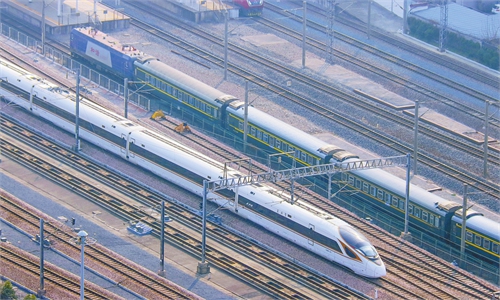
As the major method of chunyun, China's national railway network is expected to carry 540 million passenger trips during the 2026 Spring Festival travel rush running from Monday to March 13, averaging 13.48 million trips per day, up 5.0 percent year on year, according to China Railway.
To ensure orderly Spring Festival travel, China's railway authorities have flexibly added services, with up to more than 1,500 additional inter-regional through passenger trains operating daily at peak times. During peak periods, the national railway network is expected to run over 14,000 passenger trains per day, lifting seat capacity by 5.3 percent year on year, China Railway told the Global Times in a statement.
Cross-border services have also been strengthened, including the Guangzhou-Shenzhen-Hong Kong high-speed rail and international passenger routes linking China with Laos, Mongolia, Russia and Vietnam, with Hong Kong now directly connected to 110 mainland stations. In addition, rail operators are coordinating with local tourism authorities to roll out travel services that boost holiday consumption and support domestic demand, per the statement.
Meanwhile, air travel is projected to exceed 95 million passenger trips, also setting a new record.
Air China said on Monday that it plans to operate over 70,000 passenger flights during the travel rush, representing a 10.1 percent growth compared to the 2025 Spring Festival travel season. Approximately 1,800 flights will be scheduled daily, an increase of 160 flights year-on-year.
Meanwhile, driving has increasingly emerged as a popular travel option for Spring Festival trips. During the travel rush, average daily car rental orders nationwide are projected to post double-digit year-on-year growth during the holidays and the total number of new energy vehicle trips is expected to reach 380 million in the nine-day holidays, according to the Ministry of Transport.
Bian Yongzu, executive deputy editor-in-chief of Modernization of Management magazine, said chunyun is a phenomenon unique to China, with hundreds of millions of people traveling within a short, highly concentrated period before the Spring Festival. The scale and time sensitivity of this movement highlight not only China's transport capacity, but also its strong ability in social organization, inter-governmental coordination and overall governance.
This migration of Chinese people has also drawn attention from some foreign media outlets. Reuters reported that the 40-day travel rush during the country's biggest holiday is often read as a barometer of China's economic health and a pressure test for its vast transportation system.
Wang Peng, an associate research fellow at the Beijing Academy of Social Sciences, told the Global Times that changes in chunyun travel patterns also reflect China's broader economic upgrading. The growing use of high-speed rail and air travel has made journeys home faster and more comfortable, underscoring improvements in infrastructure and rising living standards.
Beyond transportation, chunyun carries deep cultural significance, he said. Centered on family reunion, the annual migration also boosts consumption and regional economies, Wang said.
Also, some families, instead of staying in their hometowns, choose traveling together as a new way of reunion and consolidating family bonds, which could strongly boost the festival economy, observers said.
As the Year of Horse approaches, Bian Yongzu said the positive meanings of this zodiac help foster optimism and motivation for the year ahead, while the massive population movement also stimulates consumption, regional economies and longer-term growth momentum nationwide.
RELATED ARTICLES