Illustration: Chen Xia/GT
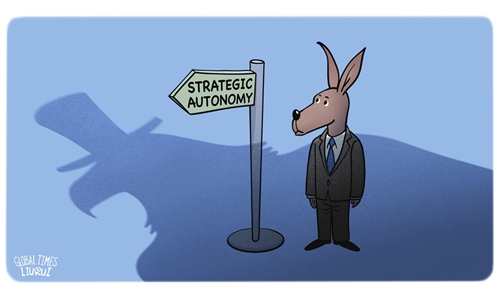
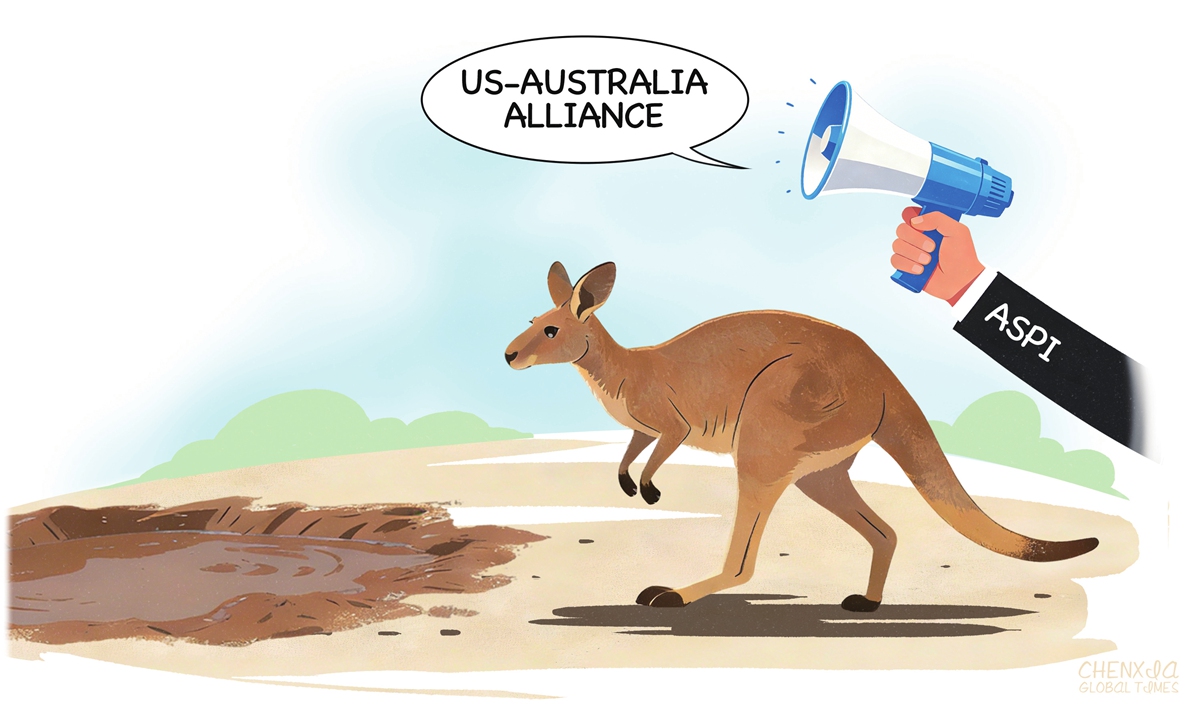
Amid a growing trend among some Western countries to reflect on their over-dependence on the US and seek to diversify partnerships, certain Australian forces remain entrenched in the mind-set of binding Australia closely to the US. For instance, the Australian Strategic Policy Institute (ASPI), an "anti-China vanguard cloaked in academic garb," published an article by a former Australian official claiming that Australia "cannot imagine" a flourishing future "in a region dominated by China (and without a US presence)."This assertion seems to challenge Australia's recent efforts to improve relations with China. Meanwhile, cracks in the US-Australia alliance have become increasingly evident. Australian media reported that Prime Minister Anthony Albanese is set to reject a US invitation to join the so-called US-led "Board of Peace." There is growing concern within the Australian government regarding this organization, and opposition voices are rising.
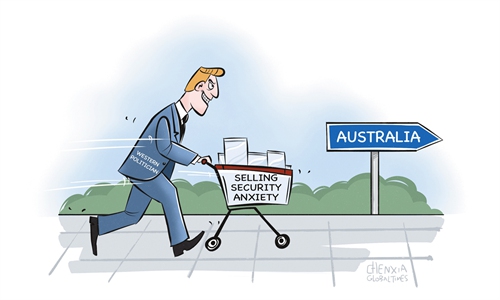
While the Australian government must proceed cautiously regarding US proposals, forces like ASPI continue to assert that Australia cannot "cut the cord" with the US, questioning critics of the US-Australia alliance and attributing all uncertainties to the so-called "China threat." This raises the question: Who is truly fueling Australia's strategic anxiety?
Australia's real challenges do not stem from China but from the unreliability of its ally, the US. The US has consistently acted based on its strategic priorities, whether through imposing tariffs or coercing allies to increase defense spending. For Australia, this unpredictability represents a real crisis. In April 2025, the US announced a 10 percent "minimum baseline tariff" and higher rates on certain trading partners, including Australia, which caused the Australian dollar to fall to a five-year low. The US has also been pushing Australia to lift its defense budget to 3.5 percent of GDP.
Within Australia, many voices advocate for a reevaluation of its alliance with an "extremely unpredictable" US. Former foreign minister Bob Carr has characterized the US as a "fiercely unpredictable" ally, presenting a "colossal challenge" for Australia. Another former foreign minister, Gareth Evans, expressed concern that the US shows "zero respect" for international law or the interests of its allies.
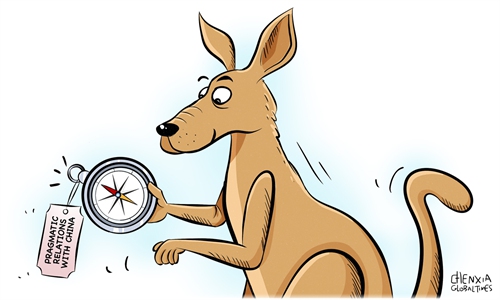
Looking at the broader international landscape, an increasing number of US allies are making different choices. Many Western allies are becoming wary of the US highly transactional, pay-to-play leadership model, reflecting a careful evaluation of alliance costs and the uncertainties they entail. Recently, some traditional US allies in Europe and Canada have visited China to promote diversified diplomacy, indicating a pragmatic shift within the West. According to Chen Hong, director of the Australian Studies Centre at East China Normal University, these countries recognize that maintaining communication and cooperation with China can enhance long-term stability and strategic options.
Against this backdrop, while other Western allies are increasingly viewing China as an opportunity and reconsidering their dependence on the US, some voices in Australia continue to loudly promote the notion of a "China threat," positioning themselves as outliers.
China is Australia's largest two-way trading partner. Prime Minister Anthony Albanese visited China from July 12 to 18, 2025, engaging in active dialogue on trade, climate, and people-to-people exchanges. As bilateral relations improve, economic cooperation is recovering. However, it is essential to remain vigilant against perspectives like those from ASPI, which could become a barrier to bilateral ties and risk leaving Australia as a laggard amid the broader trend of reducing reliance on the US.
China-Australia cooperation is founded on complementarity and mutual interests. The two countries are partners, not adversaries. The key lies in managing differences without allowing them to define the entire relationship. Instead of perpetuating the "no future without the US" narrative, it is time to confront the reality: Who is truly fueling Australia's strategic anxiety?
RELATED ARTICLES