Starmer defends China visit against criticism at parliament, advocates finding ways to cooperate; Chinese experts see ties recovery as test of UK strategic foresight
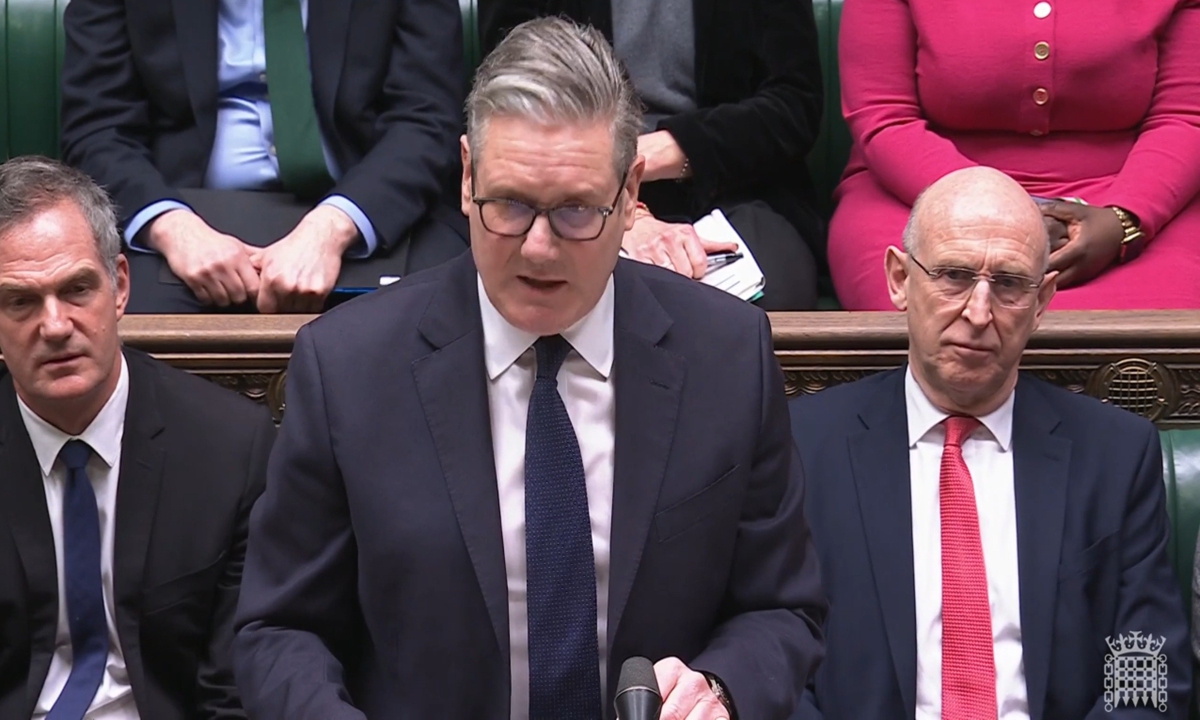
Keir Starmer, UK prime minister, speaks at parliament on Monday, February 2026. Photo: Screenshot from parliamentlive.tv
British Prime Minister Keir Starmer defended the outcomes of his visit to China as he faced criticism from some lawmakers at parliament, and advocated finding ways to cooperate with China in face of geopolitical realities. Chinese experts described UK domestic criticism as predictable, adding that enhancing relations with China is not a task that can be accomplished instantaneously, and the recovery of bilateral relations also serves as a test of the UK leadership's strategic foresight with a proper understanding of China.
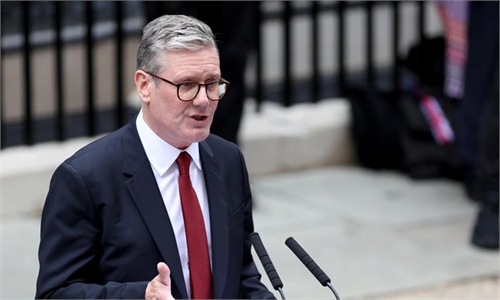
Starmer paid an official visit to China from January 28 to 31. This was the first visit to China by a UK prime minister in eight years. Prime Minister Starmer is also the first leader from a permanent member of the UN Security Council that China receives in 2026, according to Chinese Foreign Ministry.
However, Starmer's trip faced criticism from some Conservative Party members. Conservative former security minister Tom Tugendhat raised the issue of China's sanctions on some British parliamentarians, according to the report by Independent.
In 2021, Chinese Foreign Ministry announced that the Chinese side decides to sanction nine individuals and four entities on the UK side that maliciously spread lies and disinformation against China, including Tugendhat.
During the trip this year, Starmer said China has lifted "all restrictions" on six current members of the British Parliament, BBC reported.
Tugendhat claimed that the sanctions were removed on six people "who are still in the House but not the one who isn't," and claimed the move as a "direct affront to democracy," per Independent.
Responding to this, Starmer said he raised it directly, and that got the response that restrictions do not apply to parliamentarians. "I accept the challenge, the point, that we need to go further. That doesn't mean that what we've achieved should be put to one side," Independent reported.
He also added: "In order to go further, we have to engage, and we have to engage at the leader level."
Conservative leader Kemi Badenoch accused Starmer of adopting a "supine and short-termist approach," claiming he came back to the UK with "next to nothing" apart from a Labubu doll, Independent reported.
Starmer defended his position, and said "ignoring China for eight years achieved nothing." He said the lifting of Chinese sanctions on British MPs is an early indication of the progress that can be made through engagement, per the report.
In a statement to the Commons, Starmer said "it would be impossible to safeguard our national interests without engaging with this geopolitical reality," as he pointed to China as the world's second biggest economy. "The fact is that we can do two things at once: we can protect ourselves, while also finding ways to cooperate. It was in that spirit that we made this visit," he added. The prime minister also accuses the Conservatives of "hiding away and sticking their heads in the sand," according to the website of UK Parliament.
"China is the second biggest economy in the world, including Hong Kong. It's our third biggest trading partner, supporting 370,000 British jobs and it is an undeniable presence in global affairs," Starmer said.
In the course of UK engaging with China and gaining insight, the domestic backlash in the UK was largely predictable, said Cui Hongjian, a professor at the Academy of Regional and Global Governance at Beijing Foreign Studies University. It reflects ongoing partisan disputes in the UK, the Conservatives' tendency to shirk responsibility - criticizing from the sidelines when they themselves cannot deliver - and a persistent desire among certain UK politicians for unilateral gains.
Cui noted that China-UK relations have remained stagnant for years, with much of the responsibility lying with certain domestic voices in the UK. Their persistent mindset and constant criticism ensure that every step forward for bilateral ties now encounters domestic pressure.
As a Chinese saying goes, "Illness comes like a landslide, but goes like pulling silk" - the relations between two countries have been similarly strained, Cui noted. Any warming of the relationship should be judged rationally, and initial signs of improvement will take time, he said.
Cui added that a single visit cannot fundamentally change domestic political dynamics or public opinion in the UK, and patience is required. In the UK's fragile political opinion environment, even slightly bolder steps could trigger much greater domestic criticism - or intensified pressure, he said.
Chinese analysts added that enhancing relations with China is not a task that can be accomplished instantaneously, and it will inevitably face a range of challenges, the recovery of bilateral relation also serves as a test of the UK leadership's strategic discernment and foresight with a proper understanding of China.
These current challenges UK faced stand as a pivotal test of the UK's strategic acumen and long-term vision, as it should face up to the reality of China being its third-largest trading partner, abandon the binary "black-or-white" mindset, and move beyond policy fluctuations driven by partisan political cycles, Wang Hanyi, a research fellow at the China-UK Center for Cultural Exchange at Shanghai International Studies University, told the Global Times.
The UK should stay resolute in advancing dialogue and cooperation and foster a warming of China-UK relations, so that the fruits of cooperation truly deliver benefits to the people's livelihood, Wang added.
During a press conference on January 30, Chinese Foreign Ministry spokesperson Guo Jiakun said Starmer's visit has produced fruitful outcomes, which demonstrate the breadth and depth of cooperation between the two countries.
"Through the visit, China stands ready to work with the UK to implement the important common understandings between the two leaders, see history from a broader perspective, rise above differences, respect each other, jointly develop a long-term and consistent comprehensive strategic partnership between China and the UK for the good of both peoples and the whole world," the spokesperson added.
RELATED ARTICLES