Chinese carmakers report robust January sales and exports, advancing global win-win cooperation
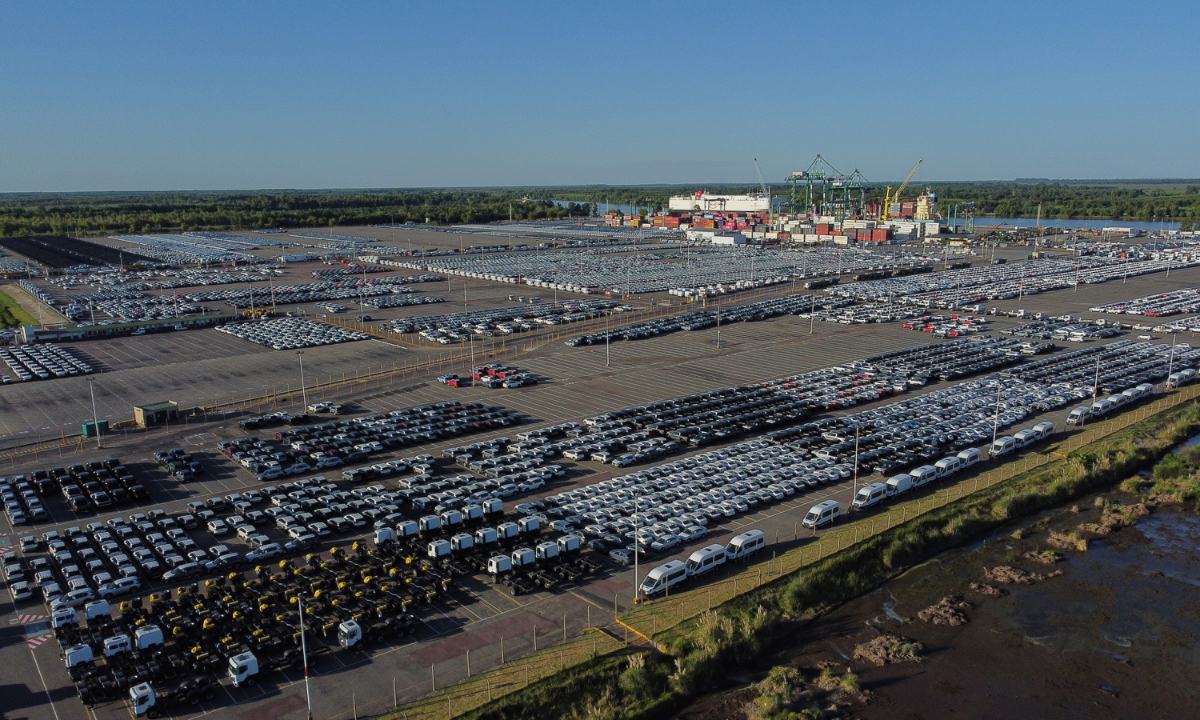
An aerial view of electric vehicles unloaded from the BYD Changzhou at the Port Terminal of Zarate after the vessel arrived from Singapore carrying a record shipment of 7,000 electric cars, marking the first time a full ship belonging to a Chinese automaker has arrived in Zarate, Argentina, on January 20, 2026. Photo: VCG
Chinese automakers have begun announcing their January delivery figures, with exports emerging as a highlight. As exports become a major growth engine, China's automotive industry chain is accelerating its global expansion, fostering broader win-win cooperation with international markets, experts said.BYD reported overseas sales of 100,000 passenger vehicles and pickup trucks in January, up 43.3 percent year-on-year, accounting for nearly half of its total monthly sales, according to its official Weibo account.
The company previously said that it expected to sell 1.3 million vehicles outside the Chinese mainland in 2026, a 24.3 percent increase from 2025. BYD is building passenger vehicle manufacturing bases in countries including Thailand, Brazil, Hungary and Uzbekistan, as it accelerates its global expansion, according to media reports.
In January, Geely's passenger vehicle sales reached 270,200 units, up 1 percent year-on-year and 14 percent month-on-month. Overseas sales totaled 60,500 units, up 121 percent year-on-year, according to the Shanghai Securities News.
Geely Auto said that it aims to export 640,000 vehicles in 2026, a year-on-year increase of more than 50 percent, and to develop three regional markets each with annual sales of 150,000 units and two markets of 100,000 units worldwide.
SAIC-GM said that its terminal sales exceeded 51,000 vehicles in January, up about 8 percent year-on-year, with new-energy vehicle (NEV) sales surging nearly 90 percent and exports more than doubling, according to the Securities Daily.
Chery Group exported 119,600 vehicles, up 48.1 percent, the ninth consecutive month with exports above 100,000 units and maintaining its position as China's top auto exporter, the report said.
Wang Peng, an associate research fellow at the Beijing Academy of Social Sciences, told the Global Times that China's auto industry is moving beyond simple vehicle exports toward driving broader "ecosystem expansion" overseas, opening up new space for localized, win-win cooperation and accelerating the globalization of the entire automotive industry chain.
According to media reports, since October, more than 15 Chinese automakers and auto parts companies have disclosed overseas expansion plans, with total planned investment exceeding 70 billion yuan ($10.08 billion).
Among them, CALB's European lithium battery gigafactory project, agreed with the Portuguese Trade & Investment Agency on January 20, carries a total investment of 2.067 billion euros ($2.437 billion), making it the largest overseas investment by China's automotive industry chain so far this year.
Wang said that NEVs are the main category of China's vehicle exports, adding that the strong overseas performance of Chinese NEVs stems from early moves into electrification and intelligent technologies. Rapid iteration in batteries, smart driving and in-car systems has given Chinese brands a clear first-mover edge over many traditional automakers, enabling them to respond faster to global market demand.
Wu Shuocheng, a veteran automobile industry analyst, told the Global Times on Tuesday that the comprehensive competitiveness of Chinese automakers continues to strengthen as improvements in product performance, technology and manufacturing costs are compounded.
As companies expand overseas, Wu said that building strong after-sales networks is crucial to earning market trust, while intense domestic competition is driving firms to seek growth abroad. Over time, this will speed up electrification and intelligent transformation in overseas markets, enabling consumers to access better products and services at lower prices.
China's complete and highly integrated NEV industry chain is a core advantage, Wang said. Large-scale production has lowered costs while supporting a wide product range, allowing Chinese automakers to offer competitively priced vehicles across multiple segments and adapt flexibly to different regional markets. Meanwhile, the shift from pure exports to localized production and operations has strengthened brand trust abroad.
Beyond sales growth, Wang said that Chinese NEVs are also having positive impacts on overseas auto industries. Their expansion is accelerating green transformation, supporting emissions reduction, and building local industrial ecosystems through investment, jobs and technology cooperation. Meanwhile, heightened competition is pushing global carmakers to innovate more rapidly, driving the broader upgrading of the global auto industry.
Wu noted that China's core advantage lies in its supply-chain strength. To succeed abroad, exports must be matched by reliable parts and service support; otherwise trust and market access will be hard to build. Localized production also requires supplier ecosystems to follow—without them, costs are hard to control and firms risk remaining "outsiders," limiting sustained expansion.
China's vehicle production reached 34.531 million units last year, while sales totaled 34.40 million, representing year-on-year increases of 10.4 percent and 9.4 percent, respectively, according the China Association of Automobile Manufacturers (CAAM).
The sector also demonstrated strong resilience in foreign trade, with exports surpassing 7 million units, a new high. NEV exports doubled year-on-year to 2.615 million, official data showed.
The CAAM also said that the country's NEV sales are expected to reach 19 million units in 2026, a rise of 15.2 percent year-on-year, while vehicle exports are expected to rise 4.3 percent to 7.4 million units.
RELATED ARTICLES